Pemberdayaan Kader Aisyiyah Pimpinan Ranting Aisyiyah Kedungwuluh Kidul Kecamatan Patikraja Melalui Pelatihan Budidaya Cacing Tanah Empowerment of Aisyiyah Cadres, Aisyiyah Branch Leadership, Kedungwuluh Kidul, Patikraja District, Through Earthworm Cultivation Training
Article Sidebar
Main Article Content
Abstract
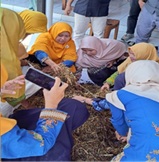
The Aisyiyah Branch Leadership (ABL) of Kedungwuluh Kidul, Patikraja District, is part of the Aisyiyah organization that focuses on women's empowerment. Kedungwuluh Kidul has abundant potential for natural resources, including organic waste from households and agriculture. This waste can be used to cultivate earthworms, which produce high-value products: vermicompost and the worms themselves. However, members of the ABL Kedungwuluh Kidul do not yet have the knowledge and technical skills related to earthworm cultivation and its business processes, so planned educational efforts are needed to optimize local potential. Therefore, through community service activities, the knowledge, abilities, and skills of the Aisyiyah Branch Leadership cadres of Kedungwuluh Kidul, Patikraja District can be improved. Community service activities are carried out through a theoretical approach (lectures), practice (training), and mentoring (evaluation). The training results showed that there was an increase in partners' understanding and skills on the benefits of vermicompost, earthworm cultivation techniques, and business prospects for earthworms and vermicompost, from the initial 70% of participants did not understand and even 30% did not understand, to 65% of participants who understood, many understood, and 35% understood. Not a single participant did not understand.
Downloads
Article Details

This work is licensed under a Creative Commons Attribution-ShareAlike 4.0 International License.
Authors who publish with this journal agree to the following terms:
- Any article on the copyright is retained by the author(s).
- Author grant the journal, right of first publication with the work simultaneously licensed under a Creative Commons Attribution License that allows others to share work with acknowledgment of the work authors and initial publications in this journal.
- Authors are able to enter into a separate, additional contractual arrangements for non-exclusive distribution of published articles of work (eg, post-institutional repository) or publish it in a book, with acknowledgment of its initial publication in this journal.
- Authors are permitted and encouraged to post their work online (e.g., in institutional repositories or on their websites) prior to and during the submission process, as can lead to productive exchanges, as well as earlier and greater citation of published work.
- The article and any associated published material is distributed under the Creative Commons Attribution-ShareAlike 4.0 International License
References
Ahmad, A., Aslam, Z., Bellitürk, K., Ullah, E., Raza, A., Asif, M. 2022. Vermicomposting by bio-recycling of animal and plant waste: A review on the miracle of nature. Journal of Innovative Sciences. 8(2):175-187. https://dx.doi.org/10.17582/journal.jis/2022/8.2.175.187
Ahmed, N., Al-Mutairi, K.A. 2022. Earthworms Effect on Microbial Population and Soil Fertility as Well as Their Interaction with Agriculture Practices. Sustainability. 14(13):7803. https://doi.org/10.3390/su14137803
Ding, S., Lin, X., He, S. 2019. Earthworms: A Source of Protein. Journal of Food Science and Engineering. 9:159-170. https://doi.org/10.17265/2159-5828/2019.05.001
Hazra, F., Dianisa, N., Widyastuti, R. 2018. Kualitas dan Produksi Vermikompos Menggunakan Cacing African Night Crawler (Eudrilus eugeniae). Jurnal Ilmu Tanah dan Lingkungan. 20(2):77-81. https://journal.ipb.ac.id/index.php/jtanah/article/view/29280
Lesmana, R., Osani. 2022. Pengaruh Populasi Cacing Tanah dan Jenis Media Tanam terhadap Kualitas Pupuk Organik. Jurnal Agroekoteknologi Tropika Lembab. 5(1):72-77. https://e-journals.unmul.ac.id/index.php/agro/article/view/8020
Li, H., Zhou, Y., Mei, H., Li, J., Chen, X., Huang, Q., Li, X., Tang, J. 2023. Effects of Long-Term Application of Earthworm Bio-Organic Fertilization Technology on Soil Quality and Organo-Mineral Complex in Tea Garden. Forests. 14(2):225. https://doi.org/10.3390/f14020225
Mashur, 2020. Pemanfaatan Sampah Organik Rumah Tangga Sebagai Media Budidaya untuk Meningkatkan Produktivitas Ccaing Tanah Eisenia fetida. Jurnal Sangkareang Mataram. 6(2):6-14. https://sangkareang.org/index.php/SANGKAREANG/article/view/202
Mashur, M., Bilad, M.R., Hunaepi, H., Huda, N., Roslan, J. 2021. Formulation of Organic Wastes as Growth Media for Cultivation of Earthworm Nutrient-Rich Eisenia foetida. Sustainability. 13(18):10322. https://doi.org/10.3390/su131810322
Nisa, H., Santoso, H., Laili, S. 2020. Keanekaragaman dan Kepadatan Populasi Cacing Tanah di Perkebunan Jeruk Organik Kecamatan Karangploso Kabupaten Malang. Jurnal Ilmiah Biosaintropis (Bioscience-Tropic). 6(1):40–45. https://doi.org/10.33474/e-jbst.v6i1.295
Pratama, M.R., Wita, H., Handayani, F., Kurniawan, R., Saputra, J., Nada, K., Muchlisinalahuddin, Helga Yermadona, H., Earnestly, F. 2022. REGE (Recycle Vegetable Waste): Pemberdayaan Limbah Sayur Menjadi Pupuk Organik Padat dan Cair Ramah Lingkungan di Pasar Koto Baru. PengabdianMu: Jurnal Ilmiah Pengabdian kepada Masyarakat. 7(1):17-24. https://doi.org/10.33084/pengabdianmu.v7i1.2246
Rachman, F., Octalyani, E., Maulana, A., An-Najjah, I.S., Fauzan, N.D. 2021. H2 Super: Inovasi Pupuk Organik Cair dari Sampah Pasar H2, Desa Sido Mukti, Kecamatan Gedung Aji Baru. Altruis: Journal of Community Services. 2(1):4-7. https://doi.org/10.22219/altruis.v2i1.15962
Singh, J., Schädler, M., Demetrio, W., Brown, G.G., Eisenhauer, N. 2019. Climate change effects on earthworms - a review. Soil Organisms. 91(3): 113–137. https://doi.org/10.25674/so91iss3pp114
Tedesco, D.E.A., Castrica, M., Tava, A., Panseri, S., Balzaretti, C.M. 2020. From a Food Safety Prospective: The Role of Earthworms as Food and Feed in Assuring Food Security and in Valuing Food Waste. Insects. 11(5):293. https://doi.org/10.3390/insects11050293
Thejesh, C. 2020. Role of Earthworms for Sustainable Agriculture: A Review. International Journal of Research and Review. 7(5):391-396. https://www.researchgate.net/publication/369014279_Role_of_Earthworms_for_Sustainable_Agriculture_A_Review
Yushra, Sahabuddin, Sabarno L. J., H. 2022. Pengaruh Penembahan Ekstrak Cacing Tanah Pada Pakan Terhadap Pertumbuhan Sintasan Dan Konversi Pakan Larva Ikan Nila Oreochromis Niloticus. Jurnal Ilmiah Ecosystem. 22(2):278 – 285. https://journal.unibos.ac.id/eco/article/view/1555