Pelatihan Penggunaan Google Workspaces dan AI untuk Peningkatan Kompetensi Guru Raudhatul Athfal Training on Using of Google Workspace and AI to Improve the Competence of Raudhatul Athfal Teachers
Article Sidebar
Main Article Content
Abstract
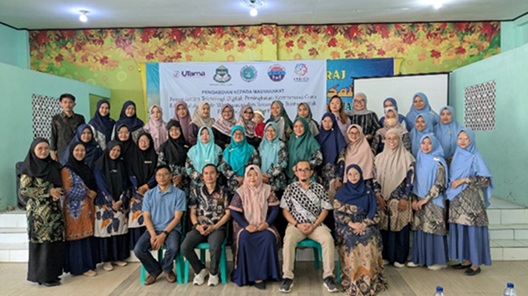
The advancement of digital technology requires improved competencies among educators, including teachers at Raudhatul Athfal (RA), to optimize the learning process. This community service program aims to enhance the skills of RA teachers in utilizing Google Workspaces and to introduce the use of artificial intelligence (AI) tools, specifically ChatGPT, in the development of teaching materials. The methods employed include needs assessment through observation and interviews, module development, hands-on training, practical sessions for creating digital learning materials, and evaluation through questionnaires. The activity was conducted at the RA Al Hidayah Hall in Pangandaran, with the participation of 47 teachers. The results of the questionnaire evaluations and participant feedback showed a significant improvement in the participants' ability to use digital platforms to support innovative learning. This program demonstrates that practice-based training is efficacious in improving the digital literacy of RA teachers and has the potential to be replicated in other regions to support the transformation of early childhood education.
Downloads
Article Details

This work is licensed under a Creative Commons Attribution-ShareAlike 4.0 International License.
Authors who publish with this journal agree to the following terms:
- Any article on the copyright is retained by the author(s).
- Author grant the journal, right of first publication with the work simultaneously licensed under a Creative Commons Attribution License that allows others to share work with acknowledgment of the work authors and initial publications in this journal.
- Authors are able to enter into a separate, additional contractual arrangements for non-exclusive distribution of published articles of work (eg, post-institutional repository) or publish it in a book, with acknowledgment of its initial publication in this journal.
- Authors are permitted and encouraged to post their work online (e.g., in institutional repositories or on their websites) prior to and during the submission process, as can lead to productive exchanges, as well as earlier and greater citation of published work.
- The article and any associated published material is distributed under the Creative Commons Attribution-ShareAlike 4.0 International License
References
Retrieved from https://media.nesta.org.uk/documents/Future_of_AI_and_education_v5_WEB.pdf
Fitria, Y. (2020). Penggunaan Google Workspace dalam meningkatkan motivasi belajar anak usia dini. Jurnal Pendidikan Anak Usia Dini, 14(2), 123–132. https://doi.org/10.21009/JPUD.142.08
Jakob, J. C. (2023). Exploring the Use of Flipped Classroom in Influencing Listening Comprehension of Civil Engineering Students. IJET (Indonesian Journal of English Teaching), 12(1), 48-56. https://doi.org/10.15642/ijet2.2023.12.1.48-56
Misbah, M. (2022). Peningkatan literasi digital guru PAUD melalui pelatihan Microsoft Office di daerah 3T. Jurnal Pengabdian Masyarakat Digital, 3(1), 45–52. https://doi.org/10.1234/jpmd.v3i1.1001
Ningsih, S., & Asrizal, A. (2021). Pelatihan penggunaan Google Classroom bagi guru PAUD di wilayah pedesaan Jawa Tengah. Jurnal Abdimas Digital, 3(1), 44–51. https://doi.org/10.25077/abdimasdigital.v3n1.p44-51
Persulessy, S. I., & Jakob, J. C. (2023). Utilization of Blog in Learning English For Civil Engineering Students. English Community Journal, 7(1), 27-35. https://doi.org/10.32502/ecj.v7i1.5616
Rahmawati, D., & Lestari, S. (2023). Pelatihan media pembelajaran kreatif berbasis Canva untuk guru PAUD di masa adaptasi kebiasaan baru. Jurnal Abdi Cendekia, 5(2), 75–84. https://doi.org/10.5678/jac.v5i2.2023
Sari, A., & Wibowo, H. (2021). Strategi pelatihan literasi digital untuk guru PAUD di wilayah urban. Jurnal Pengabdian Kepada Masyarakat Indonesia, 6(2), 78–85. https://doi.org/10.24198/jpkmi.v6n2.78-85
UNESCO. (2019). Artificial intelligence in education: Challenges and opportunities for sustainable development. Paris: United Nations Educational, Scientific and Cultural Organization. https://unesdoc.unesco.org/ark:/48223/pf0000366994
Zawacki-Richter, O., Marín, V. I., Bond, M., & Gouverneur, F. (2019). Systematic review of research on artificial intelligence applications in higher education – Where are the educators? International Journal of Educational Technology in Higher Education, 16(39). https://doi.org/10.1186/s41239-019-0171-0