Pembinaan Guru-Guru di Pulau Tidung Melalui Seminar Deep Learning pada Pembelajaran Abad 21 Teacher Training on Tidung Island Through a Seminar on Deep Learning in 21st Century Education
Article Sidebar
Main Article Content
Abstract
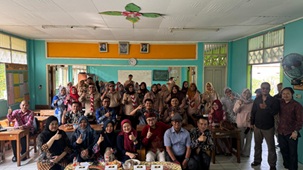
Deep learning in a pedagogical context is an in-depth learning approach that involves essential understanding, emotional engagement, and the reinforcement of values and character. In practice, not all teachers have a sufficient understanding of this deep learning approach. This service project aims to improve teachers' understanding of Deep Learning in 21st-century learning on Tidung Island. The activity was conducted as a 32-hour seminar held over three days, from June 10 to 12, 2025, in a hybrid format combining in-person and online sessions. A total of 48 teachers from public elementary schools and kindergartens on Tidung Island participated in the seminar. The event was held at SD Negeri Pulau Tidung 01 Pagi, located in the Thousand Islands archipelago. The seminar materials included: 1) What is Deep Learning?, 2) Deep Learning in 21st-Century Education, 3) The Application of AI in Education: Strategies and Practices of Deep Learning in the Curriculum, and 4) Enhancing Literacy Through Deep Learning, presented by four speakers. The seminar results indicated that teacher training was conducted on Tidung Island through a seminar, and that the seminar increased teachers' understanding of deep learning in 21st-century learning.
Downloads
Article Details

This work is licensed under a Creative Commons Attribution-ShareAlike 4.0 International License.
Authors who publish with this journal agree to the following terms:
- Any article on the copyright is retained by the author(s).
- Author grant the journal, right of first publication with the work simultaneously licensed under a Creative Commons Attribution License that allows others to share work with acknowledgment of the work authors and initial publications in this journal.
- Authors are able to enter into a separate, additional contractual arrangements for non-exclusive distribution of published articles of work (eg, post-institutional repository) or publish it in a book, with acknowledgment of its initial publication in this journal.
- Authors are permitted and encouraged to post their work online (e.g., in institutional repositories or on their websites) prior to and during the submission process, as can lead to productive exchanges, as well as earlier and greater citation of published work.
- The article and any associated published material is distributed under the Creative Commons Attribution-ShareAlike 4.0 International License
References
Aeni, A. N., Hanifah, N., Rahimah, R., & Arifuddin, A. (2024). Development of Smart Apps Creator (SAC)-Based Android Application Learning Media to Improve Students’ Understanding of Islamic Education Materials in Elementary Schools. Al Ibtida: Jurnal Pendidikan Guru MI, 11(2), 359. https://doi.org/10.24235/al.ibtida.snj.v11i2.18531
Anggoro, S., Sopandi, W., & Sholehuddin, M. (2017). Influence of Joyful Learning on Elementary School Students’ Attitudes Toward Science. Journal of Physics: Conference Series, 812(1), 1–6. Institute of Physics Publishing. https://doi.org/10.1088/1742-6596/812/1/012001
Anwar, K. (2016). Comparative Study of Learning Outcomes Between the Application of the Seminar Method and the Preparatory Assignment Method in History Learning. Indonesian Journal of History Education, 1(1), 27–36. Retrieved from https://journal.unnes
Ardiati, S., Hartinah, S., & Basukiyatno, B. (2024). Aplikasi Google Map untuk Meningkatkan Motivasi Peserta Didik Pada Pembelajran Geografi di SMA. Journal of Education Research, 5(3), 4137–4144. https://doi.org/10.37985/jer.v5i3.1537
Asyhad Sadiq, M., & Alimuddin, A. (2025). Assesment Pembelajaran Dalam Kurikulum Deep Learning. Jurnal Penelitian Ilmu-Ilmu Sosial, 2(11). https://doi.org/10.5281/zenodo.15568889
Bhagyalakshmi, A., Sridevi, D., Dambal, A. A., Ravibabu, K., & Lakshmi Chaitanya, G. (2020). Effectiveness of seminar as an educational tool among the undergraduate medical students: A study. MRIMS Journal of Health Sciences, 8(2), 2321–7294. Retrieved from http://www.mrimsjournal.com/
Cadorin, L., Bagnasco, A., Rocco, G., & Sasso, L. (2014). An integrative review of the characteristics of meaningful learning in healthcare professionals to enlighten educational practices in health care. Nursing Open, 1(1), 3–14. https://doi.org/10.1002/nop2.3
Cahyani, I. (2025). Pembelajaran Mendalam Bahasa Indonesia Berbasis Minful, Meaningful dan Joyful Learning. SANDIBASA III (Seminar Nasional Pendidikan Bahasa Dan Sastra Indonesia, 3(1), 1–8. https://doi.org/10.23969/jp.v11i01.42820
Colomer, J., Serra, T., Cañabate, D., & Bubnys, R. (2020, May 1). Reflective learning in higher education: Active methodologies for transformative practices. Sustainability (Switzerland), Vol. 12. MDPI. https://doi.org/10.3390/su12093827
Diputera, A. M., Zulpan, Z., & Eza, G. N. (2024). Memahami Konsep Pendekatan Deep Learning dalam Pembeljaran Anak Usia Dini Yang Meaningful, Mindful dan Joyful: Kajian Melalui Filsafat Pendidikan. Bunga Rampai Usia Emas (BRUE), 10(2), 108–120. https://doi.org/10.24114/jbrue.v10i2.67168
Faizal, Khoirunnisa, & Budiono, H. (2025). Science and Social Learning Tools based on Artificial Intelligence (AI) in growing Elementary Schools’ Digital Literacy. Jurnal Penelitian Dan Pengembangan Pendidikan, 9(1), 147–157. https://doi.org/10.23887/jppp.v9i1.87473
Feriyanto, F., & Anjariyah, D. (2024). Deep Learning Approach Through Meaningful, Mindful, and Joyful Learning: A Library Research. Electronic Journal of Education, Social Economics and Technology, 5(2), 208–212. https://doi.org/10.33122/ejeset.v5i2.321
Fitri, A., Amin, K., Tauhid, Z., Ramadona, A., Sumbar Pariaman, I., Al Azhar Pekanbaru, S., & Suska Riau, U. (2025). Initiating a Full Fulfillment Curriculum-Based Deep Learning: Integration of Knowledge and Character in Learning. Jurnal PAJAR, 9(1), 96–104. https://doi.org/10.33578/pjr.v9i1.10133
Gutierez, S. (2015). Teachers’ reflective practice in lesson study: A tool for improving instructional practice. Alberta Journal of Educational Research, 61(3), 314–328. Retrieved from https://www.researchgate.net/publication/301633235
Haliza, R. V., Lestari, I., Usman, H., & Sarifah, I. (2025). The Effect of Prodigy Math Learning Media Based on Digital Based Learning on Student Learning Outcomes in Grade IV Mathematics Subjects. Proceedings of the International Conference on Education Practice (ICEP 2024), 182–194. Advances in Social Science, Education and Humanities Research. https://doi.org/10.2991/978-2-38476-376-4_16
Huda, K., & Djono, D. (2025). Mengintegrasikan Teori Pembelajaran Bermakna dan Konstruktivisme dalam Pembelajaran Sejarah di Era Digital. Jurnal Artefak, 12(1), 137. https://doi.org/10.25157/ja.v12i1.18462
Ivtzan, I., Gardner, H. E., & Smailova, Z. (2011). Mindfulness Meditation and Curiosity: The Contributing Factors to Welling and The Process of Closing The Self-discrepancy gap. International Journal of Wellbeing, 1(3), 316–326. https://doi.org/10.5502/ijw.v1i2.2
Jaramillo, J. J., & Chiappe, A. (2024). The AI-driven classroom: A review of 21st century curriculum trends. Prospects, 54(3), 645–660. https://doi.org/10.1007/s11125-024-09704-w
Jud, J., Karlen, Y., & Hirt, C. N. (2024). Linking teachers’ and students’ motivation for self-regulated learning: is there a signal and how is it transmitted? Metacognition and Learning, 19(3), 939–965. https://doi.org/10.1007/s11409-024-09393-y
Junior, W., High School, S., Akimoto, H., Akimoto, Y., & Ugawa, Y. (2018). Utilization of AR and Google Maps in high school geography field work-Practice at Waseda Senior High School. GIS Theory and Applications of GIS, 26(2), 37–43. https://doi.org/10.5638/thagis.26.93
Kaloeti, A. K. (2024). The Impact of Google Form Practice Test on Improving Non English Students Tenses. Premise: Journal of English Education, 13(3), 769. https://doi.org/10.24127/pj.v13i3.9690
Ketut, L., & Widhiasih, S. (2023). Youtube Videos in Literacy Course: Students’ Response and Practice. International Journal of Applied Science and Sustainable Development (IJASSD), 5(2), 45–52. https://e-journal.unmas.ac.id/index.php/IJASSD/article/view/8226
Khairunisa, D., & Aqida, D. S. (2023). Teacher Competence in Developing Interactive Learning in Madrasah Ibtidaiyah in the 21st Century. Sunan Kalijaga International Journal on Islamic Educational Research, 7(2), 107–123. https://doi.org/10.14421/skijier.2023.72.02
Khalifa, M., & Albadawy, M. (2024). Using artificial intelligence in academic writing and research: An essential productivity tool. Computer Methods and Programs in Biomedicine Update, 5, 1–11. https://doi.org/10.1016/j.cmpbup.2024.100145
Kurz, T. L., Jayasuriya, S., Swisher, K., Mativo, J., Pidaparti, R., & Robinson, D. T. (2024). The Impact of Teachable Machine on Middle School Teachers’ Perceptions of Science Lessons after Professional Development. Education Sciences, 14(4). https://doi.org/10.3390/educsci14040417
Latifah, S. (2014). Integrasi Pendidikan Karakter Dalam Pembelajaran di Sekolah. Jurnal Ilmiah Pendidikan Fisika, 3(2), 24–40. https://doi.org/10.24042
Lebert, A., & Vilarroya, Ó. (2024). The links between experiential learning and 4E cognition. Annals of the New York Academy of Sciences, 1541(1), 37–52. https://doi.org/10.1111/nyas.15238
Lee, U., Jeong, Y., Kim, S., Son, Y., Byun, G., Kim, H., & Lim, C. (2025). Video Generation AI Transform K-12 Education? Examining Teachers’ Perspektives Through TPACK and TAM. Ithaca, New York. https://doi.org/10.13140/RG.2.2.26490.20166
Maisyaroh, R., & Nadiah, N. (2024). Pengaruh Metode Joyfull Learning Terhadap Prestasi Belajar Peserta Didik. Juwara: Jurnal Wawasan Dan Aksara, 4(2), 295–305. https://doi.org/10.58740/juwara.v4i2.121
Malinda, E., & Daulay, S. H. (2024). The Effectiveness of Duolingo as an English Learning Platform for Students: A Students Feedback. Electronic Journal of Education, Social Economics and Technology, 5(2), 63–69. https://doi.org/10.33122/ejeset.v5i2.242
Minguillón, J., Aibar, E., Lerga, M., Lladós, J., & Meseguer-Artola, A. (2018). Wikipedia in academia as a teaching tool: from averse to proactive faculty profiles. New York. https://doi.org/10.48550/arXiv.1801.07138
Moos, D. C., & Ringdal, A. (2012). Self-Regulated Learning in the Classroom: A Literature Review on the Teacher’s Role. Education Research International, 2012, 1–15. https://doi.org/10.1155/2012/423284
Morrison, J. R., Risman, K. L., Joseph Reilly, M., & Jane Eisinger, E. M. (2020). An Evaluation of Prodigy: A Case-Study Approach to Implementation and Student Achievement Outcomes. http://jhir.library.jhu.edu/handle/1774.2/62841
Muawanah, U., Marini, A., & Sarifah, I. (2024). The interconnection between digital literacy, artificial intelligence, and the use of E-learning applications in enhancing the sustainability of Regional Languages: Evidence from Indonesia. Social Sciences and Humanities Open, 10. https://doi.org/10.1016/j.ssaho.2024.101169
Mulya, M. A., Maryanti, R., Wulandary, V., & Irawan, A. R. (2022). The Effectiveness of YouTube Media to Improve Knowledge and Literacy of Elementary School Students. Indonesian Journal of Educational Research and Technology, 3(1), 19–24. https://doi.org/10.17509/ijert.v3i1.38689
Muzaffar, H., Nikolaus, Cassandra. J., & Richardson, S. M. N. (2023). Students’ Reflections on an Experiential Learning Rotation With the Peer-Education Abaout Weight Steadiness ClubProgram. Pedagogy in Healt Promotion, 9(2), 138–149. https://doi.org/10.1177/2373379920960647?urlappend=%3Futm_source%3Dresearchgate.net%26utm_medium%3Darticle
Nofamataro Zebua. (2025). Education Transformation : Implementation of Deep Learning in 21st-Century Learning. Harmoni Pendidikan : Jurnal Ilmu Pendidikan, 2(2), 146–152. https://doi.org/10.62383/hardik.v2i2.1405
Permana, T. E., Ln, S. Y., & Chaerudin, R. M. (2020). Peningkatan Wawasan Mahasiswa Melalui Manajemen Pembelajaran Seminar Pada Akademi Sekretari Dan Manajemen Ariyanti. Edutech, 19(1), 71–85. https://doi.org/10.17509/e.v1i1.21538
Putra Bhakti, C., Alfarizqi, M., Ghiffari, N., & Salsabila, K. (2018). JOYFUL LEARNING: ALTERNATIVE LEARNING MODELS TO IMPROVING STUDENT’S HAPPINESS. Varia Pendidikan, 30(2), 30–35. https://doi.org/10.23917/varidika.v30i2.7572
Rawani, D., Putri, R. I. I., Zulkardi, & Susanti, E. (2023). The Reflective Teaching Practices using PMRI and Collaborative Learning. Mathematics Education Journal, 17(1), 69–88. https://doi.org/10.22342/jpm.17.1.17208.69-88
Rejeki Tarigan, J., Kembaren, B. P. B., Fionasari, R., Pambudi, N., & Hartono, R. (2024). Analysis of the Effectiveness of E-Books in Increasing Students’ Digital Literacy. Journal Emerging Technologies in Education, 2(1), 36–48. https://doi.org/10.70177/jete.v2i1.736
Rinaldi, R., Wiyaka, W., & Prastikawati, E. F. (2022). Google Form as an Online Assessment Tool to Improve the Students’ Vocabulary Mastery. SALEE: Study of Applied Linguistics and English Education, 3(1), 56–71. https://doi.org/10.35961/salee.v3i1.307
Rosmiati, N. S., Sujana, A., & Aeni, A. N. (2023). Development of Chatbot Learning Media on Earth Rotation and Revolution Materials for Grade 6 Elementary School Students. Jurnal IPA Dan Pembelajaran IPA), 7(3), 210–233. https://doi.org/10.24815/jipi.v7i2.32054
S, R., Rahmawati, A., Fatrisna, Y., & Fazis, M. (2025). Kesiapan Sekolah dalam Menghadapi Pembelajaran Deep Learning di SMA Negeri 1 Pulau Punjung. Indo-MathEdu Intellectuals Journal, 6(3), 4363–4374. https://doi.org/10.54373/imeij.v6i3.3347
Sari, L. P., Hastomo, T., & Nurchurifiani, E. (2023). Assessing The Efficacy of Dualingo for Acquiring English Vocabulary Skill: Experimental Research. Journal of English Teaching, Applied Linguistics and Literatures (JETALL), 6(2), 193. https://doi.org/10.20527/jetall.v6i2.17145
Sarif, S., & AR, A. (2024). Efektivitas Artificial Intelligence Text to Speech dalam Meningkatkan Keterampilan Membaca. Jurnal Naskhi Jurnal Kajian Pendidikan Dan Bahasa Arab, 6(1), 1–8. https://doi.org/10.47435/naskhi.v6i1.2697
Segú Odriozola, M. I. (2023). Autoethnography as a Tool for the Achievement of Deep Learning of University Students in Service-Learning Experiences. Social Sciences, 12(7), 1–2. https://doi.org/10.3390/socsci12070395
Şimşek, E. E. (2024). The Use of Augmented Reality-Supported Activities in Environmental Education for Early Childhood: A Quasi-Experimental Study. Sustainability (Switzerland), 16(23). https://doi.org/10.3390/su162310374
Suhermi, L., Barokah, N., & Kamal, R. (2025). Pembelajaran Kontekstual sebagai Inovasi Kreatif dalam Menjadikan. JISPENDIORA: Jurnal Ilmu Sosial, Pendidikan Dan Humaniora, 4(2), 94–103. https://doi.org/10.56910/jispendiora.v4i2.2197
Sujinem, S. (2025). Understanding the Implementation of Deep Learning Approch in English. Jurnal Revorma, 5(1), 54–70. https://doi.org/10.20961/ijsascs.v8i2.95098
Villegas-Ch, W., Arias-Navarrete, A., & Palacios-Pacheco, X. (2020). Proposal of an Architecture for the Integration of a Chatbot with Artificial Intelligence in a Smart Campus for the Improvement of Learning. Sustainability (Switzerland), 12(4), 1–20. https://doi.org/10.3390/su12041500
Wang, X., Geng, L., Zhou, K., Ye, L., Ma, Y., & Zhang, S. (2016). Mindful Learning Can Promote Connectedness to Nature: Implicit and Explisit Evidence . Consciousnees and Cognition, 44, 1–7. https://doi.org/10.1016/j.concog.2016.06.006
Willis, V. (2023). The Role of Artificial Intelligence (AI) in Personalizing Online Learning. 3(1), 1–13. Retrieved from www.carijournals.org
Wulansari, K., & Sunarya, Y. (2023). Keterampilan 4c (Critical Thinking, Creativity, Communication, dan Collaborative) Guru Bahasa Indonesia Sma dalam Pembelajaran Abad 21 di Era Industri 4.0. Jurnal Basicedu, 7(3), 1667–1674. https://doi.org/10.31004/basicedu.v7i3.5360
Yaseen, H., Mohammad, A. S., Ashal, N., Abusaimeh, H., Ali, A., & Sharabati, A. A. A. (2025). The Impact of Adaptive Learning Technologies, Personalized Feedback, and Interactive AI Tools on Student Engagement: The Moderating Role of Digital Literacy. Sustainability (Switzerland), 17(3). https://doi.org/10.3390/su17031133
Yim, I. H. Y., & Su, J. (2025). Artificial intelligence (AI) learning tools in K-12 education: A scoping review. Journal of Computers in Education, 12(1), 93–131. https://doi.org/10.1007/s40692-023-00304-9
Zeng, H. L., Chen, D. X., Li, Q., & Wang, X. Y. (2020). Effects of seminar teaching method versus lecture-based learning in medical education: A meta-analysis of randomized controlled trials. Medical Teacher, 42(12), 1343–1349. https://doi.org/10.1080/0142159X.2020.1805100