Strategi Penerapan Deep Learning di SMK Swasta Deep Learning Implementation Strategy in Private Vocational Schools
Article Sidebar
Main Article Content
Abstract
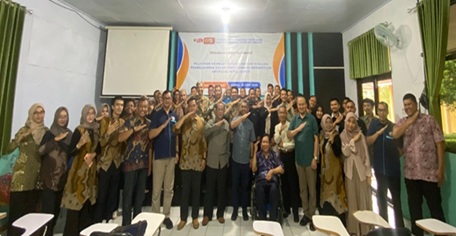
Deep learning is a policy currently being implemented in primary and secondary education, as well as in vocational schools. The implementation of deep learning in learning in vocational schools requires an exceptional understanding for teachers. This training aims to gather data and facts about the knowledge, experience, and implementation of deep learning among private vocational school teachers. The method employed is in-house training, utilizing a participatory and collaborative approach. The training was held at LPS Ciamis Private Vocational School. The training participants were 40 private vocational school teachers. The instrument used was a questionnaire using Google Forms. The results of the training showed that an average of 68% of private vocational school teachers already had a deep understanding of learning. As many as 15.8% of private vocational school teachers are familiar with the basic concept of deep learning. This knowledge was obtained from social media, friends, and the web, to the extent of 31.6%, 26.3%, respectively. As many as 89.5% of private vocational school teachers agreed that deep learning can improve the quality of learning. The teachers already have a high degree of understanding of the purpose of implementing deep learning in vocational schools, with approximately 98% understanding. 47.4% of private vocational school teachers are ready to implement deep learning, while 47.4% of private vocational school teachers are not ready to implement deep learning. Thus, deep learning still requires intensive socialization and training so that vocational school teachers can implement deep learning into the subjects they teach.
Downloads
Article Details

This work is licensed under a Creative Commons Attribution-ShareAlike 4.0 International License.
Authors who publish with this journal agree to the following terms:
- Any article on the copyright is retained by the author(s).
- Author grant the journal, right of first publication with the work simultaneously licensed under a Creative Commons Attribution License that allows others to share work with acknowledgment of the work authors and initial publications in this journal.
- Authors are able to enter into a separate, additional contractual arrangements for non-exclusive distribution of published articles of work (eg, post-institutional repository) or publish it in a book, with acknowledgment of its initial publication in this journal.
- Authors are permitted and encouraged to post their work online (e.g., in institutional repositories or on their websites) prior to and during the submission process, as can lead to productive exchanges, as well as earlier and greater citation of published work.
- The article and any associated published material is distributed under the Creative Commons Attribution-ShareAlike 4.0 International License
References
Adriana. (2021). Model Pembelajaran Berbasis Deep Learning Bagi Siswa Inklusi di Pendidikan Vokasi Systematic Literature Review. Jurnal Tiarsie, 18(4), 127–132. https://doi.org/10.32816/tiarsie.v18i4.129
Ardiansyah, M., & Nugraha, M. L. (2025). Implementasi deep learning untuk meningkatkan hasil pembelajaran di sekolah menengah kejuruan se-Jakarta Barat. Research and Development Journal Of Education, 11(1), 302–309. http://dx.doi.org/10.30998/rdje.v11i1.26453
Barus, A. H. B., Khairum, D., Sianipar, D. M., Mailani, E., & Rarastika, N. (2025). Analisis Kelebihan Dan Kekurangan Pendekatan Deep Learning. Sindoro: Cendikia Pendidikan, 15(1), 141–150. https://doi.org/10.9644/sindoro.v3i9.267
Deviv, S., Akhmad, N. F., Munir, N. S., Arifuddin, M. S., Nooviar, M. S., Mustamin, Astutik, W., & Asri. (2025). Workshop Pembelajaran Deep Learning bagi Guru SMKN 5 Pangkep untuk Peningkatan Proses Pembelajaran. J . A . I : Jurnal Abdimas Indonesia, 5(1), 629–640. https://doi.org/10.34697/jai.v5i1.1418
Diponegoro, M. H., Kusumawardani, S. S., & Hidayah, I. (2021). Tinjauan Pustaka Sistematis: Implementasi Metode Deep Learning pada Prediksi Kinerja Murid. Jurnal Nasional Teknik Elektro Dan Teknologi Informasi, 10(2), 131–138. https://doi.org/10.22146/jnteti.v10i2.1417
Khotimah, D. K., & Abdan, M. R. (2025). Analisis pendekatan deep learning untuk meningkatkan efektivitas pembelajaran PAI di SMKN Pringkuku. Jurnal Pendidikan Dan Pembelajaran Indonesia (JPPI), 5(2), 866–879. https://doi.org/10.53299/jppi.v5i2.1466
Nadawina, N., Jaya, A., Ramadhanti, D., Imronudin, I., Fatchiatuzahro, F., Halim, A., & Jati, G. P. R. S. (2025). Penerapan Pembelajaran Deep Learning dalam Pendidikan di Indonesia. Yogayakarta: Star Digital Publishing. https://doi.org/10.65094/ypdnj013
Oktavianus, A. J. E., Naibaho, L., & Rantung, D. A. (2023). Pemanfaatan Artificial Intelligence pada Pembelajaran dan Asesmen di Era Digitalisasi. Jurnal Kridatama Sains Dan Teknologi, 5(2), 473–486. https://doi.org/10.53863/kst.v5i02.975
Organisation for Economic Co-operation and Development (OECD). (2023). PISA 2022 Results (Volume I): The State of Learning and Equity in Education. https://www.oecd.org/en/publications/pisa-2022-results-volume-i_53f23881-en.html
Prihantini, P., Sutarto, S., Apriliyani, E. S., Stavinibelia, S., Arsyad, M., & Mukhtar, D. (2025). Deep Learning Approaches in Education: A Literature Review on Their Role in Addressing Future Challenge. TOFEDU: The Future of Education Journal, 4(5), 1213–1220. https://journal.tofedu.or.id/index.php/journal/index
Pusat Kurikulum dan Pembelajaran. (2025). Naskah Akademik Pembelajaran Mendalam: Menuju Pendidikan Bermutu untuk Semua. Jakarta: Kemdikdasmen RI. https://gurudikdas.dikdasmen.go.id/news/naskah-akademik-pembelajaran-mendalam-pendidikan-bermutu-untuk-semua
Putra, R. A., Rahmawati, Y., & Halim, A. (2025). Project-Based Learning in the Progress of Deep Learning in a Vocational High School. Sosioedukasi: Jurnal Ilmiah Ilmu Pendidikan Dan Sosial, 14(1), 474–484. https://doi.org/10.36526/sosioedukasi.v14i1.5428
Rahman, S. A., Widjaya, A., Nasrullah, N., Arrazaq, F., Zulkarnain, Z., & Andriana, A. (2023). Pengembangan Model Pembelajaran Deep Learning Inovatif untuk Meningkatkan Pendidikan Inklusif di Sekolah Menengah Kejuruan Penyelenggara Pendidikan Inklusi. Jurnal Pengabdian Tri Bhakti, 5(2), 125–135. https://doi.org/10.36555/jptb.v5i2.2226
Raup, A., Ridwan, W., Khoeriyah, Y., Supiana, S., & Zaqiah, Q. Y. (2022). Deep Learning dan Penerapannya dalam Pembelajaran. JIIP - Jurnal Ilmiah Ilmu Pendidikan, 5(9), 3258–3267. https://doi.org/10.54371/jiip.v5i9.805
Sari, A. W., & Arta, D. J. (2025). Implementasi Deep Learning : Suatu Inovasi Pendidikan. WASPADA (Jurnal Wawasan Pengembangan Pendidikan), 13(01), 121–126. https://doi.org/10.61689/waspada.v13i1.727
Sari, D. (2025). Analysis of the Use of AI (Artificial Intelligence) Based Learning Media in State Vocational High Schools (SMK) in Langkat Regency. Jurnal Dimensi Pendidikan Dan Pembelajaran, 13(1), 37–47. http://dx.doi.org/10.24269/dpp.v13i1.10463
Shafik, W. (2024). Deep learning impacts in the field of artificial intelligence. In Deep Learning Concepts in Operations Research, 9–26. https://doi.org/10.1201/9781003433309-2?urlappend=%3Futm_source%3Dresearchgate.net%26utm_medium%3Darticle
Sumardi, K., Rohendi, D., Saripudin, S., & Ramadhan, M. O. (2024). Kemampuan Guru SMK Mengimplementasikan Artificial Intelligence dalam Perangkat Ajar. Jurnal Pengabdian Kepada Masyarakat Nusantara (JPkMN), 5(4), 5828–5835. https://doi.org/10.55338/jpkmn.v5i4.4244
Tsai, C. C., Chung, C. C., Cheng, Y. M., & Lou, S.-J. (2022). Deep learning course development and evaluation of artificial intelligence in vocational senior high schools. Frontiers in Psychology, 13(September), 1–18. https://doi.org/10.3389/fpsyg.2022.965926
Turmuzi, A. (2025). Pendekatan Deep Learning untuk Menciptakan Pengalaman Belajar yang Bermakna. Journal Scientific of Mandalika (Jsm), 6(7), 1711–1719. https://doi.org/10.36312/10.36312/vol6iss7pp1711-1719
Wahjusaputri, S., Nastiti, T. I., Sukmawati, W., Bunyamin, B., & Johan, J. (2024). Development of Teaching Factory Model-Based Artificial Intelligence : Improving the Quality of Learning Vocational Schools in Indonesia. Al-Ishlah: Jurnal Pendidikan, 16(4), 5173–5183. https://doi.org/10.35445/alishlah.v16i4.5979
World Economic Forum (2024). Shaping the Future of Learning: The Role of AI in Education 4.0. Insight Report. World Economic Forum. https://www.weforum.org/publications/shaping-the-future-of-learning-the-role-of-ai-in-education-4-0/