Optimalisasi Pemanfaatan Teknologi Otomasi dan Energi Terbarukan di BLK Don Bosco Sumba Melalui Pelatihan Industri 4.0 Optimizing the Utilization of Automation Technology and Renewable Energy at BLK Don Bosco Sumba Through Industry 4.0 Training
Article Sidebar
Main Article Content
Abstract
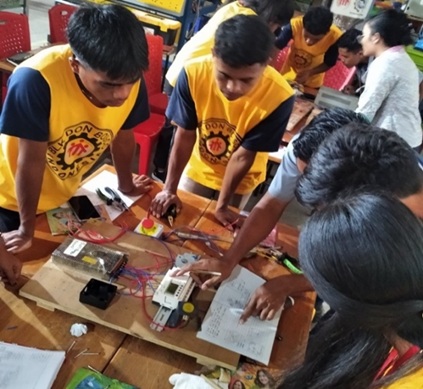
The community service program aims to improve the technical skills of students and instructors at the Don Bosco Job Training Center (BLK) in Sumba through the application of Industry 4.0 technologies. The training focused on three main aspects: programming and operating the Programmable Logic Controller (PLC), product design using SolidWorks software and 3D printing, and designing and installing Solar Power Plant (PLTS) systems. The results of this activity showed that the training successfully increased participants' understanding of industrial automation technology and renewable energy. PLCs allow students to operate industrial automation control systems, while training in SolidWorks and 3D printing enables participants to understand digital design and manufacturing fundamentals. In the solar PV training, participants could design and assemble a simple solar PV system suitable for use in the local environment. This training also helps optimize existing facilities, such as PLCs and 3D printers, that have not been used to their full potential. This program significantly enhances participants' skills and readiness to face future developments in industrial technology and renewable energy.
Downloads
Article Details

This work is licensed under a Creative Commons Attribution-ShareAlike 4.0 International License.
Authors who publish with this journal agree to the following terms:
- Any article on the copyright is retained by the author(s).
- Author grant the journal, right of first publication with the work simultaneously licensed under a Creative Commons Attribution License that allows others to share work with acknowledgment of the work authors and initial publications in this journal.
- Authors are able to enter into a separate, additional contractual arrangements for non-exclusive distribution of published articles of work (eg, post-institutional repository) or publish it in a book, with acknowledgment of its initial publication in this journal.
- Authors are permitted and encouraged to post their work online (e.g., in institutional repositories or on their websites) prior to and during the submission process, as can lead to productive exchanges, as well as earlier and greater citation of published work.
- The article and any associated published material is distributed under the Creative Commons Attribution-ShareAlike 4.0 International License
References
Estrada-Jimenez, L. A., Pulikottil, T., Nikghadam-Hojjati, S., & Barata, J. (2023). Self-organization in smart manufacturing—Background, systematic review, challenges and outlook. IEEE Access, 11, 10107–10136. https://doi.org/10.1109/ACCESS.2023.3240433
Garg, S., Guizani, M., Guo, S., & Verikoukis, C. (2020). Guest editorial special section on AI-driven developments in 5G-envisioned industrial automation: Big data perspective. IEEE Transactions on Industrial Informatics, 16(2), 1291–1295. https://doi.org/10.1109/TII.2019.2955963
Ghobakhloo, M. (2020). Industry 4.0, digitization, and opportunities for sustainability. Journal of Cleaner Production, 252, Article 119869. https://doi.org/10.1016/j.jclepro.2019.119869
Jamwal, A., Agrawal, R., Sharma, M., & Giallanza, A. (2021). Industry 4.0 technologies for manufacturing sustainability: A systematic review and future research directions. Applied Sciences, 11(12), Article 5725. https://doi.org/10.3390/app11125725
Kalsoom, T., Ahmed, S., Rafi-ul-Shan, P. M., Azmat, M., Akhtar, P., Pervez, Z., Imran, M. A., & Ur-Rehman, M. (2021). Impact of IoT on manufacturing Industry 4.0: A new triangular systematic review. Sustainability, 13(22), Article 12506. https://doi.org/10.3390/su132212506
Kavadias, K. A., & Triantafyllou, P. (2021). Hybrid renewable energy systems’ optimisation: A review and extended comparison of the most-used software tools. Energies, 14(24), Article 8268. https://doi.org/10.3390/en14248268
Liu, X. (2020). Training strategies for practical ability of college students majoring in computer-aided design. International Journal of Emerging Technologies in Learning (iJET), 15(16), 134–146. https://doi.org/10.3991/ijet.v15i16.15935
Wójcicki, K., Biegańska, M., Paliwoda, B., & Górna, J. (2022). Internet of Things in industry: Research profiling, application, challenges and opportunities—A review. Energies, 15(5), Article 1806. https://doi.org/10.3390/en15051806
Yulianto, B., Maarif, S., Wijaya, C., & Hardjomidjojo, H. (2019). Energy security scenario based on renewable resources: A case study of East Sumba, East Nusa Tenggara, Indonesia. BISNIS & BIROKRASI: Jurnal Ilmu Administrasi dan Organisasi, 26(1), Article 2. https://doi.org/10.20476/jbb.v26i1.10170
Zhang, X., Ma, Y., Jiang, Z., Chandrasekaran, S., Wang, Y., & Fonkoua Fofou, R. (2021). Application of design-based learning and outcome-based education in basic industrial engineering teaching: A new teaching method. Sustainability, 13(5), Article 2632. https://doi.org/10.3390/su13052632