Komunikasi Bermakna: Intervensi Psikologi Fakultas Kedokteran dan Ilmu Kesehatan pada Komunitas Sahabat Ilmu Jambi Meaningful Communication: A Psychological Intervention by the Faculty of Medicine and Health Sciences for the Sahabat Ilmu Jambi Community
Article Sidebar
Main Article Content
Abstract
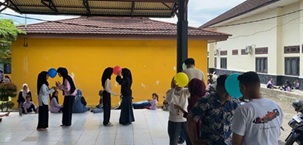
Attachment and interpersonal communication are essential for building a solid, supportive community. The Sahabat Ilmu Jambi community requires the strengthening of these aspects to foster positive interactions among its members. This activity aimed to enhance participants' understanding and skills through a psychoeducational intervention consisting of psychoeducation, group discussion, and outbound games. The program was conducted over two days in person at Universitas Jambi and the Jambi Cultural Park, with five participants attending consistently. Evaluation was carried out using a pretest and a posttest. The results showed increased scores for most participants, indicating improved understanding and the potential for stronger social bonds. This activity demonstrates that community-based, educational, and interactive interventions are effective in strengthening attachment and interpersonal communication within groups.
Downloads
Article Details

This work is licensed under a Creative Commons Attribution-ShareAlike 4.0 International License.
Authors who publish with this journal agree to the following terms:
- Any article on the copyright is retained by the author(s).
- Author grant the journal, right of first publication with the work simultaneously licensed under a Creative Commons Attribution License that allows others to share work with acknowledgment of the work authors and initial publications in this journal.
- Authors are able to enter into a separate, additional contractual arrangements for non-exclusive distribution of published articles of work (eg, post-institutional repository) or publish it in a book, with acknowledgment of its initial publication in this journal.
- Authors are permitted and encouraged to post their work online (e.g., in institutional repositories or on their websites) prior to and during the submission process, as can lead to productive exchanges, as well as earlier and greater citation of published work.
- The article and any associated published material is distributed under the Creative Commons Attribution-ShareAlike 4.0 International License
References
Allen, K.-A., & Kern, M. L. (2023). Understanding strengths-based interventions for sense of belonging in education. Educational Psychology Review. https://doi.org/10.1007/s10648-023-09771-7
Baek, Y., Lee, J., & Kim, H. (2023). Positive social experiences and emotional involvement as predictors of group belonging and prosocial behavior. Journal of Community Psychology, 51(2), 389–402. https://doi.org/10.1002/jcop.22958
Bowlby, J. (1982). Attachment and loss: Vol. 1. Attachment (2nd ed.). Basic Books.
Gao, W., Chen, G., & Li, B. (2023). The effects of teacher–student reciprocity on students sense of belonging at university: A moderated mediation model based on attachment theory. Frontiers in Education, 8, 1284177. https://doi.org/10.3389/feduc.2023.1284177
Genita, M. A., Lestari, F., & Pramudita, D. (2024). Closeness and belongingness: Boosting student engagement in Jakarta universities. Indonesian Journal of Psychology and Education, 9(1), 55–68. https://www.researchgate.net/publication/386741732
Liu, J. H., Zhang, R., & Li, Y. (2023). The profiles, predictors, and intergroup outcomes of cultural attachment. Journal of Cross-Cultural Psychology, 54(8–9), 739–755. https://doi.org/10.1177/00220221231185725
Mikulincer, M., & Shaver, P. R. (2019). Attachment in adulthood: Structure, dynamics, and change (2nd ed.). Guilford Press.
Nurturing Bonds Review. (2025). Nurturing bonds that empower learning: A systematic review of the relational dimensions of teacher–student relationships and their impact on engagement, achievement, and early school leaving. Frontiers in Education, 10, 1522997. https://doi.org/10.3389/feduc.2025.1522997
Raque-Bogdan, T. L., Brown, S. D., & Ayala, J. (2022). Interpersonal interventions for enhancing relational functioning in groups. Journal of Counseling Psychology, 69(4), 415–430. https://doi.org/10.1037/cou0000612
Sholichah, I., & Kushartati, D. (2023). Komunikasi empatik dalam diskusi kelompok: Implikasi bagi resiliensi sosial. Jurnal Ilmu Komunikasi, 21(2), 233–248. https://psikologi.unmuhjember.ac.id/images/e_prosiding/E-Prosiding%20Simposium%20Penelitian%20Sarjana%20Vol%203%202025.pdf
Sholichah, N., & Kushartati, D. (2023). Pelatihan komunikasi empatik untuk meningkatkan resiliensi keluarga. Psychology Journal of Universitas Ahmad Dahlan, 13(1), 22–33. https://journal.uad.ac.id/index.php/Psychology/article/view/17085
Suryani, R., Putri, K., & Harahap, R. S. (2024). The role of parental attachment and self-concept clarity among adolescents. Children and Youth Services Review, 157, 107441. https://doi.org/10.1016/j.childyouth.2024.107441
Wright, A. G. C., Hopwood, C. J., & Zimmermann, J. (2022). The Contemporary Integrative Interpersonal Theory of personality: A framework for understanding interpersonal processes and psychopathology. Personality Disorders: Theory, Research, and Treatment, 13(6), 557–568. https://doi.org/10.1037/per0000580