Edukasi Kecakapan Digital bagi Remaja di SMA Negeri 1 Taebenu Kabupaten Kupang Digital Skills Education for Teenagers at Taebenu 1 State Senior High School, Kupang Regency
Article Sidebar
Main Article Content
Abstract
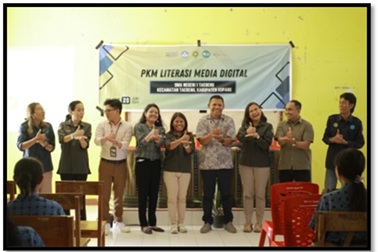
Today's youth are digital natives. Digital media has become an integral part of their lives. Students at Taebenu State Senior High School I, a sample of youth, need adequate digital education to offset the high level of digital activity in their daily lives. These youths' digital routines require the provision of sound digital skills to prevent them from engaging in inappropriate and counterproductive digital activities. This was a key consideration for the team in organizing a community service activity in the form of digital education for the youth group. The implementation method consisted of material presentations and simulations (workshops) facilitated by competent speakers. The substance of the educational activities included: 1) Technical competence in operating digital devices and 2) Normative competence in the form of ethical boundaries in the use of digital media. The evaluation of the activity revealed an increase in knowledge and depth of understanding among the majority of participants regarding digital competence. Additionally, participants felt motivated to apply these various competencies in their digital activities. Overall, this community service activity was well-received and appreciated by participants. The school hopes that capacity-building activities like this can be carried out on a continuous basis.
Downloads
Article Details

This work is licensed under a Creative Commons Attribution-ShareAlike 4.0 International License.
Authors who publish with this journal agree to the following terms:
- Any article on the copyright is retained by the author(s).
- Author grant the journal, right of first publication with the work simultaneously licensed under a Creative Commons Attribution License that allows others to share work with acknowledgment of the work authors and initial publications in this journal.
- Authors are able to enter into a separate, additional contractual arrangements for non-exclusive distribution of published articles of work (eg, post-institutional repository) or publish it in a book, with acknowledgment of its initial publication in this journal.
- Authors are permitted and encouraged to post their work online (e.g., in institutional repositories or on their websites) prior to and during the submission process, as can lead to productive exchanges, as well as earlier and greater citation of published work.
- The article and any associated published material is distributed under the Creative Commons Attribution-ShareAlike 4.0 International License
References
Admass, W. S., Munaye, Y. Y., & Diro, A. A. (2024). Cyber security: State of the art, challenges and future directions. In Cyber Security and Applications, 2. https://doi.org/10.1016/j.csa.2023.100031
Bana, M. (2023, February 26). Tingkatkan Indeks Literasi Digital, PKBI NTT Gelar Workshop. Timexkupang.Fajar.Co.Id.
Becker, M. (2019). Privacy in the digital age: comparing and contrasting individual versus social approaches towards privacy. Ethics and Information Technology, 21(4). https://doi.org/10.1007/s10676-019-09508-z
Bufacchi, V. (2021). Truth, lies and tweets: A Consensus Theory of Post-Truth. Philosophy and Social Criticism, 47(3). https://doi.org/10.1177/0191453719896382
Cooper, S. (2002). Technoculture and Critical Theory : In The Service Of Machine. Routledge.
Heitmayer, M., & Schimmelpfennig, R. (2024). Netiquette as Digital Social Norms. International Journal of Human-Computer Interaction, 40(13). https://doi.org/10.1080/10447318.2023.2188534
Higgins, G. E., Wolfe, S. E., & Marcum, C. D. (2008). Digital piracy: An examination of three measurements of self-control. Deviant Behavior, 29(5). https://doi.org/10.1080/01639620701598023
Malik, A. (2013). Revolusi Gutenberg (Makna Penemuan Mesin Cetak bagi Kemajuan Peradaban Manusia : Dari Tradisi Lisan ke Tulisan). Jurnal Komunikasi, 2(2). https://jurnal.uns.ac.id/candi/article/view/91046
Martono, N. (2012). Sosiologi Perubahan Sosial : Perspektif Klasik, Modern, Postmodern, Dan Postkolonial . Raja Grafindo Persada. https://www.researchgate.net/profile/Nanang-Martono/publication/325169790_Sosiologi_Perubahan_Sosial/links/5afbdee5a6fdccacab19349b/Sosiologi-Perubahan-Sosial.pdf
McLuhan, M. (1964). Understanding Media: The Extention of Man. In Physics of life reviews (Vol. 8). Routledge.
Monks, F. . (1999). Psikologi Perkembangan: Pengantar Dalam Berbagai Bagiannya. Gadja Mada University Press.
Nguyen, M. H., Gruber, J., Fuchs, J., Marler, W., Hunsaker, A., & Hargittai, E. (2020). Changes in Digital Communication During the COVID-19 Global Pandemic: Implications for Digital Inequality and Future Research. Social Media and Society, 6(3). https://doi.org/10.1177/2056305120948255
Prensky, M. (2012). From Digital Natives to Digital Wisdom: Introduction. In From Digital Natives to Digital Wisdom: Hopeful Essays for 21st Century Education. https://doi.org/10.61468/jofdl.v16i2.189
Qutni, D., & Oesman, A. M. (2022). Urgensi Literasi Digital bagi Generasi Milenial dalam Konservasi Budaya. LIBRARIA: Jurnal Perpustakaan, 10(2). https://doi.org/10.21043/libraria.v10i2.17468
Sabillon, R., Cano, J., Cavaller, V., & Serra, J. (2016). Cybercrime and Cybercriminals: A Comprehensive Study. In International Journal of Computer Networks and Communications Security, 4(6). https://www.researchgate.net/publication/304822458_Cybercrime_and_Cybercriminals_A_Comprehensive_Study
Sari, S. (2019). LITERASI MEDIA PADA GENERASI MILENIAL DI ERA DIGITAL. Profesional: Jurnal Komunikasi Dan Administrasi Publik, 6(2). https://doi.org/10.37676/professional.v6i2.943
Thornhill-Miller, B., Camarda, A., Mercier, M., Burkhardt, J. M., Morisseau, T., Bourgeois-Bougrine, S., Vinchon, F., El Hayek, S., Augereau-Landais, M., Mourey, F., Feybesse, C., Sundquist, D., & Lubart, T. (2023). Creativity, Critical Thinking, Communication, and Collaboration: Assessment, Certification, and Promotion of 21st Century Skills for the Future of Work and Education. In Journal of Intelligence, 11(3). https://doi.org/10.3390/jintelligence11030054