Peningkatan Kesadaran Hukum Mahasiswa melalui Forum Diskusi Kritis terhadap RKUHAP di Kota Makassar Improving Student Legal Awareness through a Critical Discussion Forum on the RKUHAP in Makassar City
Article Sidebar
Main Article Content
Abstract
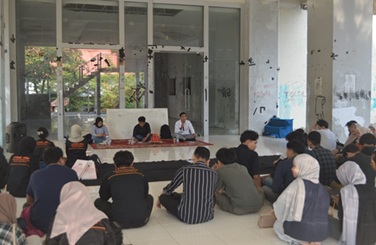
The reform of Indonesia's criminal procedure law, as outlined in the Draft Criminal Procedure Code (RKUHAP), is set to take effect in January 2026 and has sparked mixed reactions among academics, legal practitioners, and civil society. This discussion was held as a moral calling and a form of academic protest against several articles in the RKUHAP that are perceived as granting excessive power to law enforcement authorities. The primary objective of this activity was to provide a more comprehensive understanding to students and student organizations from Universitas Negeri Makassar and Universitas Hasanuddin about the dynamics of criminal law reform in Indonesia, both from theoretical perspectives and practical experiences. The method employed was an open forum, consisting of two main sessions: one featuring conceptual insights delivered by academic lecturers, and the other analyzing real-life legal cases presented by representatives from the Legal Aid Institute (LBH) Makassar. The event took place in the courtyard of the BU Building at Universitas Negeri Makassar, with active participation from students across different faculties and organizations. The outcome showed that participants gained a deeper and more complete understanding of how complex the criminal procedure reform really is. They could see both the potential for stronger human rights protection on one hand, and the risks of backsliding on due process principles on the other. Overall, this event made a significant contribution to shaping critical legal awareness among students as agents of change and to encouraging more youth involvement in advocating for legal reform in Indonesia.
Downloads
Article Details

This work is licensed under a Creative Commons Attribution-ShareAlike 4.0 International License.
Authors who publish with this journal agree to the following terms:
- Any article on the copyright is retained by the author(s).
- Author grant the journal, right of first publication with the work simultaneously licensed under a Creative Commons Attribution License that allows others to share work with acknowledgment of the work authors and initial publications in this journal.
- Authors are able to enter into a separate, additional contractual arrangements for non-exclusive distribution of published articles of work (eg, post-institutional repository) or publish it in a book, with acknowledgment of its initial publication in this journal.
- Authors are permitted and encouraged to post their work online (e.g., in institutional repositories or on their websites) prior to and during the submission process, as can lead to productive exchanges, as well as earlier and greater citation of published work.
- The article and any associated published material is distributed under the Creative Commons Attribution-ShareAlike 4.0 International License
References
Arief, B. N. (2010). Bunga rampai kebijakan hukum pidana: Perkembangan penyusunan konsep KUHP baru (Edisi revisi). Jakarta: Kencana Prenada Media Group. https://books.google.co.id/books?id=Clc_DwAAQBAJ&printsec=copyright&h#v=onepage&q&f=false
Asshiddiqie, J. (2006). Pengantar ilmu hukum tata negara. Jakarta: Konstitusi Press.
Hikmah, N., Surawan, S., Ansari, M. R., Endah, E., & Muslimah, M. (2022). Pelatihan peningkatan kompetensi guru dalam membuat media pembelajaran berbasis IT di SMP Muhammadiyah Palangka Raya: Training for increasing teachers’ competence in making IT-based learning media at SMP Muhammadiyah Palangka Raya. PengabdianMu: Jurnal Ilmiah Pengabdian kepada Masyarakat, 7(5), 652–663. https://doi.org/10.33084/pengabdianmu.v7i5.3175
Komnas HAM. (2025, 25 Juni). Komnas HAM terima 176 aduan dugaan penyiksaan oleh polisi selama 2020–2024. Kompas.com. https://nasional.kompas.com/read/2025/06/25/18150661/komnas-ham-terima-176-aduan-dugaan-penyiksaan-oleh-polisi
Mahkamah Konstitusi Republik Indonesia. (2020). Putusan MK No. 91/PUU-XVIII/2020 tentang Pengujian Formil Undang-Undang Cipta Kerja. Jakarta: MKRI. https://www.mkri.id/public/content/persidangan/putusan/putusan_mkri_8240_1637822490.pdf
Rochman, S., Lestari, D. P., & Wijaya, T. (2022). Problematika pembaharuan hukum pidana dalam RKUHAP: Analisis kritis terhadap pasal-pasal kontroversial. Jurnal Hukum dan Pembangunan, 52(3), 455–472. https://doi.org/10.21143/jhp.vol52.no3.3509
Soekanto, S. (1983). Faktor-faktor yang mempengaruhi penegakan hukum. Jakarta: Rajawali Press.
Sutrisna, S. M. D. (2023). Hukum acara pidana: Penerapan due process of law. JIHAD: Jurnal Ilmu Hukum dan Administrasi, 5(2), 77–89. https://doi.org/10.58258/jihad.v5i2.5614
Tempo. (2025, 17 Juli). Panja pastikan masa penangkapan dalam RKUHAP hanya satu hari. Tempo.co. https://www.tempo.co/hukum/panja-pastikan-masa-penangkapan-dalam-rkuhap-hanya-satu-hari-2026736
Undang-Undang Nomor 12 Tahun 2011 tentang Pembentukan Peraturan Perundang-Undangan sebagaimana telah diubah dengan Undang-Undang Nomor 13 Tahun 2022. Lembaran Negara Republik Indonesia Tahun 2022 Nomor 143. https://peraturan.bpk.go.id/Details/39188/uu-no-12-tahun-2011