Sosialisasi dan Penerapan Pengendalian Hama Terpadu pada Tanaman Hortikultura di KWT La’o Socialization and Implementation of Integrated Pest Management on Horticultural Crops in KWT La'o
Article Sidebar
Main Article Content
Abstract
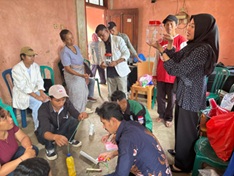
Horticultural crops have a potential market share, as evidenced by increasing demand for quantity and quality. Pesticides are chemical compounds formulated to control pests and diseases that attack plants. The numerous environmental disturbances caused by chemical pesticides have led to the development of Integrated Pest Management (IPM), one of its goals being to control pests using natural enemies and botanical pesticides. The Women Farmers Group (KWT), assisted by Soverdia La'o, is a group of 17 members formed in 2018 in Wali Village, Langke Rembong District, Manggarai Regency. The purpose of this community service is to help the people of Wali Village, KWT La'o, acquire new skills in using various types of pest traps for horticultural plants, understanding their benefits, making and applying pest traps, and applying them with ease. Community Service (PkM) was conducted in Karot Village, Manggarai Regency. Initial preparation for this activity included a site survey to analyze existing problems at the PkM location. The training was conducted directly, beginning with a clear and concise delivery of the material and using PPT images and pest traps previously made by the presenter to clarify the explanation. Evaluation was carried out using a simple questionnaire distributed before the presentation of the material (pre-test) and after the presentation and demonstration (post-test). Based on this service, the village community has acquired new skills related to various types of pest traps for horticultural plants, the benefits of these traps, the skills required to make and apply them, and the ease of applying them.
Downloads
Article Details

This work is licensed under a Creative Commons Attribution-ShareAlike 4.0 International License.
Authors who publish with this journal agree to the following terms:
- Any article on the copyright is retained by the author(s).
- Author grant the journal, right of first publication with the work simultaneously licensed under a Creative Commons Attribution License that allows others to share work with acknowledgment of the work authors and initial publications in this journal.
- Authors are able to enter into a separate, additional contractual arrangements for non-exclusive distribution of published articles of work (eg, post-institutional repository) or publish it in a book, with acknowledgment of its initial publication in this journal.
- Authors are permitted and encouraged to post their work online (e.g., in institutional repositories or on their websites) prior to and during the submission process, as can lead to productive exchanges, as well as earlier and greater citation of published work.
- The article and any associated published material is distributed under the Creative Commons Attribution-ShareAlike 4.0 International License
References
Angreini, N., Rahim, M., dan Salam, I. 2021. Analisis Pengembangan Komoditas Unggulan Sub Sektor Hortikultura Di Kabupaten Konawe. Jurnal Perencanaan Wilayah, 6(1): 46. https://doi.org/10.33772/jpw.v6i1.17334
Asril, M., Lismaini, M.S., Ginting, E., Suryani, C., Wati, M., Ahsan, E., dan Joeniarti. 2022. Pengelolaan Hama Terpadu. Penerbit Yayasan Kita Menulis. Medan. https://kitamenulis.id/2022/12/26/pengelolaan-hama-terpadu/
Diratmaja, I. G. P. A. dan Zakiah. 2015. Konsep dasar dan penerapan PHT padi sawah di tingkat petani. Agros, 17(1): 33-45. https://garuda.kemdiktisaintek.go.id/documents/detail/761671
Direktorat Jenderal Hortikultura. 2022. Laporan Tahunan Direktorat Jenderal Hortikultura Tahun 2022. Direktorat Jenderal Hortikultura. Jakarta. https://hortikultura.pertanian.go.id/2022/01/
Erdiansyah., Iqbal., Ningrum, D.R.K., dan Damanhuri. 2018. Pemanfaatan Tanaman Bunga Marigold dan Kacang Hias terhadap Populasi Arthropoda pada Tanaman Padi Sawah. Agriprima, Agricultural Journal of Sciences. 2(2):117-125. https://doi.org/10.25047/agriprima.v2i2.91
Gunawan, M. 1993. Pengembangan komoditas hortikultura dalam sisitem agribisnis. Pangan. 16(4): 55-64. http://repository.lppm.unila.ac.id/view/year/2018.html
Indiati, S. W., dan Marwoto, M. 2017. Penerapan pengendalian hama terpadu (PHT) pada tanaman kedelai. Buletin Palawija, 15(2), 87-100. https://doi.org/10.21082/bul%20palawija.v15n2.2017.p87-100
Istifadah, N., dan Dono, D. 2010. Eksplorasi Dan Kebul (Bemisia tabaci Genn) Dari Beberapa Perkembangbiakan Masal Musuh Alami Kutu Sentra Produksi Tanaman Sayuran Di Jawa Barat. Departemen Koperasi. Jakarta. https://doi.org/10.31004/abdidas.v3i6.705
Itap. 2015. Wawancara Pribadi: Cara Budidaya Ubi Alabio (Dioscorea alata L.). Teluk Cati. HSU. https://dx.doi.org/10.31602/zmip.v41i2.425
Khairad, F., Noer, M., dan Refdinal, M. 2020. Analisis Wilayah Sentra Produksi Komoditas Unggulan Pada Sub Sektor Tanaman Pangan Dan Tanaman Hortikultura Di Kabupaten Agam. Agrifo : Jurnal Agribisnis Universitas Malikussaleh, 5(1): 60–72. https://doi.org/10.29103/ag.v5i1.2958
Lakitan, B. 2013. Dasar-dasar Fisiologi Tumbuhan. PT. Raja Grafindo Persada. Jakarta. https://www.rajagrafindo.co.id/produk/dasar2-fisiologi-pertumbuhan/
Laxmishree, C. and Nandita, S. 2017. Botanical pesticides – a major alternative to chemical pesticides: A review. Int. J. of Life Sciences, 5(4): 722-729. https://oaji.net/articles/2017/736-1514997361.pdf
Lestari, P., Helina, S., Ginting, C., dan Maryono, T. 2023. Pemanfaatan Agensia Hayati untuk Mengendalikan Hama dan Penyakit Jagung di Desa Rejo Mulyo, Lampung Selatan. Jurnal Pengabdian Fakultas Pertanian Universitas Lampung, 2(1): 68–79. https://doi.org/10.23960/jpfp.v2i1.6726
Liana, D., Panjaitan, F.P., Taopan, R.A., Astuti, T., Purba, D.P., Knaofmone, E., Ariefin, M.N., Adi, D.D., Choirunnisa, J.P., Mulu, M., Jelatu, S., dan Rofita, D. 2024. Penerapan Teknologi Budidaya Bawang Merah Bima Brebes sesuai Kondisi Agroekosistem untuk Meningkatkan Pengetahuan Kelompok Tani Bantang Cama. PengabdianMu: Jurnal Ilmiah Pengabdian kepada Masyarakat, 9(5): 912-920. https://doi.org/10.33084/pengabdianmu.v9i5.6534
Manan, A. M., Nurtiati, N., dan Mugiastuti, E. 2018. Pengelolaan Tanaman Bawang Merah Ramah Lingkungan dengan Pemanfaatan Biopestisida Trichoderma. Jurnal SOLMA, 7(2): 182. https://garuda.kemdiktisaintek.go.id/documents/detail/4107746
Nurkholis., Saechon, I., dan Susanti. 2023. Penerapan Teknologi Pengendalian Hama Terpadu (PHT) Dalam Pengembangan Tanaman Kubis. Jurnal Ilmiah Hijau Cendekia. 8(1): 31-37. https://doi.org/10.32503/hijau.v8i1.3078
Pitaloka, D. 2020. Hortikultura: Potensi, Pengembangan dan Tantangan. Jurnal Teknologi Terapan: G-Tech, 1(1): 1–4. https://doi.org/10.33379/gtech.v1i1.260
Probojati, R. T., Lisanty, N., dan Ghazali, A. M. 2022. Produksi Pestisida Nabati dari Serai, Cengkeh, dan Lada di Desa Sanggrahan, Kabupaten Nganjuk. JATIMAS : Jurnal Pertanian dan Pengabdian Masyarakat, 2(1): 67. https://doi.org/10.30737/jatimas.v2i1.2560
Siregar, A.Z., dan Tulus, E. J. 2016. Pengendalian Hama Terpadu Menggunakan Yellow Sticky Trap Meningkatkan Produktivitas Kopi di Telagah. Jurnal BUDIMAS, 5(2): 1–23. http://orcid.org/0000-0002-7077-9852
Sumartini. 2016. Biopestisida untuk Pengendalian Hama dan Penyakit Tanaman Aneka Kacang dan Umbi. Iptek Tanaman Pangan, 11(2): 159-166. https://garuda.kemdiktisaintek.go.id/documents/detail/619694
Wardana, R., Erdiyansyah, I.I., dan Putri, S.U. 2017. Pemanfaatan Presistensi Tanaman Hama Refugia Sebagai Sistem Pengendali Hama Padi pada Kelompok Tani Suren Jaya 01, Kecamatan Ledokombo. In Seminar Nasional Hasil Pengabdian Kepada Masyarakat (pp.233-237). https://doi.org/10.25047/agriprima.v2i2.91