Pengenalan Alat Musik Tradisional Indonesia bagi Mahasiswa International Summer School 2025 di Universitas Mulawarman, Kalimantan Timur Introduction to Traditional Musical Instrument Training for International Summer School 2025 Students at Mulawarman University, East Kalimantan
Article Sidebar
Main Article Content
Abstract
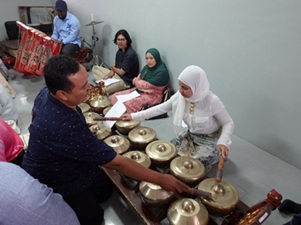
The introduction to traditional musical instrument training for students of the 2025 International Summer School at Mulawarman University was conducted to showcase Indonesia's cultural wealth through a musical arts approach. This activity aims to provide an understanding of cultural values and practical skills in playing traditional instruments, particularly the sape', gamelan, gong, and gendang, which are used to accompany the East Kalimantan regional song titled "Leleng." The training was organized by the Summer School 2025 Committee in collaboration with the Faculty of Cultural Sciences and was attended by 25 international students from various countries. The series of community service activities consisted of a preparation stage involving planning of materials and equipment, an implementation stage through the introduction of instruments, demonstrations, and hands-on practice assistance, and an evaluation stage to assess participants' level of understanding and satisfaction. Based on the questionnaire results, 90% of participants expressed satisfaction with the implementation of this activity. The results of the activity showed that international students were highly enthusiastic and able to master the basic techniques of playing traditional musical instruments well, even producing simple rhythms in groups. Participants also expressed that this experience not only improved their musical skills but also enriched their cultural knowledge and fostered appreciation for traditional Indonesian art. Overall, the training activity successfully achieved its primary objective: introducing traditional music as part of national identity while serving as an effective cross-cultural learning medium.
Downloads
Article Details

This work is licensed under a Creative Commons Attribution-ShareAlike 4.0 International License.
Authors who publish with this journal agree to the following terms:
- Any article on the copyright is retained by the author(s).
- Author grant the journal, right of first publication with the work simultaneously licensed under a Creative Commons Attribution License that allows others to share work with acknowledgment of the work authors and initial publications in this journal.
- Authors are able to enter into a separate, additional contractual arrangements for non-exclusive distribution of published articles of work (eg, post-institutional repository) or publish it in a book, with acknowledgment of its initial publication in this journal.
- Authors are permitted and encouraged to post their work online (e.g., in institutional repositories or on their websites) prior to and during the submission process, as can lead to productive exchanges, as well as earlier and greater citation of published work.
- The article and any associated published material is distributed under the Creative Commons Attribution-ShareAlike 4.0 International License
References
Christina, D., Yetti, E., & Herdiati, D. (2025). Membentuk Generasi Cinta Budaya Lewat Musik Tradisional di Usia Emas. LEARNING: Jurnal Inovasi Penelitian Pendidikan Dan Pembelajaran, 5(2), 933–947. https://jurnalp4i.com/index.php/learning
Ernawati, & Munaf, D. R. (2024). Digitization of Traditional Indonesian Music for Preservation and Democratization of Knowledge. International Journal of Multidisciplinary Research and Publications (IJMRAP), 7(1), 248–255.
Halimah, L. (2016). Musik Dalam Pembelajaran. EduHumaniora: Jurnal Pendidikan Dasar, 2(2). https://doi.org/https://doi.org/10.17509/eh.v2i2.2763
Hananto, F. (2020). Gamelan Sebagai Simbol Estetis Kebudayaan Masyarakat Jawa. Representamen, 6(01). https://doi.org/10.30996/representamen.v6i01.3511
Isar, Y. R., & Triandafyllidou, A. (2021). Introduction to this Special Issue Cultural Diplomacy: What Role for Cities and Civil Society Actors? International Journal of Politics, Culture and Society, 34(4), 393–402. https://doi.org/10.1007/s10767-020-09385-1
Kiring, M. (2023). Organologi dan Fungsi Sape dalam Ritual Panen Raya Dayak Kayan Kalimantan Utara Organology and Function of Sape in Kayan Dayak Harvest Ritual North Kalimantan. 12, 445–459. https://doi.org/10.24036/js.v12i3.125265
Larasati, Y. G., Fernando, H., Abdullah, I., Harpawati, T., & Morin, L. (2024). Bibliometric Analysis of 20 years of Traditional Music Research Trends in Asia: 2004-2024. Resital, 25(3), 392–413. https://doi.org/10.24821/resital.v25i3.14983
Mulyati, S. A. (2016). Musik Tradisional Sampek Kalimantan Timur. In Pelataran Seni, 1(1). https://doi.org/10.20527/jps.v1i1.1442
Setiawan, S., & Setyoko, A. (2022). Organologi dan Bunyi Kendang Jawa. Jurnal Mebang: Kajian Budaya Musik Dan Pendidikan Musik, 2(2), 75–90. https://doi.org/10.30872/mebang.v2i2.31
Sugiyono. (2008). Metode Penelitian Pendidikan. Alfabeta.
Suprapto, N., Rizki, I. A., Saphira, H. V., Alfarizy, Y., & Jannah, S. N. (2024). Exploration of science concepts in Indonesian indigenous culture: actualization of the Indonesian curriculum. Journal of Turkish Science Education, 21(3), 410–429. https://doi.org/10.36681/tused.2024.022