Transformasi Posyandu menjadi Pusat Pembelajaran Interaktif bagi Anak Usia Sekolah Dasar melalui Kegiatan PKM Transforming Posyandu into an Interactive Learning Center for Elementary School Children through the Student Creativity Program
Article Sidebar
Main Article Content
Abstract
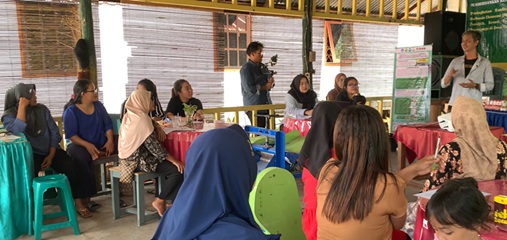
Student Service Activities (PKM) were carried out to provide an alternative learning space for elementary school-aged children in the Tiban Palem Housing Complex, Batam City, by utilizing the Bougenville 3 Health Post as an interactive learning center. The program was designed to address the limited access to non-formal learning facilities while providing an enjoyable and meaningful experience in learning basic English. The implementation method employed a thematic, communicative, participatory, and multimodal approach, integrating songs, educational games, visual media, and creative tasks. The program participants were 37 children aged 6–14 years, divided into two groups based on grade level. The results of the activities showed that the majority of participants (70–85%) were able to master the target vocabulary and construct simple sentences in accordance with the learning objectives. Observations also revealed increased motivation, active engagement, and self-confidence among the children in their oral use of English. Additionally, parental responses were highly positive, as evidenced by high ratings of learning quality (76.2%) and material suitability (81%), and by children's enthusiasm exceeding 95%. Overall, this program has succeeded in strengthening the role of posyandu as a community-based educational space, improving basic language skills, and building close collaboration between universities and the community. For sustainability, it is recommended that volunteer training and the development of similar programs in other areas be implemented.
Downloads
Article Details

This work is licensed under a Creative Commons Attribution-ShareAlike 4.0 International License.
Authors who publish with this journal agree to the following terms:
- Any article on the copyright is retained by the author(s).
- Author grant the journal, right of first publication with the work simultaneously licensed under a Creative Commons Attribution License that allows others to share work with acknowledgment of the work authors and initial publications in this journal.
- Authors are able to enter into a separate, additional contractual arrangements for non-exclusive distribution of published articles of work (eg, post-institutional repository) or publish it in a book, with acknowledgment of its initial publication in this journal.
- Authors are permitted and encouraged to post their work online (e.g., in institutional repositories or on their websites) prior to and during the submission process, as can lead to productive exchanges, as well as earlier and greater citation of published work.
- The article and any associated published material is distributed under the Creative Commons Attribution-ShareAlike 4.0 International License
References
Putri, A. D., & Dewi, R. S. (2020). Implementasi pembelajaran abad 21 dalam proses belajar mengajar. Jurnal Basicedu, 4(3), 800–810. Retrieved from https://jbasic.org/index.php/basicedu/article/view/408
Silvana, N. A., Angylia, M. P., Azzahra, N. N., Akhsannah, L. A., & Danuri. (2024). Pengaruh ketersediaan fasilitas belajar di sekolah terhadap motivasi belajar siswa di sekolah dasar. Didaktik: Jurnal Ilmiah PGSD STKIP Subang, 10(2), 736–745. https://journal.stkipsubang.ac.id/index.php/didaktik/article/view/3180
Islami, A., Supriati, H. R., Rahayu, Y., Rukhiyah, W., Fauzia, U., & Rahmalia, T. D. (2024). Posyandu sebagai sentra pendidikan masyarakat bagi anak usia dini. As Sibyan: Jurnal Pendidikan Anak Usia Dini, 8(1), 13–22. https://ftk.uinbanten.ac.id/journals/index.php/assibyan/article/view/9304
Rahmadani, F., & Yuliana, L. (2022). Akses dan kualitas pendidikan dasar di kawasan permukiman padat. Jurnal Pendidikan Masyarakat, 9(1), 12–21. https://repository.upi.edu/view//year/2026.default.html
Suryani, D., & Hidayat, M. (2023). Meningkatkan minat belajar anak melalui pembelajaran kontekstual di luar kelas. Jurnal Inovasi Pendidikan, 5(2), 77–86. https://doi.org/10.58540/jurpendis.v3i2.1034
Widodo, A., & Sari, N. P. (2021). Pendidikan berbasis komunitas: Konsep dan praktik pada pendidikan nonformal. Jurnal Pendidikan dan Pemberdayaan Komunitas, 8(1), 45–55. https://staff.universitaspahlawan.ac.id/web/upload/materials/17041-materials.pdf
Wulandari, F., & Hasanah, S. (2022). Optimalisasi ruang publik sebagai media pembelajaran anak usia dini di wilayah urban. Jurnal Pendidikan Anak, 11(2), 101–110. https://doi.org/10.21009/jpa.112.08
Nugroho, B. S., & Lestari, M. (2021). Inovasi pembelajaran Bahasa Inggris untuk anak melalui pendekatan tematik dan multimedia. Jurnal Pendidikan Bahasa, 6(1), 33–42. https://doi.org/10.24114/jpb.v6i1.23991
Viandi, A., Wahyuna, D., & Samsi, M. (2025). Enhancing English language skills through multimodal-based learning in elementary education. Syntax Admiration, 6(3), 412–420. https://www.jurnalsyntaxadmiration.com/index.php/jurnal/article/view/2025
Pitaloka, D. A. D., Wigati, F. A., & Suryaman, M. (2025). Exploring students engagement in learning vocabulary through the use of Total Physical Response (TPR) method. Journal of Educational Sciences, 9(2), 718–728. https://doi.org/10.31258/jes.9.2.p.718-728
Amiruddin, A., Baharuddin, F. R., Takbir, & Setialaksana, W. (2023). May student centered principles affect active learning and its counterpart? An empirical study of Indonesian curriculum implementation. SAGE Open, 13(4), 1–16. https://doi.org/10.1177/21582440231214375
Rochma, A. F., & Zuhriyah, M. (2025). English Kids’ Songs: Effective Media for Teaching Vocabulary. Discovery: Jurnal Ilmu Pengetahuan, 10(1), 77–87. https://doi.org/10.33752/jd.v10i1.8767%20grnjournal.us+4researchgate.net+4ejournal.undiksha.ac.id+4
Li, W., & Zou, W. (2021). Exploring primary school EFL teacher expertise in scaffolding: A comparative study. SAGE Open, 11(3), 1–15. https://doi.org/10.1177/21582440211061574
Macrine, S. L., & Fugate, J. M. B. (2021). Translating embodied cognition for embodied learning in the classroom. Frontiers in Education, 6, Article 712626. https://doi.org/10.3389/feduc.2021.712626
Pitaloka, D. A. D., Wigati, F. A., & Suryaman, M. (2025). Exploring students engagement in learning vocabulary through the use of Total Physical Response (TPR) method. Journal of Educational Sciences, 9(2), 718–728. https://doi.org/10.31258/jes.9.2.p.718-728
Gómez Franco, L. E., Badilla-Quintana, M. G., Walker, E., Restrepo, M. A., & Glenberg, A. M. (2025). Embodied activity enhances young children’s STEM comprehension and vocabulary acquisition. First Language, 01427237251345858. https://doi.org/10.1177/01427237251345858