Pendampingan Guru Pendidikan Anak Usia Dini dalam Penilaian Status Gizi Anak Usia Prasekolah Assistance for Early Childhood Education Teachers in Assessing Nutritional Status of Preschool-Aged Children
Article Sidebar
Main Article Content
Abstract
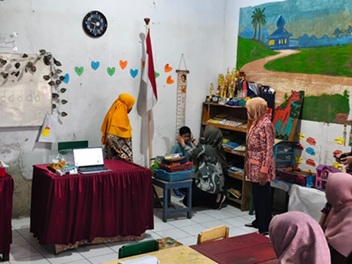
Children's cognitive, emotional, social, motoric, and language development needs to be supported with healthy growth, especially during the preschool age period. To maintain good health from a preschool age, a person must improve their level of health by controlling factors that can pose a negative risk to their own well-being. Teachers play a crucial role in the school structure as agents of change. A change agent is an individual who possesses the skills and abilities to stimulate, facilitate, and coordinate change. Anthropometric measurements are a method of assessing nutritional status that involves evaluating the dimensions and composition of the human body, including body weight and height. Monitoring the growth of early childhood through routine anthropometric measurements every month and determining nutritional status using graphs or growth curves established by the Government is crucial because it is one of the efforts to prevent stunting. This mentoring activity consists of three stages: the preparation stage, the implementation stage, and the evaluation stage. The target audience of this activity is teachers in the Early Childhood Education (PAUD) environment. The activity was conducted at Alwildan Kindergarten, Manado City, and RA Darul Faizin, Manado City, with a total of 10 participants. Pretest questionnaire results showed that only 30% of participants demonstrated good knowledge, with a score of 80 or higher. In contrast, the posttest questionnaire results indicated that all participants demonstrated good knowledge about nutrition and techniques for measuring weight and height, with a score of 80 or higher.
Downloads
Article Details

This work is licensed under a Creative Commons Attribution-ShareAlike 4.0 International License.
Authors who publish with this journal agree to the following terms:
- Any article on the copyright is retained by the author(s).
- Author grant the journal, right of first publication with the work simultaneously licensed under a Creative Commons Attribution License that allows others to share work with acknowledgment of the work authors and initial publications in this journal.
- Authors are able to enter into a separate, additional contractual arrangements for non-exclusive distribution of published articles of work (eg, post-institutional repository) or publish it in a book, with acknowledgment of its initial publication in this journal.
- Authors are permitted and encouraged to post their work online (e.g., in institutional repositories or on their websites) prior to and during the submission process, as can lead to productive exchanges, as well as earlier and greater citation of published work.
- The article and any associated published material is distributed under the Creative Commons Attribution-ShareAlike 4.0 International License
References
Chatzinikola, C., Papavasileiou, V., Andreadakis, N., & Koutelidakis, A. E. (2025). Nutrition Literacy and Food Practices of Preschool Teachers in Greece. Dietetics, 4(3), 25. https://doi.org/10.3390/dietetics4030025
Duncan, G., Kalil, A., Mogstad, M., & Rege, M. (2023). Investing in early childhood development in preschool and at home. In E. Hanushek, S. Machin, & L. Woessmann (Eds.), Handbook of the Economics of Education (pp. 1–91). North-Holland Publications. https://doi.org/10.1016/bs.hesedu.2022.11.005
Fahmida, U., Pramesthi, I. L., & Anggraini, R. (2019). Modul 5-Memenuhi Gizi Anak yang Optimal-Seri Modul Anakku Sehat dan Cerdas: Panduan Bagi Pendidik PAUD dalam Penerapan Konsep PAUD-HI Melalui Sesi Parenting. SEAMEO RECFON. https://repository.uinjkt.ac.id/dspace/bitstream/123456789/68331/1/Modul-ECCNE_PJJ-guru-2021_11zon.pdf
Habib, M. A., Alam, M. R., Rahman, T., Chowdhury, A. I., & Shill, L. C. (2023). Knowledge, attitudes, and practices (KAP) of nutrition among school teachers in Bangladesh: A cross-sectional study. PLOS ONE, 18(3), e0283530. https://doi.org/10.1371/journal.pone.0283530
Harnany, A. S., Hartono, M., Baequny, A., & Widowati, I. (2021). Pelatihan dan Pendampingan Guru PAUD dalam Pemeriksaan Status Gizi dan Pemeriksaan Tumbuh Kembang pada Anak Pra Sekolah dengan Z-Skor Kuesioner KPSP di Kecamatan Pekalongan Selatan Kota Pekalongan. Jurnal Lintas Pengabdian Masyarakat, 1(1), 12–18. https://ejournal.poltekkes-smg.ac.id/ojs/index.php/JLPM/article/view/7894
Kementerian Kesehatan Republik Indonesia. (2020). Peraturan Menteri Kesehatan Nomor 2 Tahun 2020 tentang Standar Antropometri Anak. Kementerian Kesehatan. https://peraturan.bpk.go.id/Download/144762/Permenkes%20Nomor%202%20Tahun%202020.pdf
Khor, P., Lin, G., & Khusun, H. (2021). The 1 St Seameo International Conference on Food And Nutrition: Early Childhood Care, Nutrition and Education Research and Program Evaluations to Ensure Quality Early Life for Productive Human Resources. In The Southeast Asian Journal of Tropical Medicine and Public Health, 52. https://www.seameo-recfon.org/wp-content/uploads/2022/03/BOOK_RECFON-Sup-2021.pdf
Kim, J., Kim, G., Park, J., Wang, Y., & Lim, H. (2019). Effectiveness of Teacher-Led Nutritional Lessons in Altering Dietary Habits and Nutritional Status in Preschool Children: Adoption of a NASA Mission X-Based Program. Nutrients, 11(7), 1590. https://doi.org/10.3390/nu11071590
Kim, M., Kang, D., & Lee, N. (2019). Feature Extraction From Oriental Painting for Wellness Contents Recommendation Services. IEEE Access, 7, 59263–59270. https://doi.org/10.1109/ACCESS.2019.2910135
Kolopaking, R., Herawati, N., & Pramesthi, I. L. (2019). Modul 3-Memahami Tumbuh Kembang Anak Usia Dini (0-6 Tahun)-Seri Modul Anakku Sehat dan Cerdas: Panduan Bagi Pendidik PAUD dalam Penerapan Konsep PAUD-HI Melalui Sesi Parenting. SEAMEO RECFON. https://repositori.kemendikdasmen.go.id/20943/
Mahmudah, U. (2021). Peningkatan Kualitas Pendidik PAUD sebagai Upaya dalam Pencegahan Stunting di Kecamatan Pundong Kabupaten Bantul. Jurnal Warta LPM, 24(4), 719–728. https://doi.org/10.23917/warta.v24i4.12920
Maulidiana, A. R., Fahmi, I., & Ariestiningsih, A. D. (2024). Peningkatan Kompetensi Guru Pendidikan Anak Usia Dini Dalam Pengukuran dan Pemantauan Status Gizi Anak Usia Prasekolah di Kabupaten Malang. Tri Dharma Mandiri, 4(1), 10–21. https://doi.org/10.21776/ub.jtridharma.2024.004.01.10
Nutbeam, D. (2019). Health education and health promotion revisited. Health Education Journal, 78(6), 705–709. https://doi.org/10.1177/0017896918770215
Omand, J. A., Janus, M., Maguire, J. L., Parkin, P. C., Randall Simpson, J., Keown-Stoneman, C. D., Aglipay, M., & Birken, C. S. (2021). Nutritional risk in early childhood and parent-reported school concerns. Public Health Nutrition, 24(18), 6169–6177. https://doi.org/10.1017/S1368980021001725
Peraturan Menteri Pendidikan dan Kebudayaan Republik Indonesia. (2014). Peraturan Menteri Pendidikan dan Kebudayaan Republik Indonesia Nomor 137 Tahun 2014 tentang Standar Nasional Pendidikan Anak Usia Dini. Kementerian Pendidikan dan Kebudayaan RI. https://jdih.kemendikdasmen.go.id/sjdih/siperpu/dokumen/salinan/permendikbud%20no%20137%20tahun%202014.pdf
Resor, J., Hegde, A. V., & Stage, V. C. (2021). Pre-service early childhood educators’ perceived barriers and supports to nutrition education. Journal of Early Childhood Teacher Education, 42(4), 345–361. https://doi.org/10.1080/10901027.2020.1740841
Sari, H. N., Maryani, K., & Rusdiyani, I. (2022). Pola Asupan Gizi Anak Usia Dini Pada Masa Pandemi COVID-19. As-Sibyan: Jurnal Pendidikan Anak Usia Dini, 7(1), 51–64. https://doi.org/10.32678/assibyan.v7i1.9836
Şenol, Y., & Şenol, F. B. (2023). Health Promotion in Preschool Children. Children, 10(8), 1385. https://doi.org/10.3390/children10081385
Taylor, M. K., Sullivan, D. K., Ellerbeck, E. F., Gajewski, B. J., & Gibbs, H. D. (2019). Nutrition literacy predicts adherence to healthy/unhealthy diet patterns in adults with a nutrition-related chronic condition. Public Health Nutrition, 22(12), 2157–2169. https://doi.org/10.1017/S1368980019001289
Vamos, S., Okan, O., Sentell, T., & Rootman, I. (2020). Making a Case for Education for Health Literacy: An International Perspective. International Journal of Environmental Research and Public Health, 17(4), 1436. https://doi.org/10.3390/ijerph17041436