Pemberdayaan Siswa melalui Pelatihan Kreatif Ecobrick: Meningkatkan Keterampilan dan Kepedulian Lingkungan di Sekolah Dasar Student Empowerment through Creative Training Ecobricks: Improving Skills and Environmental Awareness in Elementary Schools
Article Sidebar
Main Article Content
Abstract
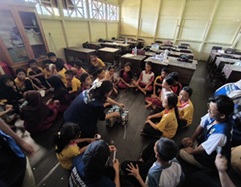
Plastic waste management has become a significant environmental challenge, particularly in urban areas. SD Negeri 2 Tumbang Talaken in Central Kalimantan faces issues with plastic waste management, with most waste being disposed of carelessly. One solution implemented is the Ecobrick method, which utilizes used plastic bottles to process plastic waste into valuable products such as furniture or building materials. This Ecobrick training program aims to raise students' awareness of the importance of waste management and teach them skills in recycling plastic waste into valuable items. The method involves educating students about the importance of waste management and hands-on practice in making Ecobricks by compacting plastic waste into used bottles. The training results showed an increase in students' understanding of waste management and creativity in producing Ecobricks, which can be used for school decorations or furniture. This program also supports character development in line with the Merdeka Curriculum, while contributing to the creation of an environmentally friendly school. The success of this program opens opportunities to involve more schools in efforts to reduce plastic waste and promote sustainable environmental management.
Downloads
Article Details

This work is licensed under a Creative Commons Attribution-ShareAlike 4.0 International License.
Authors who publish with this journal agree to the following terms:
- Any article on the copyright is retained by the author(s).
- Author grant the journal, right of first publication with the work simultaneously licensed under a Creative Commons Attribution License that allows others to share work with acknowledgment of the work authors and initial publications in this journal.
- Authors are able to enter into a separate, additional contractual arrangements for non-exclusive distribution of published articles of work (eg, post-institutional repository) or publish it in a book, with acknowledgment of its initial publication in this journal.
- Authors are permitted and encouraged to post their work online (e.g., in institutional repositories or on their websites) prior to and during the submission process, as can lead to productive exchanges, as well as earlier and greater citation of published work.
- The article and any associated published material is distributed under the Creative Commons Attribution-ShareAlike 4.0 International License
References
Aromi, Z., Putri, O. A., & Rahayu, R. (2024). Pengelolaan Sampah Plastik di Kota-kota Indonesia. Jurnal Ekologi, Masyarakat Dan Sains, 5(2), 251–255. https://doi.org/10.55448/5f7d0846
Badan Pusat Statistik Indonesia. (2024). Statistik Lingkungan Hidup Indonesia 2024. Badan Pusat Statistik. https://www.bps.go.id/id/publication/2024/11/29/f24c83748852c605dd2c73cb/statistik-lingkungan-hidup-indonesia-2024.html
Rahayu, E. D. P., Harris, A., & Cerminand, N. I. (2024). Pemanfaatan Sampah Plastik Dalam Pembuatan Ecobrick Pada Kegiatan Pengabdian Masyarakat di SDN 46 Cakra Negara, Kota Mataram. Bhakti: Jurnal Pengabdian Masyarakat, 1(1), 23–31. https://doi.org/10.71024/bhakti.2024.v1i1.7
Fatonah, N. F., Nurhidayat, Y., & Salwa, U. (2025). Pemanfaatan Ecobrick sebagai Bahan Bangunan Alternatif dalam Program Pengabdian Masyarakat di Desa Kadumekar. ADINDAMAS (Jurnal Pengabdian Kepada Masyarakat) 5, 53–79. https://doi.org/10.37726/adindamas.v5i1.1435
Fitrasih, R., Izza, R. L., Ardy, R., Putra, M., & Ngatijo, Y. (2024). Jurnal Bina Desa Pemberdayaan Masyarakat dalam Pemanfaatan Limbah Sampah Anorganik sebagai Bahan Dasar Pembuatan Ecobrick di Desa Blimbing Kecamatan Karangnongko Pendahuluan. 6(2), 238–243. https://pekat.sinergis.org/pekat/article/view/81
Gagaramusu, Y., Azizah, Arianto, Kaharu, S. N., Zulnuraini, Rahayu, A. P., Aditya, A. D., & Sitepu, M. S. (2024). Sustainable Lifestyle Education: An Ecobrick Module for Enhancing Students’ Creativity in Pancasila Student Profile Projects. International Journal of Elementary Education, 8(3), 547–562. https://doi.org/10.23887/ijee.v8i3.82860
Hapsari, F., & Wahyuni, S. (2020). Pembuatan Ecobrick sebagai Upaya Menumbuhkan Sekolah Ramah Lingkungan di SMP PGRI 30 Jakarta dalam Rangka Mendukung Program Sekolah Adiwiyata. Literatus, 2(2), 156–161. https://doi.org/10.37010/lit.v2i2.90
Iju, M. V., Dinatha, N. M., & Kua, M. Y. (2024). Pemanfaatan Sampah Plastik dalam Pembuatan Ecobrick untuk Meningkatkan Kreativitas Siswa SMP St. Agustinus Langa. GLOBAL ABDIMAS: Jurnal Pengabdian Masyarakat, 4(2), 115–125. https://journal.intelekmadani.org/index.php/globalabdimas/article/view/595
Ikhsan, M., & Tonra, W. S. (2021). Pengenalan Ecobrick di Sekolah Sebagai Upaya Penanggulangan Masalah Sampah. PATIKALA: Jurnal Pengabdian Kepada Masyarakat, 1(1), 32–38. https://doi.org/10.51574/patikala.v1i1.95
Kaulan, M. K. K., Aghniarrahmah, C., & Maulita, R. (2024). Peningkatan Kesadaran Dan Kreativitas Pengelolaan Sampah Plastik Bagi Siswa Sekolah Dasar Dengan Metode Ecobrick. PENDIS (Jurnal Pendidikan Ilmu Sosial), 3(3), 1–13. https://doi.org/10.61721/pendis.v3i3.398
Majida, A. Z., Muzaki, A., Karomah, K., & Awaliyah, M. (2023). Pemanfaatan Sampah Plastik dengan Metode Ecobrick Sebagai Upaya Mengurangi Limbah Plastik. Profetik: Jurnal Pengabdian Masyarakat, 1(01), 49–62. https://doi.org/10.62490/profetik.v1i01.340
Nursanti Fia, Fitriyani, Indriani, P. (2024). Pemanfaatan Ecobrick Sebagai Inovasi Pembelajaran Berbasis Lingkungan Di Sekolah SMPN 6 Samarinda Dengan Program Kerja Adiwiyata. Jurnal Inovasi Refleksi Profesi Guru, 1(1 No. 2 (2024)), 71–76. https://jurnal.sainsglobal.com/index.php/gpp/article/view/664
Sandy Putra Leria, Patria, D. (2020). Pengolahan Sampah Plastik Melalui Kreativitas Produk Ecobrik. 05(01), 11–15. https://doi.org/10.55732/3wv11c97
Suhendri, E. (2022). Ecobrick-Based School Waste Management Efforts (Plastic Brick) in Improving Literary Culture. Jurnal EduHealth, 12(02), 54–62. http://ejournal.seaninstitute.or.id/index.php/healt/article/view/154
Suidarma, I. M., & Antini, N. L. A. S. (2023). Penerapan Ecobrick Sebagai Solusi dalam Mengurangi Jumlah Sampah Plastik di Desa Pemogan. JPPM (Jurnal Pengabdian Dan Pemberdayaan Masyarakat), 7(1), 157. https://doi.org/10.30595/jppm.v7i1.9918
Suminto, S. (2017). Ecobrick: solusi cerdas dan kreatif untuk mengatasi sampah plastik. PRODUCTUM Jurnal Desain Produk (Pengetahuan Dan Perancangan Produk), 3(1), 26. https://doi.org/10.24821/productum.v3i1.1735
Wanti, A. A., Ma, S., Naufal, M., & Farochi, A. (2025). Pembuatan Meja Ramah Lingkungan Di Universitas Sunan. 3(2), 694–708. https://doi.org/10.32806/pps.v3i2.723
Yani, N. L. S., Zakaria, M. S., Sulistia, N., Aprillaili, R. V., Anggraini, R. T., Amalinda, R., Hartono, S. B., Noviandari, T., & Anas, Z. N. (2024). Ecobrick Goes To School: Pelatihan Mengolah Sampah Plastik Berbasis Sekolah Adiwiyata Di Smp Negeri 25 Malang. Jurnal Abdimas Bina Bangsa, 5(1), 717–723. https://doi.org/10.46306/jabb.v5i1.1063
Zulfa, A., Indasari, N. L., & Ummah, F. (2025). Ecobrick as a Sustainable Lifestyle Implementation in Shaping Students’ Creativity and Environmental Care. EDUCARE: Journal of Primary Education, 6(1), 1–14. https://doi.org/10.35719/educare.v6i1.301