Edukasi Green Chemistry: Daur Ulang Minyak Jelantah menjadi Sabun sebagai Upaya Pengurangan Limbah Rumah Tangga Green Chemistry Education: Recycling Used Cooking Oil into Soap as an Effort to Reduce Household Waste
Article Sidebar
Main Article Content
Abstract
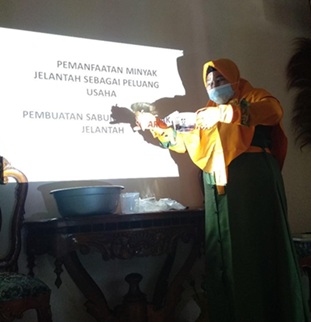
The increasing household consumption of cooking oil has led to a rise in used cooking oil waste, which, if reused, can endanger health and, if disposed of carelessly, causes environmental pollution. This condition prompted the implementation of a community service program, which involved training women's religious study groups in Bumi Sejahtera Housing, Pekanbaru City, on how to use cooking oil in soap. This activity aimed to enhance community knowledge about the dangers of using used cooking oil, raise environmental awareness, and provide practical skills in processing used cooking oil into soap products that have both functional and economic value. The program was conducted in several stages, including a preliminary survey, material preparation, socialization, soap-making demonstrations, hands-on practice with participants, and post-training evaluation. The results showed high enthusiasm from participants, as reflected in their active involvement during discussions and practical sessions. Participants could produce soap from used cooking oil with good foaming quality and fragrance, making it suitable for household use. In addition, some participants expressed interest in continuing independent soap production by collecting used cooking oil from the surrounding community, thereby opening up opportunities for program sustainability and increasing the economic value of household waste. This program successfully improved community understanding of the impacts of used cooking oil, reduced potential environmental pollution, and provided skills that can be further developed into small-scale businesses.
Downloads
Article Details

This work is licensed under a Creative Commons Attribution-ShareAlike 4.0 International License.
Authors who publish with this journal agree to the following terms:
- Any article on the copyright is retained by the author(s).
- Author grant the journal, right of first publication with the work simultaneously licensed under a Creative Commons Attribution License that allows others to share work with acknowledgment of the work authors and initial publications in this journal.
- Authors are able to enter into a separate, additional contractual arrangements for non-exclusive distribution of published articles of work (eg, post-institutional repository) or publish it in a book, with acknowledgment of its initial publication in this journal.
- Authors are permitted and encouraged to post their work online (e.g., in institutional repositories or on their websites) prior to and during the submission process, as can lead to productive exchanges, as well as earlier and greater citation of published work.
- The article and any associated published material is distributed under the Creative Commons Attribution-ShareAlike 4.0 International License
References
Abriana, A., Mahendradatta, M., Djide, N., & Zainal. (2013). Analysis of Trans Fatty Acid Content and Viscosity of the Repeteadly Used Frying Oil. International Journal of Agriculture System, 1(1), 71–79. http://pasca.unhas.ac.id/ijas/pdf/7) IJAS Vol. 1 Issue 1 June 2013.pdf
Ansori, P. B. (2024). Pelatihan Pembuatan Sabun Cuci Piring Pada ibu-ibu Arisan RT 08 RW 11 Kelurahan Sidomulyo Barat Pekanbaru Putra. Jurnal Pengabdian Masyarakat Sasambo, 1(4), 54–59. https://doi.org/10.54099/jpma.v3i1.816
CARVALHO, A. P. H. DE. (2013). Qualidade Física, Química E Antimicrobiana De De Fritura E Diferentes Agentes Saponificantes Qualidade Física, Química E Antimicrobiana De. 0–181. https://repositorio.bc.ufg.br/tede/items/2ea6c4ab-ae47-4adf-a613-5606a27ba540
Handayani, K., Kanedi, M., Farisi, S., & Setiawan, W. A. (2021). Pembuatan Sabun Cuci Dari Minyak Jelantah Sebagai Upaya Mengurangi Limbah Rumah Tangga. Jurnal Pengabdian Kepada Masyarakat (JPKM) TABIKPUN, 2(1), 55–62. https://doi.org/10.23960/jpkmt.v2i1.25
Haryono, Fairus, S., Sari, Y., & Rakhmawati, I. (2010). Pengolahan Minyak Goreng Kelapa Sawit Bekas menjadi Biodiesel Studi Kasus : Minyak Goreng Bekas dari KFC Dago Bandung. Prosiding Seminar Nasional Teknik Kimia Kejuangan Pengembangan Teknologi Kimia Untuk Pengolahan Sumber Daya Alam Indonesia ISSN 1693 – 4393, m, A03-1 to A03-5. https://core.ac.uk/reader/229046033
Jaarin, K., & Kamisah, Y. (2012). Repeatedly Heated Vegetable Oils and Lipid Peroxidation. Lipid Peroxidation. https://doi.org/10.5772/46076
Lukitasari, M., Khoirotil U, S. Z., & Sukri, A. (2022). Pengolahan Limbah Minyak Jelantah Menjadi Sabun Cuci Piring Di Kelurahan Kanigoro Kota Madiun. Sasambo: Jurnal Abdimas (Journal of Community Service), 4(1), 99–109. https://doi.org/10.36312/sasambo.v4i1.645
Pauhesti, P., Yanti, W., Wijayanti, P., Koesmawardani, W. T., & Jane, G. (2022). Pemanfaatan Minyak Jelantah Untuk Pembuatan Sabun Batang Bagi Anggota Karang Taruna Duri Pulo, Kecamatan Gambir, Jakarta Pusat. Abdimas Universal, 4(2), 281–286. https://doi.org/10.36277/abdimasuniversal.v4i2.228
Rustiana, T., & Rahayu, D. (2021). Variasi Waktu Kontak Arang Aktif Untuk Menurunkan Bilangan Peroksida Pada Minyak Goreng Bekas Pakai. Medical Technology and Public Health Journal, 5(1), 104–110. https://doi.org/10.33086/mtphj.v5i1.1470
Sriyana, H. Y., Oktaviananda, C., Muryanto, S., & Rosaria, T. D. (2023). Pemberdayaan Ekonomi Ibu-Ibu PKK RT 01 RW 11 Kelurahan Meteseh Kecamatan Tembalang Kota Semarang Melalui Pelatihan Pembuatan Sabun Cuci Piring. Jurnal Karya Untuk Masyarakat (JKuM), 4(2), 103–113. https://doi.org/10.36914/jkum.v4i2.943
Sufi, C. A., Erlita, D., & Maria, E. (2023). Inovasi Pemanfaatan Minyak Jelantah menjadi Sabun Cair Antibakteri. Blend Sains Jurnal Teknik, 2(1), 65–71. https://doi.org/10.56211/blendsains.v2i1.299