Pengembangan Teknologi Tepat Guna Pengolahan Sampah untuk Mendukung Desa Mandiri Budaya Berkelanjutan di Panggungharjo Development of Waste Processing Technology to Support a Sustainable Independent Cultural Village in Panggungharjo
Article Sidebar
Main Article Content
Abstract
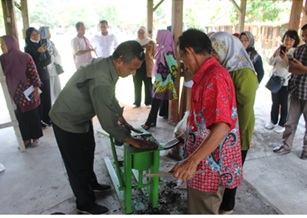
Panggungharjo Village, located in Sewon Subdistrict, Bantul Regency, Special Region of Yogyakarta, holds a strategic position due to its cultural significance within Yogyakarta's special status. The village leverages this position to develop Kawasan Karangkitri as an integrated hub for artistic, tourism, economic, and environmental activities. Aligned with its status as an Independent Cultural Village (Desa Mandiri Budaya), the initiative aims to create a sustainable rural environment, enhance community welfare, and contribute to achieving the Sustainable Development Goals (SDGs). This community service program focuses on organic waste management through appropriate technology and community empowerment. A key innovation is the development of a compost block-making machine, which not only enhances waste processing efficiency but also adds economic value to the final compost product. Collaboration among the village government, community members, and academics from Universitas Muhammadiyah Surakarta and Universitas Islam Indonesia has been instrumental in providing skills training and intensive support for organic waste management. The program's outcomes include increased community capacity in environmental management, the emergence of new economic opportunities through compost-based enterprises, and the preservation of social and cultural characteristics. By introducing innovative waste management practices and emphasizing local wisdom, this initiative supports the village's transition into a sustainable tourism destination. With synergy between technology and the community, Panggungharjo Village aspires to be a competitive model of rural development that balances local traditions and innovation, contributing to environmental regeneration and resilience.
Downloads
Article Details

This work is licensed under a Creative Commons Attribution-ShareAlike 4.0 International License.
Authors who publish with this journal agree to the following terms:
- Any article on the copyright is retained by the author(s).
- Author grant the journal, right of first publication with the work simultaneously licensed under a Creative Commons Attribution License that allows others to share work with acknowledgment of the work authors and initial publications in this journal.
- Authors are able to enter into a separate, additional contractual arrangements for non-exclusive distribution of published articles of work (eg, post-institutional repository) or publish it in a book, with acknowledgment of its initial publication in this journal.
- Authors are permitted and encouraged to post their work online (e.g., in institutional repositories or on their websites) prior to and during the submission process, as can lead to productive exchanges, as well as earlier and greater citation of published work.
- The article and any associated published material is distributed under the Creative Commons Attribution-ShareAlike 4.0 International License
References
Dinas-Kebudayaan-DIY. (2022). Masterplan Rintisan Desa Mandiri Budaya Panggungharjo.
Fatoni, M. (2023, August 13). Sistem kelola sampah TPS3R KUPAS di Desa Panggungharjo Bantul, solusi atasi persoalan sampah. TribunJogja.com. https://jogja.tribunnews.com/2023/08/13/sistem-kelola-sampah-tps3r-kupas-di-desa-panggungharjo-bantul-solusi-atasi-persoalan-sampah
Firdaus, H., Rukmorini, R., & Daeng, M. F. (2024, June 7). Darurat sampah di Yogyakarta, kenapa TPA Piyungan sempat dibuka kembali? Kompas. https://www.kompas.id/baca/nusantara/2024/06/07/darurat-sampah-di-yogyakarta-kenapa-tpa-piyungan-sempat-dibuka-kembali
Hafida, S. H. N., Dewi, R. P., Kesumaningtyas, M. A., Nastiti, B. A., Puspitasari, W., Masruroh, L., Meliani, Satria, A. B., Ali, F. A., & Bima, D. S. (2019). Analisis keberlanjutan desa wisata (studi kasus Desa Wisata Sepakung, Kecamatan Banyubiru, Kabupaten Semarang). Jurnal Ilmiah Pariwisata, 24(3), 170–176. https://doi.org/10.30647/jip.v24i3.1313
Indrawati, I., Nurhasan, N., Hidayati, R., Nugrahaini, F. T., Haryanti, D., & Musthofa, Z. (2023). Pengembangan Desa Wisata Bumi Arum Majasto berbasis histori, lingkungan, dan ekonomi. Warta LPM, 26(3), 319–328. https://doi.org/10.23917/warta.v26i3.1454
Junaedi. (2023). Pengelolaan sampah mandiri berbasis kawasan. Kalurahan Panggungharjo. https://www.panggungharjo.desa.id/pengelolaan-sampah-mandiri-berbasis-kawasan/
Kastenholz, E., Salgado, M., & Silva, R. (2023). Resilient and regenerative rural tourism: the case of Travancinha Village, Portugal. Cadernos de Geografia, 48, 81–97. https://www.researchgate.net/publication/377259984_Resilient_and_regenerative_Rural_Tourism_the_case_of_Travancinha_Village_Portugal
Kusumawati, Y., Werdany, K. E., Darnoto, S., Zulaekah, S., Sutrisna, E., Wardiono, K., Maimun, M. H., Anis, M., Yuniar, S., Nurfauzia, E. N., Widananda, C., Rahmi, A. N., & Nurhaliza, A. A. R. F. (2023). Pendampingan kader kesehatan dalam pengelolaan tabungan sampah anorganik dan pelatihan pembuatan pupuk kompos di Kabupaten Sukoharjo. Warta LPM, 26(4), 492–500. https://doi.org/10.23917/warta.v26i4.2563
Rinepta, A. G. (2024, May). Desentralisasi sampah mulai Mei, begini persiapan Pemkot Jogja. DetikJogja. https://www.detik.com/jogja/berita/d-7220881/desentralisasi-sampah-mulai-mei-begini-persiapan-pemkot-jogja
Rizaty, M. A. (2021). Mayoritas sampah nasional dari aktivitas rumah tangga pada 2020. Databoks. https://databoks.katadata.co.id/layanan-konsumen-kesehatan/statistik/7ea3525df6cc3a9/mayoritas-sampah-nasional-dari-aktivitas-rumah-tangga-pada-2020
SIPSN. (2024). Capaian kinerja pengelolaan sampah tahun 2023. https://sipsn.menlhk.go.id/sipsn/
Wayan Anik Leana, N., Oktaviani, E., Sulistyanto, P., Ulinnuha, Z., Agroteknologi, J., Pertanian, F., Jenderal Soedirman Korespondensi, U., & Leana, N. (2022). Optimalisasi pengolahan sampah rumah tangga menjadi pupuk organik dan budidaya sayuran di PP Al-Jamil, Purwokerto. Panrita Abdi: Jurnal Pengabdian Kepada Masyarakat, 6(1), 8–17.
Widiyaningrum, P., Setiati, N., Rini Indriyanti, D., & Diterima, N. (2024). Pemberdayaan Karang Taruna dalam pengelolaan sampah organik berorientasi profit. Panrita Abdi: Jurnal Pengabdian Kepada Masyarakat, 8(1), 47–55. http://journal.unhas.ac.id/index.php/panritaabdi