Penguatan Literasi Digital dan Model Pembelajaran Jarak Jauh Inovatif untuk Meningkatkan Ketangguhan Masyarakat di Era Digital Strengthening Digital Literacy and Innovative Distance Learning Models to Increase Community Resilience in the Digital Era
Article Sidebar
Main Article Content
Abstract
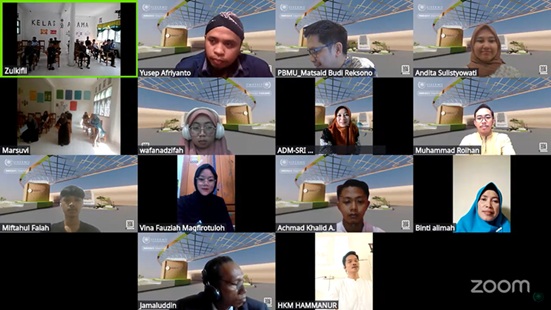
The article aims to describe the urgency, implementation, and impact of collaborative efforts in creating an innovative education ecosystem and a resilient society in the digital era. The digital era presents both opportunities and challenges for education and community resilience. Higher education institutions are required to develop innovative, inclusive, and sustainable distance learning (DL) models, while society, especially youth, faces a serious threat from the rise of online gambling. In response, Universitas Siber Muhammadiyah implemented a community service program at Pondok Pesantren Nur Ma'arif Sepang, Polewali Mandar, West Sulawesi, employing a participatory and collaborative approach. The program was implemented from February to June 2025, with its peak in a webinar held on May 25, 2025. The method included a needs assessment, the design of modules on digital literacy, legal awareness, mental health, and Islamic financial literacy, followed by workshops, training sessions, and mentoring sessions. The results showed a significant improvement in participants' knowledge, with average pretest scores of 68.20 increasing to 83.75 in the posttest. The most notable improvements were in legal understanding and Islamic financial literacy. Supporting factors included high participant enthusiasm, accessible learning materials, and the involvement of young tech-savvy teachers, while major obstacles were limited internet access and insufficient hardware. This program concludes that integrating innovative distance learning and digital literacy based on Islamic values can enhance youth resilience against digital disruption and strengthen pesantren's role as an agent of social change.
Downloads
Article Details

This work is licensed under a Creative Commons Attribution-ShareAlike 4.0 International License.
Authors who publish with this journal agree to the following terms:
- Any article on the copyright is retained by the author(s).
- Author grant the journal, right of first publication with the work simultaneously licensed under a Creative Commons Attribution License that allows others to share work with acknowledgment of the work authors and initial publications in this journal.
- Authors are able to enter into a separate, additional contractual arrangements for non-exclusive distribution of published articles of work (eg, post-institutional repository) or publish it in a book, with acknowledgment of its initial publication in this journal.
- Authors are permitted and encouraged to post their work online (e.g., in institutional repositories or on their websites) prior to and during the submission process, as can lead to productive exchanges, as well as earlier and greater citation of published work.
- The article and any associated published material is distributed under the Creative Commons Attribution-ShareAlike 4.0 International License
References
OECD. (2024). Governing with artificial intelligence: Are governments ready? https://www.oecd.org/en/publications/governing-with-artificial-intelligence_795de142-en.html
Putri, A., et al. (2024). Dampak sosial judi online pada remaja di Indonesia. Jurnal Sosial dan Teknologi, 6(1), 45–57. https://journal.budiluhur.ac.id/index.php/deviance/article/view/2759
Otoritas Jasa Keuangan. (2020). Laporan tahunan Otoritas Jasa Keuangan 2020. https://ojk.go.id/id/data-dan-statistik/laporan-tahunan/Pages/Laporan-Tahunan-OJK-2020.aspx
Adolph, R. (2016). Pendidikan di era digital: Tantangan bagi Generasi Z. https://repository.unugiri.ac.id:8443/7100/1/FullBook%20Pendidikan%20di%20Era%20Digital-%20Tantangan%20bagi%20Generasi.pdf
UNESCO. (2020). Education in a post-COVID world: Nine ideas for public action. International Commission on the Futures of Education.
Mutiaraningrum, I., & Nugroho, A. (2021). Online learning in higher education during COVID-19 pandemic: Students’ perception and challenges. Jurnal Pendidikan Teknologi, 20(2), 129–140. https://www.unesco.org/en/articles/education-post-covid-world-nine-ideas-public-action
Najib, M. A., & Maunah, B. (2022). Inovasi pendidikan di era digital, 10. https://doi.org/10.30603/tjmpi.v10i1.2462
PPATK. (2024). Laporan tahunan Pusat Pelaporan dan Analisis Transaksi Keuangan 2024. https://www.ppatk.go.id/publikasi/read/256/laporan-tahunan-ppatk-tahun-2024.html
Imaduddin, M. F., Rubai, D., & Alam, M. (2025). Kebiasaan abnormal di era digital: Studi kualitatif pada kasus judi online dan kecanduan gadget anak. Edukatif, 7(4), 981–989. https://doi.org/10.31004/edukatif.v7i4.8438
American Psychiatric Association. (2013). Diagnostic and statistical manual of mental disorders (5th ed.). https://doi.org/10.1176/appi.books.9780890425596
Griffiths, M. D. (2012). Internet gambling, player protection, and social responsibility. In Routledge international handbook of Internet gambling (pp. 227–248). Routledge. https://www.taylorfrancis.com/chapters/edit/10.4324/9780203814574-17/internet-gambling-player-protection-social-responsibility-mark-griffiths
Calado, F., & Griffiths, M. D. (2016). Problem gambling worldwide: An update and systematic review of empirical research (2000–2015). Journal of Behavioral Addictions, 5, 592–613. https://pmc.ncbi.nlm.nih.gov/articles/PMC5370365/
Safirah, Y., Muslihun, & Wijaya, P. A. (2024). Pengaruh digitalisasi, literasi keuangan, dan gaya hidup terhadap perilaku menabung Generasi Z di Kota Mataram. Jurnal Hukum Ekonomi Syariah, 8, 58–61. https://doi.org/10.26618/j-hes.v8i1.14473
Sugiyono. (2016). Metode penelitian kuantitatif, kualitatif, dan R&D. Alfabeta.
Ife, J. (2013). Community development in an uncertain world. Cambridge University Press.
Graham, C. R. (2013). Emerging practice and research in blended learning. In M. G. Moore (Ed.), Handbook of distance education (pp. 333–350). Routledge.
Livingstone, S., & Helsper, E. (2007). Gradations in digital inclusion: Children, young people and the digital divide. New Media & Society, 9, 671–696. https://doi.org/10.1177/1461444807080335
Creswell, J. W., & Creswell, J. D. (2017). Research design: Qualitative, quantitative, and mixed methods approaches. Sage Publications. https://books.google.co.id/books?id=4uB76IC_pOQC