Strategi Inovatif Pendampingan Guru PKBM melalui Integrasi Budaya Lokal dan Media Digital Interaktif Innovative Strategies for PKBM Teachers: Integrating Local Culture and Interactive Digital Media
Article Sidebar
Main Article Content
Abstract
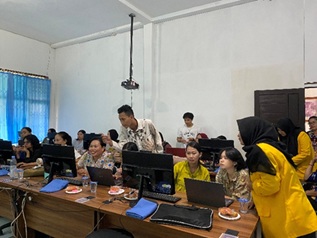
The advancement of educational technology has opened new opportunities to strengthen the implementation of Project-Based Learning (PjBL). Three training sessions were conducted as part of the mentoring program. The first training aimed to equip PKBM teachers with proficiency in SketchUp. The second training focused on developing teachers' skills in utilizing Evobook. The third training was designed to equip teachers with the ability to create miniature models of Huma Betang. Based on participants' post-training questionnaires, the average improvement in understanding of SketchUp and Evobook was 4.56. The highest score in this aspect was achieved by PKBM Homy School (4.80), while the lowest was Candra Kirana (4.44). The ease of use of both media was rated at 4.13, with Homy School (4.30) receiving the highest score and Bangkirai (4.00) the lowest. In terms of usefulness for learning, the average rating was 4.56, with Homy School (4.90) scoring the highest and Candra Kirana (4.13) the lowest. The relevance of SketchUp and Evobook to participants' needs received an average score of 4.36, with Homy School (4.70) at the highest and Candra Kirana (4.06) at the lowest. Meanwhile, participants' interest in applying these tools in their classrooms averaged 4.49, with Homy School (4.70) the highest and Candra Kirana (4.31) the lowest.
Downloads
Article Details

This work is licensed under a Creative Commons Attribution-ShareAlike 4.0 International License.
Authors who publish with this journal agree to the following terms:
- Any article on the copyright is retained by the author(s).
- Author grant the journal, right of first publication with the work simultaneously licensed under a Creative Commons Attribution License that allows others to share work with acknowledgment of the work authors and initial publications in this journal.
- Authors are able to enter into a separate, additional contractual arrangements for non-exclusive distribution of published articles of work (eg, post-institutional repository) or publish it in a book, with acknowledgment of its initial publication in this journal.
- Authors are permitted and encouraged to post their work online (e.g., in institutional repositories or on their websites) prior to and during the submission process, as can lead to productive exchanges, as well as earlier and greater citation of published work.
- The article and any associated published material is distributed under the Creative Commons Attribution-ShareAlike 4.0 International License
References
Abdullah, A. H., Wahab, R. A., Mokhtar, M., Atan, N. A., Halim, N. D. A., Surif, J., Zaid, N. M., Ashari, Z. M., Ibrahim, N. H., Kohar, U. H. A., Hamzah, M. H., & Rahman, S. N. S. A. (2022). DOES Sketchup Make Improve Students Visual-Spatial Skills? IEEE Access, 10, 13936–13953. https://doi.org/10.1109/ACCESS.2022.3147476
Arent, E., Thesalonika, E., Azis, F., Shofiyah, S., Jakob, J. C., Amzana, N., ... & Marlena, R. (2023). Perencanaan Pendidikan. Penerbit Tahta Media. https://tahtamedia.co.id/index.php/issj/article/view/227
Fani, T., & Ghaemi, F. (2011). Implications of Vygotsky’s zone of proximal development (ZPD) in teacher education: ZPTD and self-scaffolding. Procedia - Social and Behavioral Sciences, 29, 1549–1554. https://doi.org/10.1016/j.sbspro.2011.11.396
Hadi, L., & Suhendra. (2025). Problem-Solving On Numeracy Literacy Problems Based On Polya’s Theory In Terms Of Habits Of Mind. Mathline : Jurnal Matematika Dan Pendidikan Matematika, 10(1), 255–270. https://doi.org/10.31943/mathline.v10i1.843
Houston, K., & Lazenbatt, A. (1996). A peer-tutoring scheme to support independent learning and group project work in mathematics. Assessment and Evaluation in Higher Education, 21(3), 251–266. https://doi.org/10.1080/0260293960210305
Kiftiah Kecana, A., & Gofur, A. (2023). The Philosophy Of Huma Betang As A Medium For Reactualizing The ValueOf Religious Moderation In Central Kalimantan. https://doi.org/10.18326/aicoies.v2i1.545
Loi, A., Kwirinus, D., & Peri, H. (2023). THE CONCEPT OF “HUMA BETANG” AS A MODEL OF THE VALUES OF THE PHILOSOPHY OF LIFE OF THE DAYAK COMMUNITY IN CENTRAL KALIMANTAN. Jurnal Pendidikan Sosiologi Dan Humaniora, 14(2), 219. https://doi.org/10.26418/j-psh.v14i2.64914
Mairing, J. P., Sugiharto, W., Trissan, M. R., Oktaviana, A., & Ratnawati, P. (2024). Ethnomathematics Of Betang Damang Batu: Exploration of Traditional Dayak Ngaju Housing In Tumbang Anoi, Central Kalimantan, In Geometry Materials. In Journal of Borneo-Kalimantan, 10(2). https://doi.org/10.33736/jbk.8034.2024
Nurwijayanti, A., & Fitriana, L. (2019). Combining Google Sketchup And Ispring Suite 8: A Breakthrough to Develop Geometry Learning Media. Journal on Mathematics Education, 10(1), 103–116. https://doi.org/10.22342/jme.10.1.5380.103-116
Perdana, I., Theasy, Y., Veniaty, S., Winata, R., & Rizaldi, M. (2024). Guru Inovatif dan Kreatif Berbasis Kearifan Lokal Menggunakan Aplikasi. Jurnal Pengabdian Kampus. 11(2), 128–133. https://doi.org/10.52850/jpmupr.v11i2.15585
Ratnawati, O. A., Mairing, J. P., Pancarita, Rizaldi, M., & Ngadi. (2025). Pendampingan Belajar Anak yang Berkonflik dengan Hukum Berbasis Mathematics Adventure in Dayak Kalimantan Tengah. PengabdianMu: Jurnal Ilmiah Pengabdian Kepada Masyarakat, 10(3). https://doi.org/10.33084/pengabdianmu.v10i3.8250
Rico, R., Hayat, M. A., Khuzaini, K., Sanusi, S., & Susanto, D. (2022). Huma Betang’s philosophical values in the character of Dayak cultural communication. JPPI (Jurnal Penelitian Pendidikan Indonesia), 8(3), 640. https://doi.org/10.29210/020221510
Diana, E., Rullyanti, M., Sembiring, L., Maisya, A., & Habibie, A. R. (2022). Pengenalan Literasi Digital untuk Peserta PKBM Ilmu Bunda Kota Bengkulu. Jurnal Kewirausahaan & Bisnis, 4(1), 11–14. https://jurnalunived.com/index.php/JKB/article/view/143
Govender, I. (2025). Digital Literacy and STEM Skills– What is the Connection? A Systematic Review. Technology, Knowledge and Learning. https://doi.org/10.1007/s10758-025-09879-x
Lukman, A. I. (2021). Pemberdayaan masyarakat melalui pendidikan nonformal di PKBM Tiara Dezzy Samarinda. DIKLUS: Jurnal Pendidikan Luar Sekolah, 5(2), 180–190. https://doi.org/10.21831/diklus.v5i2.43669
Morales, M. P. E. (2016). Participatory action research (PAR) cum action research (AR) in teacher professional development: a literature review. International Journal of Research in Education and Science, 2(1), 156–165. https://doi.org/10.21890/ijres.01395
Pijayanti, E., Rosmilawati, I., & Ganiadi, M. (2023). Perubahan Pola Pikir dan Perilaku Warga Belajar Paket C sebagai Hasil Pembelajaran Transformatif di PKBM Cipta Cendekia Kota Tangerang. Prosiding Seminar Nasional Pendidikan Non Formal, 1. https://eprints.untirta.ac.id/26911/
Rita, Y., Muliana, I. L., & Handrianto, C. (2021). Taksonomi bloom dalam materi sistem persamaan linear pada program paket c di pkbm hang tuah pekanbaru. JURING (Journal for Research in Mathematics Learning), 4(1), 69–80. http://dx.doi.org/10.24014/juring.v4i1.12354
Rizaldi, M. (2020). Berpikir kreatif siswa SMP kelas IX saat melakukan kegiatan problem posing pada materi bangun datar. Universitas Negeri Malang. https://repository.um.ac.id/id/eprint/254808
Rizaldi, M., Hidayanto, E., & Rahardi, R. (2021). Berpikir Kritis Siswa Melalui Aktivitas Problem Posing dengan Konteks Masalah yang Tidak Masuk Akal. Jurnal Pendidikan: Teori, Penelitian, Dan Pengembangan, 6(2), 191–198. https://doi.org/10.17977/jptpp.v6i2.14444
Rizaldi, M., Ratnawati, O. A., & Sasalia, P. (2025). Pengaruh Number Sense dan Working Memory terhadap Berpikir Kreatif Calon Guru Matematika Saat Problem Posing. 8, 42–50. https://doi.org/10.46918/equals.v8i1.2679
Rizaldi, M., Sasalia, P., & Pancarita. (2024). Efektivitas ChatGPT Untuk Mendorong Berpikir Kritis Mahasiswa Dalam Menyelesaikan Masalah Aljabar. EDU-MAT: Jurnal Pendidikan Matematika, 12, 168–181. https://doi.org/10.20527/edumat.v12i1.18668
Shomedran, S., Kamilah, F., & Pratiwi, I. A. (2023). Peningkatan Kemampuan Life Skill Warga Belajar Paket C Melalui Program Keterampilan (Studi Kasus di PKBM Kusuma Bangsa Kabupaten Pali). Lifelong Education Journal, 3(1), 24–30. http://dx.doi.org/10.20527/edumat.v12i1.18668
Sholihat, M. N., & Dwiyanti, W. (2024). Students Interest in Learning Mathematics through Aquascape Project-Based Learning at Vocational High School. Mathline : Jurnal Matematika Dan Pendidikan Matematika, 9(4). https://doi.org/10.31943/mathline.v9i4.585
Sion, H., & Affandi, ; Muhamad. (2024). The Multicultural Values of the Huma Betang Philosophy as a Foundation for Character Building in Elementary School Students. https://jurnalfaktarbiyah.iainkediri.ac.id/index.php/proceedings/article/view/2729
Wurdianto, K., Norsandi, D., & Fitriana, E. (2022). Etnopedagogi Batang Garing Suku Dayak Ngaju Sebagai Nilai Pendidikan Karakter Peduli Lingkungan, 4(3). https://doi.org/10.37680/scaffolding.v4i3.1936