Peningkatan Manajemen Bank Sampah dan Partisipasi Masyarakat melalui Penggunaan Aplikasi Bank Sampah Online pada Bank Sampah Bumi Inspirasi Kota Bandung Improving Waste Bank Management and Citizen Pariticipation through the Use of the Online Waste Bank Application at Bank Sampah Bumi Inspirasi Bandung City
Article Sidebar
Main Article Content
Abstract
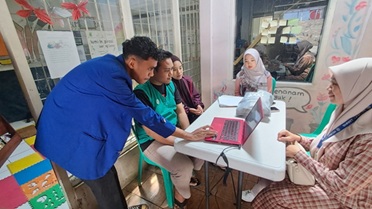
The main problems faced by community-based waste banks are the lack of a digitized transaction recording system and low community participation in waste management activities. This Community Service Activity (PKM) aims to implement an online waste bank application to improve the quality of waste bank management and encourage active community participation. The methods used in this activity include socializing about the circular economy and its application concepts, training in using the application, and assisting waste bank managers and customers in using it. The results of the activity show that the online waste bank application can simplify transaction recording, improve the transparency of financial reports, and strengthen management accountability. In addition, community participation has increased, as evidenced by the rise in the number of active customers and more frequent transactions. Thus, the implementation of the online waste bank application has proven effective in supporting orderly, transparent, and sustainable management while strengthening the application of circular economy principles at the community level.
Downloads
Article Details

This work is licensed under a Creative Commons Attribution-ShareAlike 4.0 International License.
Authors who publish with this journal agree to the following terms:
- Any article on the copyright is retained by the author(s).
- Author grant the journal, right of first publication with the work simultaneously licensed under a Creative Commons Attribution License that allows others to share work with acknowledgment of the work authors and initial publications in this journal.
- Authors are able to enter into a separate, additional contractual arrangements for non-exclusive distribution of published articles of work (eg, post-institutional repository) or publish it in a book, with acknowledgment of its initial publication in this journal.
- Authors are permitted and encouraged to post their work online (e.g., in institutional repositories or on their websites) prior to and during the submission process, as can lead to productive exchanges, as well as earlier and greater citation of published work.
- The article and any associated published material is distributed under the Creative Commons Attribution-ShareAlike 4.0 International License
References
Burhanuddin, Harjito, Pathiassana, M. T., & Pathiussina, R. T. (2021). Partisipasi masyarakat dalam keberlanjutan pengelolaan bank sampah di Desa Semamung. Jurnal Tambora, 5(2), 87–96. https://doi.org/10.36761/jt.v5i2.1130
Dinas Lingkungan Hidup. (2024). Jumlah Produksi Sampah Menurut Jenisnya di Kota Bandung.
Haryanti, S., Gravitiani, E., & Wijaya, M. (2020). Studi Penerapan Bank Sampah dalam Upaya Pengelolaan Lingkungan Hidup di Kota Yogyakarta. Jurnal Bioeksperimen, 6(1), 60–68. https://doi.org/10.23917/bioeksperimen.v5i1.2795
Hidayatullah, M. R., & Fadhliana, D. (n.d.). Creating Green Circular Economy in Waste Management: The Kampung Hijau Bank Sampah Al-Haqiqi Case. In International Journal Publishing INFLUENCE: International Journal of Science Review, 5. Retrieved from https://influence-journal.com/index.php/influence/index78
Iqbal Ab, Y., Wahyuardha Putra, F., & Jala Putra Mahardika, A. (2025). Smart Environment: Implementasi Aplikasi Bank Sampah untuk Mewujudkan Kota Kediri yang Bersih dan Berkelanjutan. Prosiding Seminar Nasional Teknologi Dan Sains, 4, 424–431. Kediri: Program Studi Teknik Informatika, Universitas Nusantara PGRI Kediri.
Kristiyanti, D. A., Permana, A. A., Saputri, F. R., Johan, M. E., Shabrina, N. H., Hartono, K. A., & Pranoto, R. A. (2024). Digital transformation in waste management: Enhancing financial transaction efficiency at a waste bank. Abdimas: Jurnal Pengabdian Masyarakat Universitas Merdeka Malang, 9(3), 459–471. https://doi.org/10.26905/abdimas.v9i3.12937
Menteri Lingkungan Hidup Dan Kehutanan Republik Indonesia. Peraturan Menteri Lingkungan Hidup dan Kehutanan Republik Indonesia Nomor 14 Tahun 2021 Tentang Pengelolaan Sampah Pada Bank Sampah. , (2021). Indonesia: https://peraturan.bpk.go.id/Details/233754/permen-lhk-no-14-tahun-2021.
Permatasari, I., & Lutfia, A. (2025). Analisis Faktor-Faktor Efektifitas Ekonomi Sirkular pada Program Bank Sampah Berdikari Joglo. Jurnal Riset dan Publikasi Ilmu Ekonomi, 3(4), 308–320. https://doi.org/10.61132/menawan.v3i4.1716
Sinaga, A. R. (2024). The Role of Waste Bank Digital in Circular Economy Value-Added Creation. Bina Bangsa International Journal of Business and Management (BBIJBM, 4(1), 81–88. https://doi.org/10.46306/bbijbm.v4i1.80
Sistra Mardius, Y., Rupiwardani, I., Saktiawan, Y., Widyagama, S., & Malang, H. (2024). Evaluasi Pengelolaan Sampah pada Bank Sampah Induk Kalpataru Kabupaten Lumajang dalam Mendukung Ekonomi Sirkular. Jurnal EnviScience, 8, 1–14. Retrieved from http://jurnalkesehatan.unisla.ac.id/index.php/jev/index