Intervensi Edukatif terhadap Cyberbullying, Kekerasan Berbasis Gender Online, dan Kesadaran Hukum UU ITE di Kalangan Remaja SMK Educational Intervention on Cyberbullying, Online Gender-Based Violence, and Legal Awareness of the ITE Law among Vocational High School Students
Article Sidebar
Main Article Content
Abstract
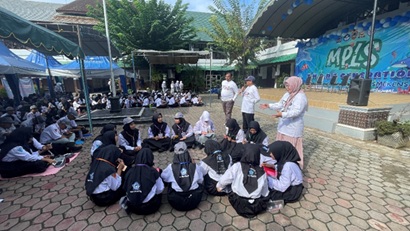
This community service program aims to enhance digital literacy among students of SMK Negeri 1 Banjarmasin, focusing on preventing cyberbullying and online gender-based violence (OGBV), and on improving legal awareness through Indonesia's Information and Electronic Transactions Law (UU ITE). The program was conducted through a series of activities, including pre-test, socialization, digital skills training, mentoring, and post-test evaluation. A total of 501 students participated, with the majority aged 15–16 years and predominantly female. The results revealed a significant increase in students' understanding of digital literacy concepts. Knowledge of OGBV increased from 65 percent in the pre-test to 89.0 percent in the post-test. Understanding of cyberbullying rose from 60 percent to 87.8 percent, while knowledge of UU ITE improved from 62 percent to 88.6 percent. Beyond theoretical knowledge, students also demonstrated practical skills in managing privacy settings, reporting harmful content, and producing positive digital content using social media platforms. This program confirms that an interactive, school-based, and contextual approach is effective in improving youth digital literacy, although challenges such as high gadget usage and weak parental supervision remain to be addressed. The success of this program is expected to serve as a model for school-based digital literacy initiatives that can be replicated in other educational communities.
Downloads
Article Details

This work is licensed under a Creative Commons Attribution-ShareAlike 4.0 International License.
Authors who publish with this journal agree to the following terms:
- Any article on the copyright is retained by the author(s).
- Author grant the journal, right of first publication with the work simultaneously licensed under a Creative Commons Attribution License that allows others to share work with acknowledgment of the work authors and initial publications in this journal.
- Authors are able to enter into a separate, additional contractual arrangements for non-exclusive distribution of published articles of work (eg, post-institutional repository) or publish it in a book, with acknowledgment of its initial publication in this journal.
- Authors are permitted and encouraged to post their work online (e.g., in institutional repositories or on their websites) prior to and during the submission process, as can lead to productive exchanges, as well as earlier and greater citation of published work.
- The article and any associated published material is distributed under the Creative Commons Attribution-ShareAlike 4.0 International License
References
Anderson M and Jiang J (2018) Teens, social media & technology 2018. Pew research center 31(2018). Washington, DC, USA: 1673–1689. https://www.pewresearch.org/internet/2018/05/31/teens-social-media-technology-2018/
Asosiasi Penyelenggara Jasa Internet Indonesia (APJII) (2025) Survei penetrasi internet Indonesia. https://survei.apjii.or.id/survei
Gámez-Guadix M, Sorrel MA and Martínez-Bacaicoa J (2023) Technology-facilitated sexual violence perpetration and victimization among adolescents: A network analysis. Sexuality research and social policy 20(3). Springer: 1000–1012. https://link.springer.com/article/10.1007/s13178-022-00775-y
Hensums M, De Mooij B, Kuijper SC, et al. (2023) What works for whom in school-based anti-bullying interventions? An individual participant data meta-analysis. Prevention science 24(8). Springer: 1435–1446. https://link.springer.com/article/10.1007/s11121-022-01387-z
Hobbs R (2017) Create to Learn: Introduction to Digital Literacy. John Wiley & Sons.
Jones LM, Mitchell KJ and Beseler CL (2024) The impact of youth digital citizenship education: Insights from a cluster randomized controlled trial outcome evaluation of the be internet awesome (BIA) curriculum. Contemporary School Psychology 28(4). Springer: 509–523. https://link.springer.com/article/10.1007/s40688-023-00465-5
Kee DMH, Al‐Anesi MAL and Al‐Anesi SAL (2022) Cyberbullying on social media under the influence of COVID‐19. Global Business and Organizational Excellence 41(6). Wiley Online Library: 11–22. https://doi.org/10.1002/joe.22175
Lan M, Law N and Pan Q (2022) Effectiveness of anti-cyberbullying educational programs: A socio-ecologically grounded systematic review and meta-analysis. Computers in Human Behavior 130. Elsevier: 107200. https://doi.org/10.1016/j.chb.2022.107200
Polanin JR, Espelage DL, Grotpeter JK, et al. (2022) A systematic review and meta-analysis of interventions to decrease cyberbullying perpetration and victimization. Prevention Science 23(3). Springer: 439–454. https://doi.org/10.1007/s11121-021-01259-y
Sorrentino A, Sulla F, Santamato M, et al. (2023) Has the COVID-19 pandemic affected cyberbullying and cybervictimization prevalence among children and adolescents? A systematic review. International journal of environmental research and public health, 20(10). MDPI: 5825. https://doi.org/10.3390/ijerph20105825