Implementasi Undang-Undang Nomor 32 Tahun 2024 pada Stasiun Riset Bekantan Provinsi Kalimantan Selatan Implementation of Law Number 32 of 2024 at the Proboscis Monkey Research Station, South Kalimantan Province
Article Sidebar
Main Article Content
Abstract
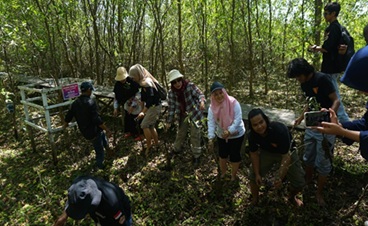
Wetland ecosystems, especially mangrove forests in South Kalimantan, face serious threats from environmental degradation and land conversion, which directly affect the sustainability of the habitat of the Proboscis Monkey (Nasalis larvatus), an endangered endemic species. The implementation of Law Number 32 of 2024, which amends Law Number 5 of 1990 on the Conservation of Biological Natural Resources and their Ecosystems, is a key instrument in strengthening conservation regulations. However, the effectiveness of implementation at the local level is still hampered by low legal awareness and community participation. This Community Service Activity aims to analyze the role of non-governmental organizations (NGOs) in supporting the implementation of the Law at the Proboscis Monkey Research Station on Curiak Island, and to empower NGOs to support its implementation. The method used in this activity was a workshop and legal training, complemented by pre- and post-tests to measure participants' level of understanding and field observations of conservation area conditions. The results of the activity showed a significant increase in participants' legal understanding, particularly regarding the definition and substance of Law Number 32 of 2024, environmental law training, and the role of non-governmental organizations in supporting the implementation of the regulation. Through the implementation workshop, the NGO's legal awareness of various environmental issues in conservation areas has increased. This is reflected in the post-test results, which show the increasing role, participation, and commitment of NGOs in protecting and preserving natural resources and ecosystems in the Curiak Island area, South Kalimantan.
Downloads
Article Details

This work is licensed under a Creative Commons Attribution-ShareAlike 4.0 International License.
Authors who publish with this journal agree to the following terms:
- Any article on the copyright is retained by the author(s).
- Author grant the journal, right of first publication with the work simultaneously licensed under a Creative Commons Attribution License that allows others to share work with acknowledgment of the work authors and initial publications in this journal.
- Authors are able to enter into a separate, additional contractual arrangements for non-exclusive distribution of published articles of work (eg, post-institutional repository) or publish it in a book, with acknowledgment of its initial publication in this journal.
- Authors are permitted and encouraged to post their work online (e.g., in institutional repositories or on their websites) prior to and during the submission process, as can lead to productive exchanges, as well as earlier and greater citation of published work.
- The article and any associated published material is distributed under the Creative Commons Attribution-ShareAlike 4.0 International License
References
Baharuddin, D., & Salim, D. (2018). Analisis Kekritisan Lahan Mangrove Kalimantan Selatan dengan Menggunakan Sistem Informasi Geografis dalam Rangka Pengelolaan Konservasi Lahan Basah Pesisir. Jurnal Enggano, 3(1), 49-67. 2. https://doi.org/10.31186/jenggano.5.3.495-509
Banjarmasin Tribun News. (2023). Lahan Mangrove Seluas 5.018 Hektare di Kalsel Berstatus Kritis, Banjarmasin Tribun News. https://banjarmasin.tribunnews.com/2024/07/29/lahan-mangrove-seluas-5018-hektare-di-kalsel-berstatus-kritis
Bergin, T., & Orlando, E. (Eds.). (2019). Forging a Socio-Legal Approach to Environmental Harms. Routledge. https://doi.org/10.4324/9781315676715-1
Blue Forests. (2023). Melindungi Mangrove Yang Tersisa, Blue Forests.
CNA. (2022). Perempuan Indonesia ini Dedikasikan Hidupnya Selamatkan Bekantan di Kalimantan Selatan. Diakses dari https://www.cna.id
Garda Animalia. (2023). Perburuan Satwa Liar Ancam Ekosistem dan Keanekaragaman Hayati di Indonesia, Kementerian Lingkungan Hidup dan Kehutanan. https://gardaanimalia.com/perburuan-satwa-liar-ancam-ekosistem-dan-keanekaragaman-hayati-di-indonesia/
Hutter, B. (Ed.). (2000). A Reader in Environmental Law. Oxford University Press.
Ishida, B. (2023). Mengatasi Ancaman Perusakan Habitat Satwa Liar di Indonesia, Universitas Indonesia. https://doi.org/10.1098/rstb.2016.0167
Klik Hijau. (2022). Isu Utama Permasalahan pada Ekosistem Mangrove di Indonesia. Diakses dari https://klikhijau.com/8-isu-utama-permasalahan-padaekosistem-mangrove-di-indonesia/.
Maliasili. (2023). Conservation collaborations that work: 10 strategies for successful partnerships, Maliasili. https://maliasili.go.tz/assets/pdfs/DOC-20230601-WA0038_230705_135553_compressed.pdf
Media Indonesia. (2023). 237 Ribu Mangrove Ditanam Serentak di Kalimantan Selatan, Media Indonesia.
Mongabay. (2023). Ekosistem Lahan Basah, Terancam dan Diancam Krisis Lingkungan. Diakses dari https://mongabay.co.id/2023/04/14/ekosistem-lahan-basah-terancam-dan-diancam-krisis-lingkungan/amp/.
Mongabay. (2025). Mengenal Para Penjaga Bekantan dari Pulau Curiak. Diakses dari https://www.mongabay.co.id/2025/03/27/mengenal-para-penjagabekantan-dari-pulau-curiak/.
Resonance Global. (2023). 5 Cross-Sector Collaboration Examples for Conservation and Climate Change Impact, Resonance Global. https://www.resonanceglobal.com/blog/5-cross-sector-collaboration-examples-for-conservation-and-climate-change-impact
Sahabat Bekantan Indonesia. (2025). Profil Organisasi Sahabat Bekantan Indonesia. Diakses dari https://www.bekantan.org/.
U.S. Fish & Wildlife Service. (2023). Why Healthy Wetlands Are Vital to Protecting Endangered Species, U.S. Fish & Wildlife Service. https://www.fws.gov/story/2023-04/why-healthy-wetlands-are-vital-protecting-endangered-species
Unsustainable Magazine. (2023). Mangrove Forests: A History, Current State, and What’s Next, Unsustainable Magazine. https://www.unsustainablemagazine.com/mangrove-forests-present-and-future/
WWF. (2024). Living Planet Report 2024: Katastropik Penurunan Drastis Populasi Satwa Liar Dunia Sebesar 73%. WWF. https://www.wwf.id/id/blog/laporan-living-planet-wwf-katastropik-penurunan-drastis-populasi-satwa-liar-dunia-sebesar-73
Yayasan IAR Indonesia. (2024). Bekantan: Upaya Pelestarian Ikon Fauna Kalimantan yang Terancam. Diakses dari https://yiari.or.id/bekantan/.