Pemanfaatan Tongkol Jagung Terfermentasi untuk Ransum Sapi Bali di Kota Parepare Utilization of Fermented Corn Cobs for Bali Cattle Rations in Parepare City
Article Sidebar
Main Article Content
Abstract
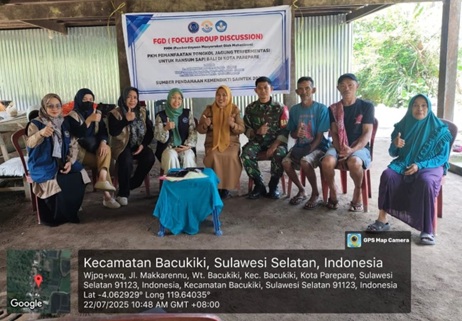
The application of science and technology is expected to provide farmers with knowledge and expertise to utilize agricultural waste as ruminant feed, thereby preserving the environment and making it more useful. The training on the use of fermented corn cobs aims to train the community in dealing with agricultural waste management, improving work ethic, standard of living, and community welfare, and having high independence, and providing knowledge and skills to the community: farmers/livestock farmers, in utilizing agricultural waste through fermented corn cobs for ruminant feed. This community service activity was carried out in Watang Bacukiki Village, Bacukiki District, Parepare City. The target participants of the community service were the Mangimpuru and Locci-Locci'E Farmer Group Partners in Watang Bacukiki Village. The method used was to provide counseling and training to transfer knowledge and skills to the farmer/livestock group partners in Watang Bacukiki Village regarding agricultural waste and its impact on human health and the environment. Furthermore, trials were conducted on Bali cattle to evaluate their use as ruminant feed. The abundance of agricultural waste, namely corncobs, is often not utilized and instead burned. After receiving counseling and training on fermented corncobs, all participants understood that fermented corncobs can be used as ruminant feed. This digital marketing outreach and training activity aims to equip farmer groups with the knowledge and skills to market fermented corn cob products online. Effective digital marketing strategies are introduced, including creating promotional content, leveraging social media and e-commerce platforms, and using compelling copywriting to increase product appeal.
Downloads
Article Details

This work is licensed under a Creative Commons Attribution-ShareAlike 4.0 International License.
Authors who publish with this journal agree to the following terms:
- Any article on the copyright is retained by the author(s).
- Author grant the journal, right of first publication with the work simultaneously licensed under a Creative Commons Attribution License that allows others to share work with acknowledgment of the work authors and initial publications in this journal.
- Authors are able to enter into a separate, additional contractual arrangements for non-exclusive distribution of published articles of work (eg, post-institutional repository) or publish it in a book, with acknowledgment of its initial publication in this journal.
- Authors are permitted and encouraged to post their work online (e.g., in institutional repositories or on their websites) prior to and during the submission process, as can lead to productive exchanges, as well as earlier and greater citation of published work.
- The article and any associated published material is distributed under the Creative Commons Attribution-ShareAlike 4.0 International License
References
To be published