Dari Lisan ke Tulisan: Penyusunan Modul Tenun untuk Pelestarian Budaya dan Pemberdayaan Masyarakat Bonen From Oral to Written: Developing a Weaving Module for Cultural Preservation and Community Empowerment in Bonen
Article Sidebar
Main Article Content
Abstract
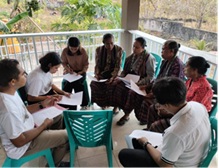
This community service program was carried out in Bonen Village, Kupang Regency, aiming to preserve traditional weaving culture while empowering women and young generations. The leading partner of this activity was the Ume Halan Foundation, which mentors the Pasuklo Weaving Community. The primary problems identified were the lack of regeneration of young weavers and the absence of written guidelines for the weaving learning process. The program was implemented through a participatory approach comprising several stages: preparation and socialization; focus group discussions to enrich data; module revision and trials; training on module use; and continuous mentoring and evaluation. The outcome of this program is a locally wisdom–based weaving module that introduces motifs, basic weaving techniques, tools and materials, and the use of natural dyes. The module was produced in both printed and digital formats to ensure accessibility across generations. The training involved approximately 15 elementary school students from SD Inpres Bonen and 12 senior weavers from the Pasuklo Community. The participatory evaluation showed that 80% of participants found the module easy to understand and engaging, and that teachers and local weavers agreed it effectively facilitated intergenerational knowledge transfer. Overall, this program contributes to cultural preservation, women's empowerment, and the revitalization of young weavers in Bonen Village, while strengthening Ume Halan's role as a sustainable community learning center.
Downloads
Article Details

This work is licensed under a Creative Commons Attribution-ShareAlike 4.0 International License.
Authors who publish with this journal agree to the following terms:
- Any article on the copyright is retained by the author(s).
- Author grant the journal, right of first publication with the work simultaneously licensed under a Creative Commons Attribution License that allows others to share work with acknowledgment of the work authors and initial publications in this journal.
- Authors are able to enter into a separate, additional contractual arrangements for non-exclusive distribution of published articles of work (eg, post-institutional repository) or publish it in a book, with acknowledgment of its initial publication in this journal.
- Authors are permitted and encouraged to post their work online (e.g., in institutional repositories or on their websites) prior to and during the submission process, as can lead to productive exchanges, as well as earlier and greater citation of published work.
- The article and any associated published material is distributed under the Creative Commons Attribution-ShareAlike 4.0 International License
References
Chambers, R. (1997). Whose Reality Counts? Intermediate Technology Publications.
Dushkova, D., & Ivlieva, O. (2024). Empowering Communities to Act for a Change: A Review of the Community Empowerment Programs towards Sustainability and Resilience. Sustainability, 16(19), 8700. https://doi.org/10.3390/su16198700
Ekowati, M. A. S. (2024). Sosialisasi Tentang Pemberdayaan Masyarakat Desa Berbudaya Dalam Meningkatkan Pembelajaran Menuju Desa Unggul (Studi Kasus Desa Gedangsasri, Kab Gunung Kidul). Jurnal Akademik Pengabdian Masyarakat, 2(6), 162–177. https://doi.org/10.61722/japm.v2i6.2836
Febriyola, E. (2025). Pengaruh Bentuk Partisipasi Masyarakat Terhadap Efektivitas Pembangunan Infrastruktur Pertanian Di Nagari Binjai Kecamatan Tigo Nagari Tahun 2022–2023. Menulis, 1(8), 489–491. https://doi.org/10.59435/menulis.v1i8.610
Freire, Paulo., Ramos, M. Bergman., Macedo, D. P. ., & Shor, Ira. (2018). Pedagogy of the oppressed. Bloomsbury Academic.
Hanson, C., & Griffith, H. F. (2016). Tanning, Spinning, and Gathering Together: Intergenerational Indigenous Learning in Textile Arts. Engaging with Indigenous Communities, 2, 225–244.
Hartiningsih. (2020). Perkembangan dan Pelestarian Kain Sasirangan Pewarna Alam di Kota Banjarmasin. Jurnal Kebijakan Pembangunan, 15(2), 231–241. https://doi.org/10.47441/jkp.v15i2.132
Hu, B., He, F., & Hu, L. (2022). Community Empowerment Under Powerful Government: A Sustainable Tourism Development Path for Cultural Heritage Sites. Frontiers in Psychology, 13. https://doi.org/10.3389/fpsyg.2022.752051
Kolimon, M., & Ataupah, F. N. (2025). Weaving Holy Communion: A Feminist Theological Study. Indonesian Journal of Theology, 13(1), 1–23. https://doi.org/10.46567/ijt.v13i1.611
Lakapu, M., Fernandez, A. J., Djong, K. D., Fernandez, M., & Gawa, M. G. (2020). Pengembangan Bahan Ajar Berbasis Etnomatematika Materi Persamaan Dan Pertidaksamaan Linear Satu Variabel. Figma Jurnal Pendidikan, 4(1), 50–56.
Lapenangga, A. K., Mberu, Y. B., Lakapu, M., Lily, B. B., Jeraman, D. S. E. D., & Lassa, M. E. (2025). Pemberdayaan Perempuan dan Anak Melalui Desain Rumah Belajar Berkelanjutan di Kampung Bonen, Kabupaten Kupang. J-Depace, 8(1), 33–46. https://doi.org/10.34124/jpkm.v8i1.208
Mardati, A. (2016). Pengembangan Modul Matematika dengan Pendekatan Kontekstual pada Materi Bangun Datar untuk Mahasiswa PGSD UAD. JPSD : Jurnal Pendidikan Sekolah Dasar, 3(1), 1–7. https://doi.org/10.26555/jpsd.v4i1.7246
Noronha, R. G., & Guimarães, M. J. S. (2017). Craft production and design as women’s emancipation instruments. Strategic Design Research Journal, 10(3). https://doi.org/10.4013/sdrj.2017.103.03
Nurhayati, S., Zahrani, N. A., & Syahputra, R. (2023). Kearifan Lokal dalam Menumbuhkan Kemandirian Ekonomi Masyarakat Desa. Jurnal Pendidikan Tambusai, 7, 21384–21389.
Putri, S. L. N., & Widodo. (2022). Strategi Pembelajaran Partisipatif dalam Menumbuhkan Jiwa Wirausaha Masyarakat melalui Pendidikan Kecakapan Wirausaha (PKW) Barbershop di UPTD SPNF SKB Sidoarjo. J+PLUS: Jurnal Mahasiswa Pendidikan Luar Sekolah, 11(1), 105–118.
Qomarrullah, R., Sokoy, F., Suratni, & Tammubua, M. (2024). The Role of Indigenous Communities in the Development of Socially-Based Environmental Education. Indonesian Journal of Intellectual Publication, 4(2), 1–11. https://doi.org/10.51577/ijipublication.v4i2.505
Rasya, G., Tahir, M., Oktaviyanti, I., & Nurhasanah. (2020). Pengembangan Modul Pembelajaran Berbasis Kearifan Lokal Suku Sasak pada Materi IPS Kelas IV DI SDN 22 Ampenan. Progres Pendidikan, 9(1), 1–9. https://doi.org/10.29303/prospek.vxix.xx
Silverius Sinaga, R., Chairunnisa, Theo Philia, I., Widia Ningsih, P., Sabrina, S., & Siahaan, P. G. (2024). Inventarisasi Motif Tradisional Kain Songket Melayu sebagai Perlindungan Potensi Indikasi Geografis di Kabupaten Batubara. Jurnal Pendidikan Tambusai, 8(3), 47807–47818.
Ubertazzi, B. (2022). Intangible Cultural Heritage, Sustainable Development and Intellectual Property. Springer International Publishing. https://doi.org/10.1007/978-3-031-08104-0
Walker, S. (2023). Education Creates Confidence and Empowerment; Confidence and Empowerment Create Opportunities; Opportunities Breed Success. Fostering Inclusive Learning Communities Together, 1(40), 1. https://repository.brynmawr.edu/tlthe
Wulandari, B. J. Widi., Johansen, P., & Hoesni, F. (2018). Tenun Ikat Dayak Iban di Kapuas Hulu (Utami, Ed.; 1st ed.). Diva Press .