Transformasi Budaya Bapukung: Dari Kearifan Lokal Menuju Strategi Efektif dalam Pemberdayaan dan Manajemen Peran Ganda Ibu Rumah Tangga Cultural Transformation of Bapukung: From Local Wisdom to Effective Strategies in Empowering and Managing the Dual Role of Mothers in the Household
Article Sidebar
Main Article Content
Abstract
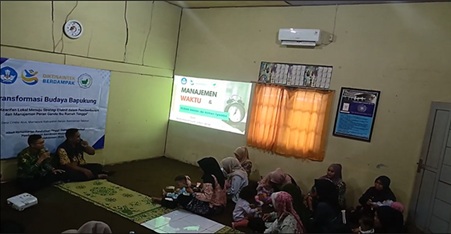
The community service partners are housewives in Cindai Alus Village, Banjar Regency, who, in addition to their domestic roles, are also actively managing home-based microenterprises, particularly in the production of traditional Banjar snacks. This condition presents challenges, as most of them still have toddlers who require full attention, often disrupting the continuity of production. The program was implemented to enhance the ability of homemakers to manage their time, balance family roles with productivity, and reintroduce the traditional bapukung method, which functions to soothe children, support better sleep, and promote child development. The approach included socialization, training, and hands-on practice in utilizing sasirangan fabric as a material for the bapukung cradle, while also providing economic value through the development of handicraft skills. The results of the program indicate an increased understanding of daily time management, improved skills in producing sasirangan fabric products, and greater awareness of the benefits of bapukung in reducing interruptions during production activities. By applying this method, homemakers can allocate their time more effectively, thereby improving business productivity. This program concludes that strengthening the capacity of homemakers through traditional and innovative approaches can encourage economic welfare while simultaneously preserving local wisdom.
Downloads
Article Details

This work is licensed under a Creative Commons Attribution-ShareAlike 4.0 International License.
Authors who publish with this journal agree to the following terms:
- Any article on the copyright is retained by the author(s).
- Author grant the journal, right of first publication with the work simultaneously licensed under a Creative Commons Attribution License that allows others to share work with acknowledgment of the work authors and initial publications in this journal.
- Authors are able to enter into a separate, additional contractual arrangements for non-exclusive distribution of published articles of work (eg, post-institutional repository) or publish it in a book, with acknowledgment of its initial publication in this journal.
- Authors are permitted and encouraged to post their work online (e.g., in institutional repositories or on their websites) prior to and during the submission process, as can lead to productive exchanges, as well as earlier and greater citation of published work.
- The article and any associated published material is distributed under the Creative Commons Attribution-ShareAlike 4.0 International License
References
Adair, J., & Bakker, A. (2021). Balanced Scorecard and Organizational Performance: A Strategic Perspective. Journal of Management Studies, 58(3), 451–468. https://doi.org/10.55606/jsr.v3i1.3409
Ahmawati, N., Prihartanti, N., & Purwandari, E. (2022). Perubahan Pola Asuh Anak di Era Modernisasi. Jurnal Psikologi Perkembangan, 10(2), 115–127. http://repository.ubharajaya.ac.id/27732/1/Artikel%20revisi%20lengkap_Prosiding%20undip.pdf
Barney, J. (1996). The Resource-Based Theory of the Firm. Organization Science, 7(5), 469–497. https://jaybarney.org/wp-content/uploads/2022/06/8-The-Resource-based-Theory-of-the-Firm-Barney-Organization-Science-1996.pdf
Cahya, N., & Prabowo, S. D. (2025). The Influence of Local Wisdom Bapukung on Productivity and Role Balance of Housewives. Anterior Jurnal, 24(Special-1), 1–12. https://doi.org/10.33084/anterior.v24iSpecial-1.9101
Chambers, R. (2014). Rural Development: Putting the Last First. London: Routledge. http://ndl.ethernet.edu.et/bitstream/123456789/54506/1/198.pdf
Fatimah, S. (2019). Keberlanjutan program pemberdayaan masyarakat: Studi kasus pada program keterampilan perempuan desa. Jurnal Pengabdian kepada Masyarakat, 5(2), 101–112. https://repository.unair.ac.id/view/year/2017.html
Fitriyani, L. (2020). Peran ganda perempuan dalam rumah tangga dan dampaknya terhadap produktivitas. Jurnal Psikologi dan Kesehatan, 8(1), 55–67. https://journal.iapa.or.id/proceedings/article/download/1082/479/
Hidayat, A. (2024). Integrasi Kearifan Lokal dalam Pembangunan Masyarakat. Jurnal Sosial dan Humaniora, 12(1), 89–102. https://www.researchgate.net/publication/391160511_KEARIFAN_LOKAL_DAN_LITERASI_MENGUNGKAP_TREN_DAN_KONTRIBUSI_RISET_GLOBAL
Kabeer, N. (2012). Women’s Economic Empowerment and Inclusive Growth: Labour Markets and Enterprise Development. International Development Research Centre. https://www.womenindisplacement.org/sites/g/files/tmzbdl1471/files/2020-10/Womens%20Economic%20Empowerment%20and%20Inclusive%20Growth.pdf
Kementerian Pemberdayaan Perempuan dan Perlindungan Anak (KPPPA). (2021). Profil Perempuan Indonesia 2021. Jakarta: KPPPA. https://www.kemenpppa.go.id/buku/profil-perempuan-indonesia-periode-tahun-2021
Koentjaraningrat. (2013). Pengantar Ilmu Antropologi. Jakarta: Rineka Cipta.
Lestari, D., Pratiwi, H., & Santosa, A. (2018). Pelatihan kewirausahaan berbasis ekonomi kreatif bagi ibu rumah tangga di Yogyakarta. Jurnal Pemberdayaan Masyarakat, 4(1), 77–89. http://repository.lppm.unila.ac.id/view/year/NULL.default.html
Ningsih, R. (2020). Kearifan Lokal sebagai Basis Pemberdayaan Perempuan. Jurnal Kebudayaan Nusantara, 5(2), 144–159. http://repository.lppm.unila.ac.id/view/subjects/L1.html
Pertiwi, L. (2023). Kearifan Lokal sebagai Sumber Daya Strategis dalam Perspektif RBV. Jurnal Manajemen dan Kewirausahaan, 15(1), 77–90. http://repository.stiesultanagung.ac.id/638/1/11.FullBook%20Manajemen%20Strategi%20Kontemporer.pdf
Rahman, A. (2022). Pelatihan manajemen keuangan rumah tangga sebagai strategi pemberdayaan ibu di Desa Sungai Tabuk. Jurnal Ekonomi dan Sosial, 10(2), 145–156. http://dx.doi.org/10.25157/ag.v1i1.2876
Rahmayani, S. (2022). Bapukung sebagai Praktik Pengasuhan Tradisional Banjar. Jurnal Antropologi Indonesia, 43(2), 201–215. https://doi.org/10.33650/trilogi.v5i4.9063
Saufi, M. (2024). Manajemen sumber daya manusia. Tim Ruang Karya (Ed.). Kalimantan Selatan: Ruang Karya Bersama. https://www.myedisi.com/ruangkarya/431042/manajemen-sumber-daya-manusia
Susanti, W. (2021). Pelatihan manajemen waktu bagi ibu rumah tangga: Upaya mengurangi stres dan meningkatkan kualitas pengasuhan. Jurnal Pendidikan dan Pemberdayaan, 6(2), 120–130. https://repository.uinsaizu.ac.id/29631/1/Prosiding%20280.pdf
White, L., & Erickson, J. (2019). The Double Burden: Women, Work, and Family Stress. Journal of Family Studies, 25(4), 612–628. https://doi.org/10.20377/jfr-1021