Pemanfaatan Software Tracker dalam Analisis Gerak Benda untuk Melatih Kemampuan Interpretasi Grafik Siswa Utilization of Tracker Software in Object Motion Analysis to Train Students' Graph Interpretation Skills
Article Sidebar
Main Article Content
Abstract
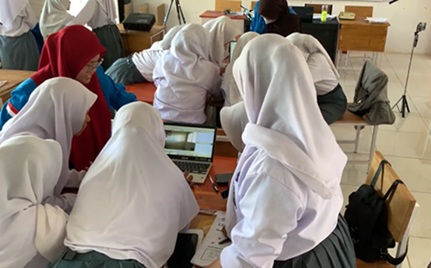
The ability to interpret graphs is important for students to understand the relationships between physical variables, which can lead to the discovery of concepts. There are problems with creating graphs for direct object motion analysis because the movement is fast, and there is a lack of supporting laboratory equipment, which hinders students from further interpreting the motion graphs. Tracker software can be used to determine the exact position and time of moving objects from video recordings of real events. However, students' knowledge of Tracker use remains minimal, and their graph-interpretation skills are also underdeveloped. Based on this, the purpose of this community service activity is to guide students in analyzing object motion using Tracker software, train students' graph-interpretation skills, and assess students' responses to the community service activity using Tracker in object motion analysis. The implementation of this community service consists of three stages: preparation, implementation, and evaluation. Community service activities include providing materials, conducting demonstrations, completing practical assignments using Tracker in object motion experiments, interpreting graphs, and giving presentations. The conclusion from this community service is that students can use Tracker software effectively to analyze object motion experiments, that students' graph interpretation skills are trained, and that students' graph interpretation skills improve. Students' responses are very good to the use of Tracker in object motion analysis to train graph interpretation skills.
Downloads
Article Details

This work is licensed under a Creative Commons Attribution-ShareAlike 4.0 International License.
Authors who publish with this journal agree to the following terms:
- Any article on the copyright is retained by the author(s).
- Author grant the journal, right of first publication with the work simultaneously licensed under a Creative Commons Attribution License that allows others to share work with acknowledgment of the work authors and initial publications in this journal.
- Authors are able to enter into a separate, additional contractual arrangements for non-exclusive distribution of published articles of work (eg, post-institutional repository) or publish it in a book, with acknowledgment of its initial publication in this journal.
- Authors are permitted and encouraged to post their work online (e.g., in institutional repositories or on their websites) prior to and during the submission process, as can lead to productive exchanges, as well as earlier and greater citation of published work.
- The article and any associated published material is distributed under the Creative Commons Attribution-ShareAlike 4.0 International License
References
Amin, B. D., Sahib, E. P., Harianto, Y. I., Patandean, A. J., Herman, & Sujiono, E. H. 2020. The Interpreting Ability on Science Kinematics Graphs of Senior High School Students in South Sulawesi, Indonesia. Jurnal Pendidikan IPA Indonesia, 9(2), 179–186. https://doi.org/10.15294/jpii.v9i2.23349
Hake, R. R. 1998. Interactive-Engagement Versus Traditional Methods: A Six-Thousand-Student Survey of Mechanics Test Data for Introductory Physics Courses. American Journal of Physics, 66(1), 64–74. https://doi.org/10.1119/1.18809
Hariroh, L., Hidayat, A., Sutopo, S., & Purwaningsih, E. 2024. Practice Rehearsal Pairs with Dynamic Video Media: Improving Students’ Kinematics Graph Interpretation Skills. Momentum: Physics Education Journal, 8(2), 230–238. https://doi.org/10.21067/mpej.v8i2.9895
Oktaviani, Y., Wahyudi, I., & Abdurrahman, A. 2020. Pengaruh Software Tracker pada Pembelajaran Koefisien Restitusi Berbasis Inkuiri Terbimbing terhadap Kemampuan Multi-Reperentasi Siswa. Kappa Journal, 4(1), 48–56. https://doi.org/10.29408/kpj.v4i1.1992
Oktriyeni, & Putra, A. 2019. Penggunaan Aplikasi Tracker pada Materi Kinematika dan Dampaknya Terhadap Pencapaian Hasil Belajar Siswa Kelas X SMA. Pillar of Physics, 12(1), 89–96. https://jurnal.ipts.ac.id/index.php/SENAR/article/download/5122/3080/
Putri, A. S., & Agustina, R. R. 2023. Enhancing Physics Learning Through Virtual Experiments: Analyzing Parabolic Motion and Maximum Height Using Tracker Software. Indonesian Science Education Journal, 4(3), 86–92. https://doi.org/10.62159/isej.v4i3.1756
Raflesiana, V., Herlina, K., & Wahyudi, I. 2019. Pengaruh Penggunaan Tracker pada Pembelajaran Gerak Harmonik Sederhana Berbasis Inkuiri Terbimbing terhadap Keterampilan Interpretasi Grafik Siswa. Gravity : Jurnal Ilmiah Penelitian Dan Pembelajaran Fisika, 5(1), 1–12. https://doi.org/10.30870/gravity.v5i1.5207
Ramli, H., Tim Chan, K., & Wing Fen, Y. 2016. Study of Simple Pendulum Using Tracker Video Analysis and High Speed Camera: An Intractive Approach to Analyze Oscillatory Motion. Solid State Science and Technology, 24(2), 297–305. https://doi.org/10.1088/1742-6596/1185/1/012132?urlappend=%3Futm_source%3Dresearchgate.net%26utm_medium%3Darticle
Renika, J., Prima, E. C., & Amprasto, A. 2024. Kinematics Analysis on Accelerated Motion Using Tracker Video Analysis for Educational Purposes. Momentum: Physics Education Journal, 8(1), 23–31. https://doi.org/10.21067/mpej.v8i1.8883
Subali, B., & Kunzainah. 2022. Pengaruh Alat Praktikum Kinematika Berbantuan Tracker terhadap Kemampuan Membaca Grafik pada Mahasiswa. Unnes Physics Educational Journal, 11(2), 56–63. https://journal.unnes.ac.id/sju/upej/article/view/60272/22828
Widoyoko, E. P. 2014. Evaluasi Program Pembelajaran: Panduan Praktis Bagi Pendidik dan Calon Pendidik. Yogyakarta: Pustaka Pelajar. https://books.google.com/books/about/Evaluasi_program_pembelajaran.html?id=o8nsSAAACAAJ
Yennita, Y., Zulirfan, Z., Irianti, M., Tukan, M. I., Ananda, T., & Naza, K. A. 2023. Preliminary Study: Profile of Students’ Interpretation Skills on the Topic of Kinematics. Jurnal Penelitian Pendidikan IPA, 9(1), 186–191. https://doi.org/10.29303/jppipa.v9i1.2509
Yusuf, E. 2016. Using Tracker to Engage Students’ Learning and Research in Physics. Pertanika Journal of Science and Technology, 24(2), 483–491. https://www.researchgate.net/publication/305154646_Using_tracker_to_engage_students'_learning_and_research_in_physics