Efektivitas Edukasi Menggunakan Media Flip Chart terhadap Peningkatan Pengetahuan Higiene dan Sanitasi Proses Produksi Makanan pada UMKM Kuliner Boga Bahari di Desa Ambulu Kecamatan Losari Kabupaten Cirebon The Effectiveness of Education Using Flip Chart Media on Improving Knowledge of Hygiene and Sanitation in Food Production Processes among Culinary MSME’s of Boga Bahari in Ambulu Village, Losari District, Cirebon Regency
Article Sidebar
Main Article Content
Abstract
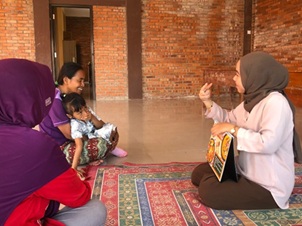
Food hygiene and sanitation play a crucial role in ensuring food quality and safety, particularly within the micro, small, and medium enterprises (MSMEs) sector. According to data from the Indonesian Food and Drug Authority (BPOM, 2022), 72 outbreaks of food poisoning were reported in Indonesia, a 44% increase from the previous year. The majority of these cases were caused by catering services (31.94%) and street food (23.61%), highlighting the urgent need for proper hygiene and sanitation practices among food handlers. This community service activity was conducted at a food-processing MSME in Ambulu Village, Losari Sub-district, Cirebon Regency, aiming to evaluate the effectiveness of using a flip chart as an educational medium to improve workers' knowledge regarding food production hygiene and sanitation. The method involved an initial interview-based knowledge assessment, educational sessions using flip charts, and a follow-up interview using the same set of questions. The subjects were two MSME employees. Results showed an improvement in the average knowledge score from 60 to 90, with a total increase of 30 points. The use of flip charts proved effective in delivering information visually, interactively, and comprehensively, making it easier for participants to understand the concepts presented. This approach demonstrates that flip-chart-based education can be an effective strategy to enhance food hygiene and sanitation practices among MSMEs, particularly in rural areas.
Downloads
Article Details

This work is licensed under a Creative Commons Attribution-ShareAlike 4.0 International License.
Authors who publish with this journal agree to the following terms:
- Any article on the copyright is retained by the author(s).
- Author grant the journal, right of first publication with the work simultaneously licensed under a Creative Commons Attribution License that allows others to share work with acknowledgment of the work authors and initial publications in this journal.
- Authors are able to enter into a separate, additional contractual arrangements for non-exclusive distribution of published articles of work (eg, post-institutional repository) or publish it in a book, with acknowledgment of its initial publication in this journal.
- Authors are permitted and encouraged to post their work online (e.g., in institutional repositories or on their websites) prior to and during the submission process, as can lead to productive exchanges, as well as earlier and greater citation of published work.
- The article and any associated published material is distributed under the Creative Commons Attribution-ShareAlike 4.0 International License
References
To be published