Pemberdayaan Kader Posyandu melalui SDIDTK dan PMT LokProhe untuk Pencegahan Stunting dan Penguatan Ekonomi Kreatif Berbasis Pangan Lokal Empowering Posyandu Cadres through SDIDTK and PMT LokProhe to Prevent Stunting and Strengthen the Local Food-Based Creative Economy
Article Sidebar
Main Article Content
Abstract
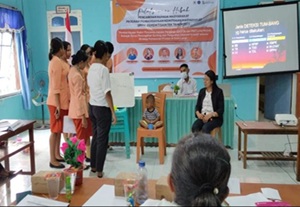
Stunting remains a public health problem in Indonesia, with long-term impacts on the quality of human resources. Efforts to prevent stunting require targeted nutritional interventions and the active role of health workers. Integrated service post (Posyandu) cadres play a strategic role as the frontline in detecting, preventing, and addressing stunting. One strategy they can implement is to provide supplementary food made from local ingredients and animal protein. The purpose of this community service is to enhance the knowledge and skills of Posyandu cadres in implementing SDIDTK, completing KMS, and processing animal protein-based PMT as a step toward preventing stunting and boosting the creative economy. The methods used in this community service activity include outreach, training, technology implementation, mentoring, and evaluation of program success. The program targets 25 integrated health posts (Posyandu) cadres and will be implemented in Langir Village in September 2025. The results of statistical tests show that the knowledge and skills of cadres regarding SDIDTK, filling out KMS, PMT LokProhe, and marketing strategies increased significantly from the sufficient category (56%) to the good and skilled category (84%) after socialization and training. Therefore, the outreach and training provided effectively improved the knowledge and skills of Posyandu cadres. It is hoped that the cadres will effectively implement child growth and development simulations and utilize local foods, thereby improving their economic well-being.
Downloads
Article Details

This work is licensed under a Creative Commons Attribution-ShareAlike 4.0 International License.
Authors who publish with this journal agree to the following terms:
- Any article on the copyright is retained by the author(s).
- Author grant the journal, right of first publication with the work simultaneously licensed under a Creative Commons Attribution License that allows others to share work with acknowledgment of the work authors and initial publications in this journal.
- Authors are able to enter into a separate, additional contractual arrangements for non-exclusive distribution of published articles of work (eg, post-institutional repository) or publish it in a book, with acknowledgment of its initial publication in this journal.
- Authors are permitted and encouraged to post their work online (e.g., in institutional repositories or on their websites) prior to and during the submission process, as can lead to productive exchanges, as well as earlier and greater citation of published work.
- The article and any associated published material is distributed under the Creative Commons Attribution-ShareAlike 4.0 International License
References
Aisyaroh, N., Fadhilah, N., Fajri, N. F., Nisa, U., Maulida, K., Lestari, F. A., & Diana, E. N. M. (2023). Pelatihan pengisian KMS pada kader posyandu balita sebagai upaya optimalisasi pemantauan tumbuh kembang balita. Community Empowerment Journal, 1(4), 143–150. https://doi.org/10.61251/cej.v1i4.29
Alaaraj, N., Soliman, A., & Rogol, A. D. (2021). Growth of malnourished infants and children: How is inflammation involved? Expert Review of Endocrinology and Metabolism, 16(5), 213–216. https://doi.org/10.1080/17446651.2021.1956903
Safitri, E. D., Febrianti, E. A., Diokta, V. S., Ramadhan, H., Hanoum, N. A., Muzakka, F., Marliana, G. S. C., Anggraheni, N. P., Suryanto, S., Lailatussyuhada, L. P. S., & Widyantari, Y. Y. D. L. (2025). Pendampingan pencegahan stunting melalui pengolahan protein nabati dan hewani dengan pangan lokal di Desa Sendangagung. Jurnal Abdi Insani, 12, 2403–2413. https://doi.org/10.61930/jurnaladm.v2i1.419
Fatimah, S., Fatmasanti, U., & Musni. (2023). Pelatihan Kader Posyandu Pengukuran Antropometri Dan Penilaian StatusGizi. Jurnal Pengabdian Masyarakat, 2(3), 33–37. https://journal.unimerz.com/index.php/piramida
Gannika, L., Mulyadi, M., & Rotty, M. P. F. (2025). Pelatihan Kader Posyandu Untuk Pemantauan Tumbuh Kembang Bayi dan Balita Di Kota Manado. Ahmar Metakarya: Jurnal Pengabdian Masyarakat, 4(2), 193–200. https://doi.org/10.53770/amjpm.v4i2.363
Juhartini, J., Fadila, F., Warda, W., & Nurbaya, N. (2022). Pemanfaatan Pangan Lokal Untuk Meningkatkan Optimal Growth Spurt Pada Balita. JMM (Jurnal Masyarakat Mandiri), 6(2), 861. https://doi.org/10.31764/jmm.v6i2.6780
Mediani, H. S., Hendrawati, S., Pahria, T., Mediawati, A. S., & Suryani, M. (2022). Factors Affecting the Knowledge and Motivation of Health Cadres in Stunting Prevention Among Children in Indonesia. Journal of Multidisciplinary Healthcare, 15 1069–1082. https://doi.org/10.2147/JMDH.S356736
Meilasari, N., & Wiku Adisasmito. (2024). Upaya Percepatan Penurunan Stunting Melalui Pemberian Makanan Tambahan (PMT) Pangan Lokal : Systematic Review. Media Publikasi Promosi Kesehatan Indonesia (MPPKI), 7(3), 630–636. https://doi.org/10.56338/mppki.v7i3.4924
Mulyani, E. Y., Sari, Y., & Widiastuti, M. (2024). Pemberdayaan Kader Posyandu untuk Inovasi MPASI-Lokal ” Ikan Kembung Como ”. 06, 25–35.
Nona, A. (2025). Produksi Ikan Tangkap di Sikka Meningkat 13% pada 2024. Radio Republik Indonesia. https://www.rri.co.id/daerah/1339279/produksi-ikan-tangkap-di-sikka-meningkat-13-pada-2024
Sambriong, M., & Maria, Y. . (2021). Peningkatan Status Gizi Anak Melalui Pendekatan Pemberdayaan Keluarga Dalam Memanfaatkan Pangan Lokal. JKP (Jurnal Kesehatan Primer), 6(1), 52–62. https://doi.org/10.31965/jkp.v6
Simbolon, D., Agustin, L. R., Ba’es, M., Shaum, M., Nesa, D., Mardiansyah, E., Safitri, K. G. A., Syari, E. D., Puspaningrum, H. A., & Roza, K. C. (2024). Intervensi stimulasi deteksi intervensi dini tumbuh kembang (SDIDTK) dan lomba balita sehat di Desa Pancamukti Kabupaten Bengkulu Tengah. ADM: Jurnal Abdi Dosen dan Mahasiswa, 2(1), 1–10. https://doi.org/10.61930/jurnaladm.v2i1.419
Sugiharti, R. K. (2023). Peningkatan Kualitas Hidup Balita Melalui Pelatihan Skrining Tumbuh Kembang Balita Bagi Ibu Dan Kader Posyandu. SELAPARANG: Jurnal Pengabdian Masyarakat Berkemajuan, 7(3), 1530. https://doi.org/10.31764/jpmb.v7i3.16010
Syamsu, A. F., Usman, H., & Kolomboy, F. (2025). Pemberdayaan Kader Posyandu Dalam Stimulasi, Deteksi Dan Intervensi Tumbuh Kembang (Sdidtk) Pada Balita di Wilayah Kerja Puskesmas Toaya Kabupaten Donggala. Jurnal Kolaboratif Sains. 8(6), 3159–3168. https://doi.org/10.56338/jks.v8i6.7912
Tri Ariani, M Muslim, & Reni Tri Lestari. (2024). Analisis Ketidaktepatan Pengisian Hasil Penimbangan Posyandu Balita Dalam Kartu Menuju Sehat Di Posyandu Aster 3 Pajangan Bantul. Jurnal Ilmu Kebidanan Dan Kesehatan (Journal of Midwifery Science and Health), 15(2), 95–100. https://doi.org/10.52299/jks.v15i2.255
Wianti, A., Setyowati, R., & Wahyuni, S. (2025). Meningkatkan Kesadaran Orang Tua Mencegah Terjadinya Stunting Pada Balita. 2(11), 5033–5038