Edukasi, Vaksinasi, dan Kastrasi Kucing dalam Meningkatkan Kesehatan Hewan dan Kesadaran Masyarakat di Bukittinggi Education, Vaccination, and Cat Castration in Improving Animal Health and Community Awareness in Bukittinggi
Article Sidebar
Main Article Content
Abstract
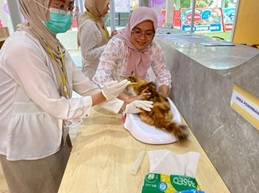
Animal health plays a crucial role in maintaining ecosystem balance and preventing the spread of zoonotic diseases. In Bukittinggi, uncontrolled cat populations and the potential spread of rabies pose significant public health concerns. This community service program aimed to improve animal health and raise public awareness through education on animal care, rabies vaccination, and male cat castration. The activity was attended by 55 community participants who owned pets. A holistic approach was employed, combining medical services—vaccination and castration—with direct community education. The program successfully vaccinated 80 cats and castrated 15 male cats, while significantly increasing community knowledge, as evidenced by pre- and post-test scores (from 6.00 to 9.55). The satisfaction rate among participants reached 96%. These results demonstrated the program's effectiveness in improving animal health, reducing the risk of zoonotic diseases, and raising public awareness about responsible pet care. This model intervention could serve as an example for zoonotic disease control and enhancing animal welfare within communities.
Downloads
Article Details

This work is licensed under a Creative Commons Attribution-ShareAlike 4.0 International License.
Authors who publish with this journal agree to the following terms:
- Any article on the copyright is retained by the author(s).
- Author grant the journal, right of first publication with the work simultaneously licensed under a Creative Commons Attribution License that allows others to share work with acknowledgment of the work authors and initial publications in this journal.
- Authors are able to enter into a separate, additional contractual arrangements for non-exclusive distribution of published articles of work (eg, post-institutional repository) or publish it in a book, with acknowledgment of its initial publication in this journal.
- Authors are permitted and encouraged to post their work online (e.g., in institutional repositories or on their websites) prior to and during the submission process, as can lead to productive exchanges, as well as earlier and greater citation of published work.
- The article and any associated published material is distributed under the Creative Commons Attribution-ShareAlike 4.0 International License
References
Cafazzo, S, Bonanni, R. and Natoli, E. (2019) Neutering Effects on Social Behaviour of Urban Unowned Free-Roaming Domestic Cats. Animals (Basel). 9(12): 1105. https://doi.org/10.3390/ani9121105
CDC (Centers for Disease Control and Prevention). (2021). One Health. https://www.cdc.gov/onehealth/index.html
Cleaveland, S., Kaare, M., Knobel, D., & Laurenson, M. K. (2017). Canine vaccination—Providing broader benefits for disease control. Veterinary Microbiology. 117(1): 43-50. https://doi.org/10.1016/j.vetmic.2006.04.009
Doherty, T. S., Dickman, C. R., Johnson, C. N., & Legge, S. (2016). Impacts and management of feral cats Felis catus in Australia. Mammal Review. 47(2): 83–97. https://doi.org/10.1111/mam.12080
Elsohaby, I., & Villa, L. (2023). Zoonotic diseases: Understanding the risks and mitigating the threats. BMC Veterinary Research. 19(1): 186. https://doi.org/10.1186/s12917-023-03736-8
Khalife S. & Kassaa, I.A. (2023). Occurrence and risk factors of feline immunodeficiency virus (FIV) and feline leukaemia virus (FeLV) in cats of Lebanon. Comp Immunol Microbiol Infect Dis, 93:101931. https://doi.org/10.1016/j.cimid.2022.101931
Ling, J. M. Y., Halim, A. F. N. A., Ahmad, D., Ramly, N., Hassan, M. R., Syed Abdul Rahim, S. S., Saffree Jeffree, M., Omar, A., & Hidrus, A. (2023). Rabies in Southeast Asia: A systematic review of its incidence, risk factors and mortality. BMJ Open. 13(5): e066587. https://doi.org/10.1136/bmjopen-2022-066587
Mackintosh, C. (2024). The effect of neutering cats on the prevalence of feline immunodeficiency virus. VNJ. 39(3): pp32-38. https://doi.org/10.56496/sibn3659
Rand, J., Saraswathy, A. M., Verrinder, J., & Paterson, M. B. A. (2024). Outcomes of a Community Cat Program Based on Sterilization of Owned, Semi-Owned and Unowned Cats in a Small Rural Town. Animals. 14(21): 3058. https://doi.org/10.3390/ani14213058
Rojas-Sanchez, E., Pereira-Mora, M., Vega-Benavides, K., & Jimenez-Soto, M. (2024). Enhancing community health: Veterinary services for underserved areas in Costa Rica with a One Health approach. One Health. 18: 100693. https://doi.org/10.1016/j.onehlt.2024.100693
Rusherina, & Sari, T. H. (2021). Pembentukan dan pelatihan kader siaga rabies di kelurahan Palas Kota Pekanbaru. DINAMISIA: Jurnal Pengabdian Kepada Masyarakat. 5(3): 733–740. https://doi.org/10.31849/dinamisia.v5i3.4161
Wallace, R. M., et al. (2020). Establishment of a high-quality rabies surveillance system in Haiti, 2015–2017. The American Journal of Tropical Medicine and Hygiene. 103(2): 660–666. https://doi.org/10.1371/journal.pntd.0004245
World Health Organization (WHO). (2018). WHO Expert Consultation on Rabies: Third report. WHO Technical Report Series, 1012. https://www.who.int/publications/i/item/WHO-TRS-1012 .