Cerdas Digital Sehat Mental,Membangun Generasi Muda yang Bijak dan Produktif di Era Digital pada Karang Taruna Diponegoro Digitally Smart, Mentally Healthy, Building a Wise and Productive Young Generation in the Digital Era at Karang Taruna Diponegoro
Article Sidebar
Main Article Content
Abstract
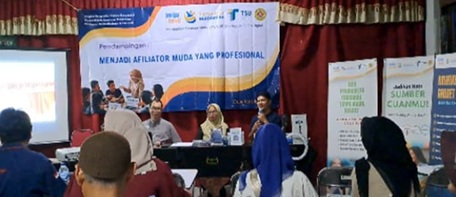
This Community Engagement Program aims to address three main problems faced by the Diponegoro Youth Organization (Karang Taruna): a lack of digital literacy and data security, low awareness of mental health, and the suboptimal use of technology for productivity. To tackle these issues, the implementing team applied a participatory approach through a detailed series of activities, covering: Initiation and Collaboration, Training Program Preparation, Training Implementation (in the form of workshops), Intensive Mentoring, and Monitoring and Evaluation The themes for the intensive workshops and mentoring consisted of three main issues: Mental Resilience in the Digital Era, Affiliate Digital Marketing, and Personal Data Security. This program has produced several key outputs, both tangible and social. Three guidebooks (Emotional Intelligence in the FOMO Era; Affiliate Marketing: Turn Social Media into a Money Machine; and Early Detection, Self-Protection), instructional videos, and an X-Banner for the "Digital Smart, Mental Health" campaign were created and delivered to the Diponegoro Youth Organization. The program was featured in national mass media, and its activity videos were uploaded to the official @TSUOFFICIAL YouTube channel. Several training participants have begun practicing digital marketing and have successfully earned income as affiliates, though the amounts remain modest. This demonstrates a positive start in utilizing technology for economic purposes. As part of the program's sustainability, the "Gatak Village Digital Youth Group" was formed as a forum for members to share knowledge and support one another. This established Digital Youth Group ensures that the positive impact continues to expand within the community.
Downloads
Article Details

This work is licensed under a Creative Commons Attribution-ShareAlike 4.0 International License.
Authors who publish with this journal agree to the following terms:
- Any article on the copyright is retained by the author(s).
- Author grant the journal, right of first publication with the work simultaneously licensed under a Creative Commons Attribution License that allows others to share work with acknowledgment of the work authors and initial publications in this journal.
- Authors are able to enter into a separate, additional contractual arrangements for non-exclusive distribution of published articles of work (eg, post-institutional repository) or publish it in a book, with acknowledgment of its initial publication in this journal.
- Authors are permitted and encouraged to post their work online (e.g., in institutional repositories or on their websites) prior to and during the submission process, as can lead to productive exchanges, as well as earlier and greater citation of published work.
- The article and any associated published material is distributed under the Creative Commons Attribution-ShareAlike 4.0 International License
References
Ahyati, I. U., Pratiwi, E. L., Humaidi, M., & Rozaq, A. (2025). Edukasi Keamanan Digital untuk Meningkatkan Literasi Digital Karyawan Perusahaan Daerah Sa-ijaan Mitra Lestari Kotabaru: Digital Security Education to Improve Digital Literacy Employees of the Regional Company Sa-ijaan Mitra Lestari Kotabaru. PengabdianMu: Jurnal Ilmiah Pengabdian Kepada Masyarakat, 10(7), 1753–1758. https://doi.org/10.33084/pengabdianmu.v10i7.9826
Belanova, N. (2023). Risks of IT technology adoption. E3S Web of Conferences. https://doi.org/10.1051/e3sconf/202337605014
Enopadria, C., Erfiana, E., & Lestari, P. A. (2023). PKM Peningkatan Pengetahuan Remaja Tentang Kesehatan Jiwa Remaja di Era Globalisasi. Jurnal Altifani Penelitian Dan Pengabdian Kepada Masyarakat, 3(3), 472–478. https://doi.org/10.59395/altifani.v3i3.428
Ghazy, N., & Lang, G. (2022). Entrepreneurship, productivity and digitalization: Evidence from the EU. Technology in Society, 70(102052). https://doi.org/10.1016/j.techsoc.2022.102052
Has, D. F. S., Yuliati, L., & Wulandari, D. (2024). Digital Marketing dalam Meningkatkan Keunggulan Kompetitif Kerupuk Singkong Desa Petung Kabupaten Gresik: Digital Marketing in Increasing Competitive Advantage “Kerupuk Singkong Ma’yah” Petung Village Gresik District. PengabdianMu: Jurnal Ilmiah Pengabdian Kepada Masyarakat, 9(4), 609–620. https://doi.org/10.33084/pengabdianmu.v9i4.6662
Humbatov, E. (2024). Fighting against violations of the right to privacy in the virtual space: ensuring the security of personal data. Vestnik of Saint Petersburg University. Law, 15(3). https://doi.org/10.21638/spbu14.2024.307
Rimawati, E., & Wibowo, A. (2023). Pengaruh Promosi, Teknologi dan Gaya Hidup Terhadap Keputusan Pembelian Makanan Secara Online. Jurnal Ilmiah Edunomika, 7(2). https://doi.org/10.29040/jie.v7i2.10271
Sejati, A. P., Iwa, L., Suryana, D., & Amir. (2023). Menumbuhkan Geliat Literasi Digital Pada Remaja di Kecamatan. Jurnal Pasca Dharma Pengabdian Masyarakat, 2(1), 47–54.
Singh, P., Bala, H., Dey, B., & Filieri, R. (2022). Enforced remote working: The impact of digital platform-induced stress and remote working experience on technology exhaustion and subjective wellbeing. Journal of Business Research, 151, 269–286. https://doi.org/10.1016/j.jbusres.2022.07.002
Sultan, M., Scholz, C., & Van Den Bos, W. (2023). Leaving traces behind: Using social media digital trace data to study adolescent wellbeing. Computers in Human Behavior Reports, 10(100281). https://doi.org/10.1016/j.chbr.2023.100281
Wulandari, A., & Nugroho, C. (2021). Literasi Digital pada Kalangan Remaja di Kulonprogo, Yogyakarta, Indonesia. Spirit Publik, 16(1), 70–85.
Yao, N.-C., & Wang, Q. (2022). Technostress from Smartphone Use and Its Impact on University Students’ Sleep Quality and Academic Performance. The Asia-Pacific Education Researcher, 32, 317–326. https://doi.org/10.1007/s40299-022-00654-5