Pengolahan Pakan Ikan dengan Pemanfaatan Limbah Jeroan Ikan Patin (Pangasius sp.) pada Kelompok Budidaya Ikan Patin “Maju Bersama” di Desa Gohong Processing Fish Feed by Utilizing Freshwater Catfish (Pangasius sp.) Offal Waste in the “Maju Bersama” Patin Fish Cultivation Group in Gohong Village
Article Sidebar
Main Article Content
Abstract
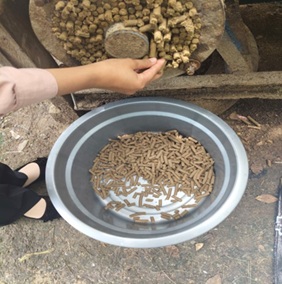
The community service partner involved in this activity is the "Maju Bersama" Patin Fish Cultivation Group, located in Gohong, Pulang Pisau, Central Kalimantan. This group has 15 earthen ponds and harvests twice a year. The harvest yield ranges from 12 to 15 tons per year. Most of the harvest is sold fresh to existing customers, while the remainder is preserved and processed into salted fish. The remaining patin fish waste has not been fully processed and could become fishery waste. The community service activity aims to minimize the impact of pollution from the disposal of post-harvest offal waste and increase the productivity of fish feed processing at the associated activity, the "Maju Bersama" Freshwater Catfish Cultivation Group. The activity method used was education and practical training in fish feed processing. The tools and materials used in this activity include: a feed machine, a stirring rod and basin, dried catfish innards, salted fish, bran, and water. The brief presentation on the utilization of offal waste to produce value-added feed products received a very positive response from the group members. The resulting feed was tested and applied to the freshwater catfish pond, and the fish responded quickly to the spread feed. The conclusion of this activity is to educate people on how to minimize the impact of pollution from offal waste disposal after post-harvest, and, as one of the efforts to increase productivity by processing fish feed, to provide the best response and encourage thinking about developing feed from waste materials.
Downloads
Article Details

This work is licensed under a Creative Commons Attribution-ShareAlike 4.0 International License.
Authors who publish with this journal agree to the following terms:
- Any article on the copyright is retained by the author(s).
- Author grant the journal, right of first publication with the work simultaneously licensed under a Creative Commons Attribution License that allows others to share work with acknowledgment of the work authors and initial publications in this journal.
- Authors are able to enter into a separate, additional contractual arrangements for non-exclusive distribution of published articles of work (eg, post-institutional repository) or publish it in a book, with acknowledgment of its initial publication in this journal.
- Authors are permitted and encouraged to post their work online (e.g., in institutional repositories or on their websites) prior to and during the submission process, as can lead to productive exchanges, as well as earlier and greater citation of published work.
- The article and any associated published material is distributed under the Creative Commons Attribution-ShareAlike 4.0 International License
References
Bhaskar, N dan Mahendrakar. N.S. 2008. Protein hydrolisate fromvisceral waste protein of catla (catla catla): optimazition of hydrolysis condition for acomercial neutral protease. Bioresource Technology, 99: 4105-4111. https://doi.org/10.1016/j.biortech.2007.09.006
Chandrapal GD. 2007. Status of trash fish utilization and fish feed requirements in aquaculture–India. Low value and trash fish in the Asia-Pacific region. https://doi.org/10.6024/jmbai.2013.55.2.01765-11
Darmawiyanti, Veni, & Baidhowi, B. (2015). Artificial Feed Production Engineering in The Center of Fisheries BrackishWater Aquaculture Situbondo East Java. Samakia: Jurnal Ilmu Perikanan, 6(2), 118–124. https://doi.org/10.5281/jsapi.v6i2.292
Hartadi, H., S. Reksodiprodjo dan A.D. Tillman. 1991. Tabel Komposisi BahanMakanan Ternak Untuk Indonesia. Yogyakarta: Gadjah Mada University Press. https://doi.org/10.20961/sainspet.v15i2.14334
Hossain U. & Alam AKMN. 2015. Production Of Powder Fish Silage From Fish Market Waters. Agric. Sci. 13(2): 13-25. https://doi.org/10.3329/sja.v13i2.26565
Hanafiah, K, A. 2011. Rancangan Percobaan Teori & Aplikasi. Ed. 3. Kementerian Kelautan dan Perikanan. 2023. Statistik ekspor perikanan Indonesia. Kementerian Kelautan dan Perikanan. https://doi.org/10.52046/agrikan.v16i1.1479
Handajani, N. I. 2015. Identifikasi Fungi Pada Unit Lumpur Aktif Pengolahan Limbah Cair Industri Tekstil. Jurnal Prosiding Seminar Nasional. https://doi.org/10.13057/psnmbi/m010506
Khairuman, A., & Khairul, A. (2002). Membuat pakan ikan konsumsi. Agro Media Pustaka. Jakarta, 83. https://jsmd.dikara.org/jsmd/article/view/40
La Apu, R. G. 2021. Pemanfaatan Limbah Jeroan Ikan Cakalang (Katsuwonus Pelamis) Sebagai Bahan Subtitusi Tepung Ikan Pada Pertumbuhan Ikan Nila (Oreochromis Niloticus). Jurnal Sains Dan Teknologi Perikanan, 1(2), 13–24. https://doi.org/10.55678/jikan.v1i2.528
[NRC]. National Research Council. 2011. Nutrient Requirement of Warmwater Fishes and Shellfishes. Wahington DC: National Academy of Science Press. https://books.google.co.id/books/about/Nutrient_Requirements_of_Warmwater_Fishe.html?id=NnQrAAAAYAAJ&redir_esc=y
Nurhayati, T., Aryanti, D., Nurjanah. 2009. Kajian Awal Potensi Ekstrak Spons sebagai Antioksidan. Jurnal Kelautan Nasional, 2(2):43-51. https://www.slideshare.net/slideshow/jurnal-spons/15741710
Romansyah, M.A. (2016). Teknik Pembuatan Pakan Buatan Ikan Gurame (Osphronemus gouramy) di CV. Mentari Nusantara Desa Batokan Kecamatan Ngantru, Kabupaten Tulungagung, Propinsi Jawa Timur. https://repository.unair.ac.id/57603/
Santoso, L. & H. Agusmansyah. 2011. Pengaruh Substitusi Tepung Kedelai Dengan Tepung Biji Karet pada Pakan Buatan terhadap Pertumbuhan ikan Bawal Air Tawar (Colossoma macropomum). Berkala Perikanan Terubuk, 39(2): 41-50. http://digilib.unila.ac.id/19194/
Virnanto, L. A., Rachmawati, D., & Samidjan, I. (2016). Pemanfaatan tepung hasil fermentasi azolla (Azolla microphylla) sebagai campuran pakan buatan untuk meningkatkan pertumbuhan dan kelulushidupan ikan gurame (Osphronemus gouramy). Journal of Aquaculture Management and Technology, 5(1), 1–7. https://ejournal3.undip.ac.id/index.php/jamt/article/view/10679