Transformasi Sampah Kaleng Aluminium Menjadi Karya Bermanfaat untuk Memberdayakan Ekonomi Masyarakat Transforming Aluminum Can Waste into Valuable Creations to Empower the Community Economy
Article Sidebar
Main Article Content
Abstract
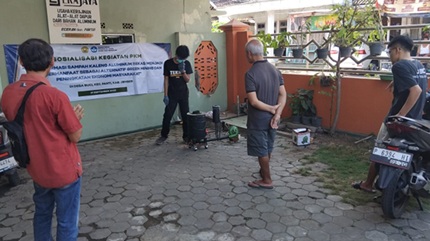
The management of inorganic waste, particularly aluminum can waste, remains a significant challenge across many regions in Indonesia. The consumption of canned products continues to rise, yet the waste management systems in place have not kept pace with this growth. Used cans are commonly discarded as trash or sold to scrap collectors at low economic value. In reality, when properly processed, these materials can be transformed into high-value raw materials for creative products. The target beneficiaries of this program are economically productive household industries, which continue to face key constraints in two critical areas: production and marketing. To address these challenges in a practical and sustainable manner, this community engagement program has been designed to improve the efficiency of aluminum can waste utilization within household production systems. Our partners are home-based aluminum artisans who, despite their productivity, currently lack access to simple, appropriate technologies to process aluminum waste effectively. As a result, the proposed solution involves designing and implementing training programs to develop recycled stoves from aluminum cans. These stoves serve not only as innovative, marketable products but also as a contribution to climate change mitigation efforts.
Downloads
Article Details

This work is licensed under a Creative Commons Attribution-ShareAlike 4.0 International License.
Authors who publish with this journal agree to the following terms:
- Any article on the copyright is retained by the author(s).
- Author grant the journal, right of first publication with the work simultaneously licensed under a Creative Commons Attribution License that allows others to share work with acknowledgment of the work authors and initial publications in this journal.
- Authors are able to enter into a separate, additional contractual arrangements for non-exclusive distribution of published articles of work (eg, post-institutional repository) or publish it in a book, with acknowledgment of its initial publication in this journal.
- Authors are permitted and encouraged to post their work online (e.g., in institutional repositories or on their websites) prior to and during the submission process, as can lead to productive exchanges, as well as earlier and greater citation of published work.
- The article and any associated published material is distributed under the Creative Commons Attribution-ShareAlike 4.0 International License
References
Adi, D. B. (2020). Karakteristik Pembakaran Butana-Udara Pada Meso-Scale Combustor Dengan Sudden Expansion dan Wire Mesh Plate. StatoR: Jurnal Ilmiah Teknik Mesin, 3(1), 38-41. Astuti Y, Prabowo A.(2021). Pemanfaatan limbah aluminium sebagai alternatif bahan baku produk kerajinan ramah lingkungan. Jurnal Tek dan Inovasi.9(2):87–94. https://garuda.kemdiktisaintek.go.id/documents/detail/2839965
Sinaga, N. (2016). Pemanfaatan Limbah Aluminium Sebagai Bahan Baku Aksesoris. https://repository.telkomuniversity.ac.id/pustaka/116110/pemanfaatan-limbah-aluminium-sebagai-bahan-baku-aksesoris.html
Alfian R, Yusron R.(2022). Strategi branding produk berbasis lingkungan pada industri rumah tangga. Jurnal Ekon dan Inovasi Usaha Kecil.6(1):44–52. https://eprints.unram.ac.id/view/type/article.html
Irrubai, M. L. (2016). Strategi labeling, packaging dan marketing produk hasil industri rumah tangga. Social Science Education Journal, 3(1), 17-26. https://doi.org/10.15408/sd.v3i1.3794
Daryanto A.(2020). Daur ulang limbah logam untuk mendukung industri kecil berbasis ekonomi sirkular. Jurnal Ilm Rek Ind.18(1):55–62. https://perpustakaan.undiksha.ac.id/katalog/
Tahalua, I., Nurhaedar, N., Syam, A. W., Dakhri, M., & WK, M. Y. N. (2025). Barang Rongsokan dan Peluang Bisnis Berbasis Ekonomi Sirkular Di Sulawesi Selatan: Tinjauan Literatur Kualitatif. Al-Buhuts, 21(1), 266-283. https://doi.org/10.30603/ab.v21i1.6468
Yuliamir, H., Hadi, S., Dewi, I. K., & Rahayu, E. (2025). Pemasaran Produk Daur Ulang dari Bank Sampah untuk Meningkatkan Daya Saing Wirausaha Lokal. Jurnal Pengabdian Masyarakat Bangsa, 3(5), 2506-2513. https://doi.org/10.59837/jpmba.v3i5.2776
Fachruzzaki F, Halim H, Lestari R.(2022). Pengaruh Campuran Sekam Padi pada Briket Batubara. Jurnal geosapta.8(1). https://dx.doi.org/10.20527/jg.v8i1.10740
Hidayat S, Nursyam H. Manajemen produksi untuk UMKM pengolahan limbah logam.(2019). Jurnal Tek dan Manajemen Industri. 8(2):112–119. https://eprints.unram.ac.id/view/year/NULL.html
Ilminnafik N, Kristianta FX, Sanjaya IB.(2017). Karakteristik Pembakaran Pada Meso Scale Combustor Dengan Bahan Bakar Butan Dan Liquefied Petroleum Gas. Jurnal ROTOR. 4(3):18-21. https://repository.ub.ac.id/id/eprint/142836/
Irawan JF, Fanteri AD, Aminah S, Ulum M.(2025). Investigation of Mining Management Based on Green Mining Integrated with the Potential and Exploration of Mineral Resource Using the AHP Method in Jember East Java. InIOP Conference Series: Earth and Environmental Science.1451(1). https://doi.org/10.1088/1755-1315/1451/1/012023
Jamil F, Asrofi M, Sidartawan R, Triono A, Sholahudin I, Kristianta FX, Nurdiansyah H.(2023). Analisis Struktur Rangka Mesin Vacum Forming Menggunakan Finite Element Analysis. Stator: Jurnal Ilmiah Teknik Mesin.6(2):43-7. https://garuda.kemdiktisaintek.go.id/journal/view/12173?page=9
Lestari D, Wibowo R.(2019). Green mining: konsep dan aplikasi dalam pengelolaan sumber daya alam berkelanjutan. Jurnal Energi dan Pertambangan Berkelanjutan. 7(3):102–110. http://repository.lppm.unila.ac.id/view/subjects/SD.type.html
Maharani E.(2021). Pemasaran digital untuk produk kerajinan dari bahan daur ulang. Jurnal Inovasi Pemasaran. 7(2):65–74. http://repository.lppm.unila.ac.id/view/year/2022.html
Yuliana R.(2020). Strategi hilirisasi produk daur ulang sebagai pendukung ekonomi kreatif lokal. Jurnal Ekon Kreatif dan Inovasi Lokal. 3(1):27–35. https://repository.umnaw.ac.id/jspui/bitstream/123456789/3745/1/Peningkatan%20UMKM.pdf
Zakaria M.(2017). Perubahan iklim dan peran teknologi berbasis masyarakat dalam mitigasi. Jurnal Ilmu Lingkungan. 15(4):155–162. https://fisika.um.ac.id/epilsurg/2018/12/2017_SNFP_6_Artikel-SNFP-2017.pdf