Pelatihan Keterampilan Produksi Video dan Live Streaming pada Kegiatan Jurnalistik SMPN 2 Nglegok Video Production and Live Streaming Skills Training at SMPN 2 Nglegok Journalism Activities
Article Sidebar
Main Article Content
Abstract
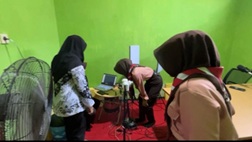
The school's journalism extracurricular activity is essential for developing students' communication skills, critical thinking, and digital media literacy. However, this potential is often hindered by gaps in knowledge and skills in utilizing modern media production technology. This community service activity aims to bridge these skill gaps through training and mentoring in video production and live streaming, supported by the installation of a mini journalism studio. The methods used include technical training, the application of appropriate technology, and participatory mentoring for teachers and students. The results showed that partners demonstrated significant improvements in technical competence, evidenced by pre-test and post-test data, as well as increased confidence. The highlight of the program was the successful independent broadcasting of the school's Dies Natalis event. Post-activity mentoring was also conducted online to ensure program sustainability. This program successfully enhanced partners' technological competencies and established journalism activities as an effective platform for strengthening students' digital skills.
Downloads
Article Details

This work is licensed under a Creative Commons Attribution-ShareAlike 4.0 International License.
Authors who publish with this journal agree to the following terms:
- Any article on the copyright is retained by the author(s).
- Author grant the journal, right of first publication with the work simultaneously licensed under a Creative Commons Attribution License that allows others to share work with acknowledgment of the work authors and initial publications in this journal.
- Authors are able to enter into a separate, additional contractual arrangements for non-exclusive distribution of published articles of work (eg, post-institutional repository) or publish it in a book, with acknowledgment of its initial publication in this journal.
- Authors are permitted and encouraged to post their work online (e.g., in institutional repositories or on their websites) prior to and during the submission process, as can lead to productive exchanges, as well as earlier and greater citation of published work.
- The article and any associated published material is distributed under the Creative Commons Attribution-ShareAlike 4.0 International License
References
Anshori, M., & Iswati S. (2017). Metode penelitian kuantitatif. Airlangga University Press.
Anydesk. (2025). What is AnyDesk? https://support.anydesk.com/docs/anydesk-overview
Creswell, J. W. ., & Guetterman, T. C. . (2019). Educational research : planning, conducting, and evaluating quantitative and qualitative research. Pearson. ISBN:9780134519395
Faizah, N., Made Sutama, I., & Yasa, N. (2022). Jurnal Pendidikan Bahasa dan Sastra Indonesia Tersedia secara online https://ejournal.undiksha.ac.id/index.php/Jjpbs Aktivitas Ekstrakurikuler Jurnalistik Di Smk Negeri 1 Singaraja. 12, 246–251. https://doi.org/10.23887/jpbsi.v12i3.39616
Lukitosari, Z. O., & Rahmat, R. (2024). Penguatan Pendidikan Karakter dalam Ekstrakurikuler PMR. Jurnal Pendidikan dan Pembelajaran Indonesia (JPPI), 4(1), 166–172. https://doi.org/10.53299/jppi.v4i1.421
OBS. (n.d.). Help Portal | OBS. Retrieved October 1, 2025, from https://obsproject.com/help
Parimarma, I. (2025). Peranan Ekskul Jurnalistik LM-NEWS di MAN 5 Bogor. https://man5bogor.sch.id/peranan-ekskul-jurnalistik-lmnews-di-man-5-bogor
Pelangi, A. (2025). Manfaat Jangka Panjang Edukasi Melalui Siaran Live streaming. Pelangi Event Production. https://studiopelangi.id/manfaat-jangka-panjang-edukasi-melalui-siaran-live-streaming/
Rosenberg, M. J. (2001). E-learning : strategies for delivering knowledge in the digital age. McGraw-Hill. The Internet and Higher Education.5(2).185-188.https://doi.org/10.1016/S1096-7516(02)00082-9
Setyaningsih, R., Abdullah, A., Prihantoro, E., & Hustinawaty, H. (2019). Model Penguatan Literasi Digital Melalui Pemanfaatan E-Learning. Jurnal ASPIKOM, 3(6), 1200. https://doi.org/10.24329/aspikom.v3i6.333
Shayeb, S., & Daher, W. (2024). The Impact of Using Digital Video Recordings by Prospective Teachers on Their Technological Pedagogical Content Knowledge. European Journal of Investigation in Health, Psychology and Education, 14(9), 2445–2462. https://doi.org/10.3390/ejihpe14090162
Sugiyono. (2011). Metode Penelitian Pendidikan (Pendekatan Kuantitatif, Kualitatif, dan R&D). Alfabeta.ISBN/ISSN: 979-8433-71-8
Wahyudin, A., Nashirudin, H., Furqon, M., Rohmad, R., & Choironi, M. A. (2023). Effectiveness of Hybrid Learning Using Streaming Technology in Education. International Journal of Instructional Technology, 2(2), 45–52. https://doi.org/10.33650/ijit.v2i2.9332
Yuliyanti, T., Negeri Abdurrahman Wahid Pekalongan, I. K., & Ardi Setyawan Sekolah Menengah Kejuruan Negeri, N. (2024). Penguatan Keterampilan Literasi Jurnalistik bagi Siswa SMK Melalui Workshop Penulisan Berita dan Desain Grafis. Jurnal Inovasi Pengabdian Masyarakat Pendidikan 5(1), 16–33. https://doi.org/10.33369/jurnalinovasi.v5i1.37164
Zubaedi. (2013). Buku Desain Pendidikan Karakter (3rd ed.). Kencana Prenada media group.