Dampak Edukasi Kesehatan dan Rehabilitasi Gigi Tiruan terhadap Status Nutrisi dan Kualitas Hidup Lansia The Impact of Denture Rehabilitation and Health Education on Nutrition and Oral Health Related Quality of Life in the Elderly
Article Sidebar
Main Article Content
Abstract
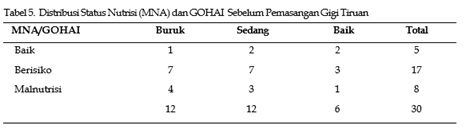
Data shows that 30.52% of older people in Padang experience tooth loss, yet only 1.53% use dentures. This condition can disrupt nutritional intake and diminish the quality of life, thereby increasing the risk of malnutrition. Malnutrition, in turn, can exacerbate the physical and mental health status of older people. A community service program was conducted involving 30 elderly participants at the Posyandu Permata Bunda in Gunung Sarik Village, Padang. The intervention comprised socialization and education on the impacts of tooth loss and the importance of dentures, oral cavity examinations, nutritional status assessment using the Mini Nutritional Assessment, and quality-of-life assessment using the Geriatric Oral Health Assessment Index (GOHAI). The participants were followed from the initial activities through the denture fabrication process. Elderly individuals with poor nutritional status tended to have a poorer quality of life. A significant improvement in quality of life was observed following denture use: the proportion of participants in the "good" category increased from 20% to 60%, while the proportion in the "poor" category decreased from 40% to 10%. A significant difference in GOHAI scores (p<0.05) was found before and after the intervention. The implementation of socialization, education, and denture installation at the posyandu effectively improved the elderly participants' quality of life. This integrated intervention can serve as a model for comprehensively addressing elderly health issues at posyandu, including providing ongoing support after denture use. These activities should be conducted periodically, with nutritional status assessments every three months and continuous monthly support for denture use.
Downloads
Article Details

This work is licensed under a Creative Commons Attribution-ShareAlike 4.0 International License.
Authors who publish with this journal agree to the following terms:
- Any article on the copyright is retained by the author(s).
- Author grant the journal, right of first publication with the work simultaneously licensed under a Creative Commons Attribution License that allows others to share work with acknowledgment of the work authors and initial publications in this journal.
- Authors are able to enter into a separate, additional contractual arrangements for non-exclusive distribution of published articles of work (eg, post-institutional repository) or publish it in a book, with acknowledgment of its initial publication in this journal.
- Authors are permitted and encouraged to post their work online (e.g., in institutional repositories or on their websites) prior to and during the submission process, as can lead to productive exchanges, as well as earlier and greater citation of published work.
- The article and any associated published material is distributed under the Creative Commons Attribution-ShareAlike 4.0 International License
References
To be published