Optimization of Inorganic Waste Recycling into Plant Pots Using the 4R Approach to Support the Adiwiyata Unggulan School Program
Article Sidebar
Main Article Content
Abstract
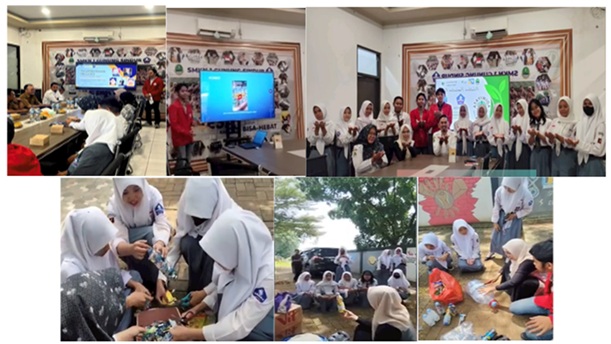
Inorganic waste, particularly plastic generated from school canteens and learning activities, remains a significant environmental challenge due to its non-biodegradability, which contributes to soil, water, and air pollution. Addressing this issue, this community service program aimed to enhance students' environmental awareness and practical skills in managing plastic waste by producing ecobricks, which were repurposed as eco-friendly plant pots to improve the school's aesthetic and ecological quality. Mercu Buana University implemented the program in collaboration with the Rawakalong Village Government to support SMKN 1 Gunung Sindur in achieving Exemplary Adiwiyata School status. The initiative combined participatory training sessions, hands-on Fs, and continuous mentoring, emphasizing the application of the 4R principles in the school environment. The results indicated a marked increase in students' engagement, knowledge, and skills in waste management, along with a measurable reduction in plastic waste volume. Ecobricks were successfully integrated into school greening activities, serving as both functional plant pots and tangible educational tools that reinforced sustainable behaviors. The program also contributed to the fulfillment of Key Performance Indicators (KPI) 3 and 7 and promoted experiential, community-based learning aligned with the Merdeka Belajar–Kampus Merdeka initiative. This study demonstrates that ecobrick-based interventions can transform environmental challenges into educational opportunities, fostering sustainable practices and participatory learning among students. Moreover, the program highlights the potential to scale ecobrick initiatives across broader school and community contexts, supporting environmental stewardship and institutional commitment to sustainability. These findings provide practical and theoretical insights into integrating hands-on waste management strategies into school-based ecological education programs.
Downloads
Article Details

This work is licensed under a Creative Commons Attribution-ShareAlike 4.0 International License.
Authors who publish with this journal agree to the following terms:
- Any article on the copyright is retained by the author(s).
- Author grant the journal, right of first publication with the work simultaneously licensed under a Creative Commons Attribution License that allows others to share work with acknowledgment of the work authors and initial publications in this journal.
- Authors are able to enter into a separate, additional contractual arrangements for non-exclusive distribution of published articles of work (eg, post-institutional repository) or publish it in a book, with acknowledgment of its initial publication in this journal.
- Authors are permitted and encouraged to post their work online (e.g., in institutional repositories or on their websites) prior to and during the submission process, as can lead to productive exchanges, as well as earlier and greater citation of published work.
- The article and any associated published material is distributed under the Creative Commons Attribution-ShareAlike 4.0 International License
References
Akbar, A., Nurhasana, R., Hasan, C., Oktorini, R., Indrajoga, D. N., Harjito, U., Hernandi, R., Ratnasari, D. N., Waruwu, A. H. G., & Hartono, I. B. (2023). Utilization of plastic waste into garden decoration using ecobrick techniques. Journal of Community Service and Empowerment, 4(1), 130–138.
Ardiansari, L., Arista, H., Rahma, A. A., & Swari, U. R. (2024). Aksi lingkungan: Praktik membuat ecobrick di sekolah dasar. Lumbung Inovasi: Jurnal Pengabdian kepada Masyarakat, 9(4), 1182–1193.
Manurung, N. E. P., Prasetyo, T., Tanjung, M. A. C. A., Africano, F., Dewantara, B., Nugraha, Y. A., Agustin, R. D., Agustina, S., Fernandez, M., & Pratami, V. I. (2025). Pemanfaatan botol plastik bekas menjadi pot hias melalui participatory action research. Jurnal Pengabdian Masyarakat Akademisi, 4(3), 164–174.
Nursanti, F., Fitriyani, F., Indriani, I., & Prasetyo, P. (2024). Pemanfaatan ecobrick sebagai inovasi pembelajaran berbasis lingkungan di SMPN 6 Samarinda dengan program kerja Adiwiyata. Jurnal Inovasi Refleksi Profesi Guru, 1(2), 71–76. https://doi.org/10.30872/jirpg.v1i2.4552
Rahayu, A. S., Awaliah, W. S. F., & Logayah, D. S. (2024). Ecobrick sebagai solusi pengurangan sampah dan membangun kebiasaan hidup bersih siswa di sekolah. Jurnal Pengabdian Masyarakat Indonesia, 4(3), 517–521. https://doi.org/10.52436/1.jpmi.2559
Salamah, Z., Sasongko, H., Nurusman, A. A., Saputri, A. I., Putri, A. L. P., & Saroh, V. Y. (2024). Ecobrick sebagai salah satu alternatif menyelesaikan permasalahan sampah plastik di Kampung Cokrokusuman Yogyakarta. Jurnal PengabdianMu: Jurnal Ilmiah Pengabdian kepada Masyarakat, 9(8), 1441–1448.
Wardani, F., & Khotimah, N. (2021). Making eco-bricks as a solution to environmental problems through empowering creative children: A case study in Baruga District, Kendari City. International Journal of Science and Society, 3(2), 214–221.
Wahyuni, S., & Hapsari, F. (2021). PKM pembuatan ecobrick sebagai upaya menumbuhkan sekolah ramah lingkungan di SMP PGRI 30 Jakarta. Jurnal Pengabdian Masyarakat Edumi, 1(1), 19–26.