Integrasi Literasi Keuangan dalam Pendidikan Menengah: Studi Kasus pada Siswa SMA Pangudi Luhur Kelas X The Integration of Financial Literacy into Secondary Education: A Case Study of Grade 10 Students at Pangudi Luhur Senior High School, Jakarta
Article Sidebar
Main Article Content
Abstract
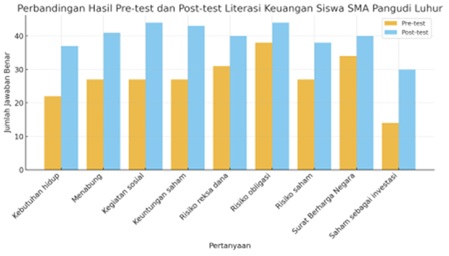
This community service activity aims to integrate financial literacy into the secondary education curriculum to foster wise, responsible financial behavior. The program was implemented for Grade 10 students at SMA Pangudi Luhur Jakarta, focusing on three main aspects: personal financial management, investment understanding, and awareness of online loan risks. The implementation methods included interactive lectures, group discussions, investment simulations, and evaluation by pre-test and post-test instruments. The results revealed a significant improvement in students' financial literacy levels. The average pre-test score of 27.4 increased to 39.7 in the post-test, reflecting a 45% enhancement in understanding. The most significant improvements were observed in students' ability to allocate expenditures to basic needs, savings, and social activities, followed by increased awareness of the characteristics and risks of a range of investment vehicles, including equities, mutual funds, and bonds. This program demonstrates that integrating financial literacy into secondary education is effective in fostering financial awareness and developing essential money management skills from an early age.
Downloads
Article Details

This work is licensed under a Creative Commons Attribution-ShareAlike 4.0 International License.
Authors who publish with this journal agree to the following terms:
- Any article on the copyright is retained by the author(s).
- Author grant the journal, right of first publication with the work simultaneously licensed under a Creative Commons Attribution License that allows others to share work with acknowledgment of the work authors and initial publications in this journal.
- Authors are able to enter into a separate, additional contractual arrangements for non-exclusive distribution of published articles of work (eg, post-institutional repository) or publish it in a book, with acknowledgment of its initial publication in this journal.
- Authors are permitted and encouraged to post their work online (e.g., in institutional repositories or on their websites) prior to and during the submission process, as can lead to productive exchanges, as well as earlier and greater citation of published work.
- The article and any associated published material is distributed under the Creative Commons Attribution-ShareAlike 4.0 International License
References
Afandi, M., & Wijayanti, N. (2023). Peningkatan literasi keuangan siswa sekolah menengah melalui edukasi dan simulasi investasi. Jurnal Pengabdian Kepada Masyarakat Indonesia, 4(2), 145–155. https://doi.org/10.24853/jpmi.4.2.145-155
Aisyah, S., & Rahmawati, D. (2024). Integrasi literasi keuangan dalam kurikulum sekolah menengah: Upaya membentuk generasi melek finansial. Jurnal Pendidikan dan Ekonomi, 9(1), 25–37. https://doi.org/10.31219/osf.io/9x34y
Amalia, F., & Rachmawati, Y. (2022). Edukasi investasi dan pengelolaan keuangan untuk siswa SMA di era digital. Jurnal Abdi Masyarakat Indonesia, 3(3), 210–220. https://doi.org/10.31219/osf.io/5w48g
Bank Indonesia. (2023). Survei nasional literasi dan inklusi keuangan 2023. Bank Indonesia.
Fadillah, R., & Sari, M. (2021). Financial literacy and behavior among high school students: Evidence from Indonesia. Journal of Economics and Education Research, 22(4), 1–12.
Hasanah, N., & Putri, R. (2020). Peningkatan literasi keuangan melalui program edukasi keuangan di sekolah menengah atas. Jurnal Abdimas, 24(2), 88–96.
Nugroho, A., & Fitriani, D. (2021). Digital financial literacy and the risk of illegal online loans among youth in Indonesia. Journal of Economic Education and Society, 12(3), 155–167.
Otoritas Jasa Keuangan. (2022). Survei nasional literasi dan inklusi keuangan (SNLIK) 2022. Otoritas Jasa Keuangan.
Otoritas Jasa Keuangan. (2023). Strategi nasional literasi keuangan Indonesia (SNLKI) 2021–2025. Otoritas Jasa Keuangan.
Pradana, R., & Santoso, H. (2024). Investment interest and risk awareness among Gen Z in Indonesia. Journal of Financial Literacy and Technology, 5(1), 44–58.
Rahman, T., & Prasetyo, D. (2024). Digital financial literacy and online loan awareness among youth. International Journal of Economics and Business Education, 5(1), 42–54. https://doi.org/10.1016/ijebe.2024.01.005
Santoso, A., & Lestari, W. (2023). The role of financial education in promoting responsible financial behavior among students. Journal of Financial Education and Practice, 14(2), 78–89.
Sari, N. M., & Putri, E. D. (2023). Financial literacy education in high school: Impact on financial behavior of students. International Journal of Educational Development, 92, 102717
Sari, P., & Nugroho, A. (2022). Edukasi literasi keuangan dan investasi untuk siswa SMA melalui metode experiential learning. Jurnal Pengabdian Pendidikan, 5(1), 33–42.
Wulandari, F., Rahman, T., & Kusuma, Y. (2022). Participatory learning methods in enhancing students’ financial literacy. Journal of Community Empowerment and Education, 4(2), 88–101.
Yuliana, D., & Firmansyah, M. (2021). Hubungan literasi keuangan dan perilaku keuangan siswa SMA di Jakarta. Jurnal Ekonomi Pendidikan dan Kewirausahaan, 9(2), 120–132. https://doi.org/10.21831/jepk.v9i2.40312