Melindungi dan Mengelola Keuangan Keluarga: Edukasi Pinjaman Online dan Manajemen Keuangan untuk Ibu-Ibu Desa Babakan Protecting and Managing Family Finances: Online Loan and Financial Management Education for Women in Babakan Village
Article Sidebar
Main Article Content
Abstract
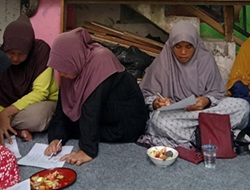
This community service program was implemented in Babakan Village, Dramaga District, Bogor Regency, focusing on empowering homemakers through financial management education, awareness of online loan risks, and the development of family economic enterprises. The objectives of this activity were to improve financial literacy, strengthen critical awareness of illegal online loans, and train practical skills to support additional family income. The methods used included interactive lectures, group discussions, demonstrations, and hands-on practice, with evaluation using pre-tests and post-tests. The results of the activity showed a significant increase in participants' understanding of financial management (p-value = 0.035), online loans (p-value = 0.002), and family economic enterprises (p-value = 0.022). Participants also successfully practiced budgeting, food production (meatballs and sempol), and business break-even analysis. These findings indicate that empowerment programs are effective in improving knowledge and skills, thereby contributing to economic resilience and family welfare in the digital era.
Downloads
Article Details

This work is licensed under a Creative Commons Attribution-ShareAlike 4.0 International License.
Authors who publish with this journal agree to the following terms:
- Any article on the copyright is retained by the author(s).
- Author grant the journal, right of first publication with the work simultaneously licensed under a Creative Commons Attribution License that allows others to share work with acknowledgment of the work authors and initial publications in this journal.
- Authors are able to enter into a separate, additional contractual arrangements for non-exclusive distribution of published articles of work (eg, post-institutional repository) or publish it in a book, with acknowledgment of its initial publication in this journal.
- Authors are permitted and encouraged to post their work online (e.g., in institutional repositories or on their websites) prior to and during the submission process, as can lead to productive exchanges, as well as earlier and greater citation of published work.
- The article and any associated published material is distributed under the Creative Commons Attribution-ShareAlike 4.0 International License
References
Amalina, Nur, Civi Erikawati, Farid Muhammad Roffifudin, Aulia Galuh Ani Sekar Arum, and Sapta Natalia Miyanti. 2024. Pemahaman Literasi Keuangan Digital Dalam Mencegah Pinjaman Online Ilegal Pada Pengurus Ranting ‘Aisyiyah Ngasem. Jurnal Pengabdian Masyarakat Nusantara (JPMN), 4 (1): 30–35. https://doi.org/10.35870/jpmn.v4i1.2813.
Deacon, E. Ruth, and Firebaugh, M. Francile. 1988. Family Resource Management: Principles and Applications. Allyn and Bacon
Firmansyah, Rizky, Vera Tri Julianti, Dediek Tri Kurniawan, Ahmad Arif Widianto, and Mohd Rizal Palil. 2021. Implications of Financial Management on Family Economic Welfare Moderated by Household Financial Literacy. Advances in Social Science, Education and Humanities Research, 649 (2): 42–51. https://doi.org/10.2991/assehr.k.220304.006.
Herremans, Irene, Peggy Hedges, Fereshteh Mahmoudian, Anne Kleffner, and Mahrukh Tahir. 2023. The Paradox of the Payday Borrower: A Case Study of the Role of Planned Behavior in Borrowers’ Motivations and Experiences. Journal of Risk and Financial Management, 16 (5). https://doi.org/10.3390/jrfm16050254.
Imanuddin, Iman, R.R Dewi Anggraeni, Fridayani, and Susanto. 2023. Construction of Consumer Protection against Illegal Online Loan Transactions as a Means of IUS Constituendum in Indonesia. Jurnal IUS Kajian Hukum Dan Keadilan, 11 (3): 539–56. https://doi.org/10.29303/ius.v11i3.1312.
Koomson, Isaac, Renato Andrin Villano, and David Hadley. 2021. Accelerating the Impact of Financial Literacy Training Programmes on Household Consumption by Empowering Women. Applied Economics, 53 (29): 3359–76. https://doi.org/10.1080/00036846.2021.1878093.
Novika, fanny, Nike Septivani, and I P Made Indra. 2022. Illegal Online Loans Become a Social Disaster for the Millenial Generation. Management Studies and Entrepreneurship Journal, 3 (3): 1174–92. https://doi.org/https://doi.org/10.37385/msej.v3i3.857.
Nadhiroh, U. and Mukhlis, I. (2023) ‘Family financial management behavior in ohusewives ( a phenomenological review )’, Formosa Journal of Science and Technology (FJST), 2(12), pp. 3161–3174. Available at: https://doi.org/https://doi.org/10.55927/fjst.v2i12.7223.
Nur, Siti Khayisatuzahro, and Aris Yuni Pawestri. 2023. Peningkatan Literasi Keuangan Dan Pencegahan Pinjaman Online Ilegal Bagi Ibu Ibu ‘Aisyiyah Jember. Jurnal Kreativitas Dan Inovasi, 3 (3): 105–11. https://doi.org/10.24034/kreanova.v3i3.6002.
Pramesti, R.A. and Karnadi (2023) Analisis kualitas sumber daya manusia dalam perilaku keuangan ibu rumah tangga lingkungan perumnas Patrang Kota Jember di era digitalisasi, Jurnal Ekonomi dan Bisnis GROWTH, 21(2), pp. 508–522. https://doi.org/https://doi.org/10.36841/growth-journal.v21i2.4020.
Purtra, Restu Adi, Divi Kusumaningrum, and Totok Minto Leksono. 2023. Perlindungan Hukum Debitur Yang Dirugikan Akibat Pinjaman Berbasis Teknologi Informasi Ilegal. Morality: Jurnal Ilmu Hukum, 9 (2): 163–69. https://doi.org/http://dx.doi.org/10.52947/morality.v9i2.454.
Supratman, Baiq Herdina Septika, Tama Krisnahadi, Sri Sukarni, and Yayang Erry Wulandari. 2024. Entrepreneurship Training for Housewives to Improve the Family Economy in Semparu Kopang Village, Central Lombok. Jurnal Abdimas (Journal of Community Service), 6 (2): 378–86. https://doi.org/10.36312/sasambo.v6i2.1857.