Modul Analisa Tulisan Tangan (Grafologi) untuk Membantu Merencanakan Masa Depan Siswa Handwriting Analysis (Graphology) Module to Help Plan Students’ Future
Article Sidebar
Main Article Content
Abstract
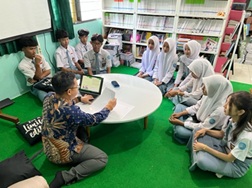
Education at the high school level plays a vital role in preparing students for the future, not only academically but also for career planning. Low career maturity among students often leads to confusion in choosing a college major and career, increasing the risk of selecting the wrong major, as our community service partner, Grabag 2 Public High School, has experienced. To address this issue, a training program was developed to create digital career guidance modules based on graphology for guidance and counseling teachers and homeroom teachers. This training consists of several stages, namely coordination, program development, socialization, training, technology implementation, mentoring, and evaluation. The program results show an increase in teachers' competence in understanding graphology and the production of 3 modules to help students recognize their character, interests, and career tendencies through handwriting analysis. Thus, this training program for developing digital modules based on graphology can be an innovative solution to improve the quality of career guidance services and help students plan their futures more accurately and purposefully.
Downloads
Article Details

This work is licensed under a Creative Commons Attribution-ShareAlike 4.0 International License.
Authors who publish with this journal agree to the following terms:
- Any article on the copyright is retained by the author(s).
- Author grant the journal, right of first publication with the work simultaneously licensed under a Creative Commons Attribution License that allows others to share work with acknowledgment of the work authors and initial publications in this journal.
- Authors are able to enter into a separate, additional contractual arrangements for non-exclusive distribution of published articles of work (eg, post-institutional repository) or publish it in a book, with acknowledgment of its initial publication in this journal.
- Authors are permitted and encouraged to post their work online (e.g., in institutional repositories or on their websites) prior to and during the submission process, as can lead to productive exchanges, as well as earlier and greater citation of published work.
- The article and any associated published material is distributed under the Creative Commons Attribution-ShareAlike 4.0 International License
References
Fadhilla, M., Saf, M. R. A., & Sahid, D. S. S. (2017). Pengenalan kepribadian seseorang berdasarkan pola tulisan tangan menggunakan jaringan saraf tiruan. Jurnal Nasional Teknik Elektro dan Teknologi Informasi, 6(3), 365–373. https://doi.org/10.22146/jnteti.v6i3.340
Fikri, I. (2012). Menggagas grafologi Islam; studi tentang konsep pengembangan kepribadian dengan pendekatan tulisan tangan Arab. Dalam Proceedings of the Annual International Conference on Islamic Studies (AICIS) XII.
Kemendikbud. (2018). Permendikbud No. 15 Tahun 2018.
Permendikbud. (2014). Permendikbud No. 111 Tahun 2014 tentang bimbingan dan konseling pada pendidikan dasar dan pendidikan menengah.
Prasetyono, D. S. (2018). Seni belajar grafologi. Laksana.
Pratiwi, D., Santoso, G. B., & Saputri, F. H. (2017). The application of graphology and enneagram techniques in determining personality type based on handwriting features. Jurnal Ilmu Komputer Dan Informasi, 10(1), 11–18. https://doi.org/10.21609/jiki.v10i1.372
Sari, A., Nanere, Y. E., & Ernawati, R. (2023). Kematangan karir siswa remaja dalam menghadapi dunia pekerjaan. Jurnal Suluh Pendidikan (JSP), 11(1). 1–8. https://doi.org/10.36655/jsp.v11i1.853
Şeşen, Y. (2024). The connection of archival science with graphology and criminology studies. Current Perspectives in Social Sciences, 28(3), 415–434. https://doi.org/10.53487/atasobed.1463808
Sharf, R. S. (2002). Applying career development theory to counseling. Thomson Brooks/Cole Publishing Co.
Suwidagdho, D., Hadi, A., & Setiawati, R. (2023). Tren penelitian perencanaan karier di Indonesia: Dari metode penelitian hingga variabel-variabel terkait. Coution: Journal of Counseling and Education, 4(1), 30–41. https://doi.org/10.47453/coution.v4i1.601
UNESCO. (2022). Transforming technical and vocational education and training for successful and just transitions: UNESCO strategy 2022–2029. UNESCO.