Pemberdayaan Ekonomi Perempuan Melalui Pelatihan Pembuatan Eco Enzyme kulit Buah di Kelurahan Kalisegoro Kota Semarang Enhancing Women's Economic Empowerment Through Training in Fruit Peel Eco Enzyme Production in Kalisegoro Subdistrict, Semarang City
Article Sidebar
Main Article Content
Abstract
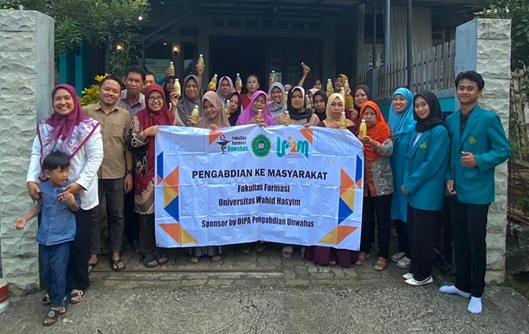
Homemakers in Kalisegoro Village, Gunungpati District, Semarang City, face two primary challenges: economic difficulties within families and suboptimal management of organic kitchen waste. A preliminary study indicated that 100% of respondents had never recycled organic waste and were unfamiliar with eco enzyme. This community service activity aimed to provide training on recycling organic kitchen waste, specifically honey, pineapple, and pressed orange peels, into a multipurpose eco enzyme. This training was expected to impart new skills, thereby improving the family's economic situation through entrepreneurship. The activity methods, implemented by a team of lecturers and students from the Faculty of Pharmacy at Wahid Hasyim University, included educational outreach (lectures, leaflets, and videos), demonstrations, and question-and-answer sessions. The training also equipped participants with packaging techniques and methods for calculating the Cost of Goods Sold (COGS). Program success was evaluated using pre-tests and post-tests administered to 22 participants from the Family Welfare Movement (PKK). The pre-test results showed an average score of 45, indicating a low initial level of understanding. After completing the entire series of activities, the post-test results showed a significant increase in the average score to 81.4. This improvement demonstrates that the training successfully enhanced participants' knowledge and skills in processing organic waste into beneficial, environmentally friendly products possessing economic value.
Downloads
Article Details

This work is licensed under a Creative Commons Attribution-ShareAlike 4.0 International License.
Authors who publish with this journal agree to the following terms:
- Any article on the copyright is retained by the author(s).
- Author grant the journal, right of first publication with the work simultaneously licensed under a Creative Commons Attribution License that allows others to share work with acknowledgment of the work authors and initial publications in this journal.
- Authors are able to enter into a separate, additional contractual arrangements for non-exclusive distribution of published articles of work (eg, post-institutional repository) or publish it in a book, with acknowledgment of its initial publication in this journal.
- Authors are permitted and encouraged to post their work online (e.g., in institutional repositories or on their websites) prior to and during the submission process, as can lead to productive exchanges, as well as earlier and greater citation of published work.
- The article and any associated published material is distributed under the Creative Commons Attribution-ShareAlike 4.0 International License
References
Jelita, R. (2022). Produksi Eco Enzyme dengan Pemanfaatan Limbah Rumah Tangga untuk Menjaga Kesehatan Masyarakat di Era New Normal. Jurnal Maitreyawira, 3 (1)(69), 5–24. https://doi.org/10.69607/jm.v3i1.49
Lustiyati, E. D., Untari, J., Rosali, W., & Dewi, D. (2024). Pelatihan Daur Ulang Limbah Organik Dapur Menjadi Eco Enzyme Bagi Ibu Rumah Tangga. JPPM (Jurnal Pengabdian Dan Pemberdayaan Masyarakat), 8(1), 9. https://doi.org/10.30595/jppm.v8i1.13336
Masruchiyah, N., & Laratmase, A. J. (2023). Pemberdayaan Perempuan dalam Pembangunan Berkelanjutan di Era Revolusi Industri 4.0. Jurnal Green Growth Dan Manajemen Lingkungan, 12(2), 125–138. https://doi.org/10.21009/10.21009.122.3
Nurmillaty, A., Agustina, M., Pratama, M. T. A., Puspita, N. I., Saputra, N., Ahyad, N., Nugraha, R., Sulastri, S., Drisani, V. B. P., Pasha, L. S., & others. (2025). Upaya Pemanfaatan Sampah Organik Kulit Buah Menjadi Eco-Enzyme di Dusun Puhun Desa Subang. Bakti Uniku, 1(1), 64–70. https://doi.org/10.25134/bakti.v1i1.33
Putra, V. E., Fadila, R., Lindawati, D., Gupitasari, J. P., Andayani, E. A., & Bekti, Y. A. (2022). Pelatihan Pembuatan Eco Enzyme Sebagai Alternatif Pengelolaan Sampah Organik Di Kota Batu. Jurnal IDAMAN (Induk Pemberdayaan Masyarakat Pedesaan), 6(1), 25. https://doi.org/10.31290/j.idaman.v(6)i(1)y(2022).page:25-31
Rosyidi, L., Rofiq, A., & Khusnudin. (2025). Peran Perempuan Dalam Pembangunan Ekonomi Dan Penguatan Kesetaraan Gender. Jurnal Istiqro, 11(1), 20–34. https://doi.org/10.30739/istiqro.v11i1.3160
Sucitra, I. D., Pratiknjo, M. H., & Kawung, E. J. (2024). GOVERNANCE: Jurnal Ilmiah Kajian Politik Lokal dan Pembangunan. GOVERNANCE: Jurnal Ilmiah Kajian Politik Lokal Dan Pembangunan, 10(3), 67–68. https://doi.org/10.59525/rechtsvinding.v3i1.840
Suhartini, B. Oktavia, T., & Aminatun, F. A. (2025). Community Empowerment In The Management Of Organic Waste Into Multi-Purpose And. Jurnal Abdi Insani, 12(2), 777–786. https://doi.org/10.29303/abdiinsani.v12i2.2313