Optimalisasi Produktivitas Mie Instan Patin (Pangasius sp) pada UMKM Dua Putri Tavida, Desa Ngerong, Kabupaten Pasuruan Optimization of Catfish (Pangasius sp) Instant Noodle Production at MSME Dua Putri Tavida, Ngerong Village, Pasuruan Regency
Article Sidebar
Main Article Content
Abstract
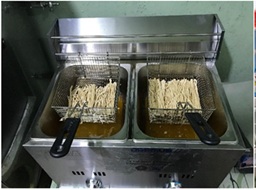
MSME Dua Putri Tavida is one of the MSMEs in Ngerong Village that consistently processes fishery products with a zero-waste concept, namely, utilizing sold catfish waste. One of its unique superior products is instant catfish noodles. The problem is that the technology is still simple and low-capacity, so it cannot be produced in large quantities, despite strong consumer demand. Therefore, the purpose of the Doktor Mengabdi Community Service program is to optimize productivity by providing appropriate technology, including a stand mixer, a 35 kg-capacity noodle printing machine, a deep fryer, and a 120 L electric oven. The service activity method comprises socialization, training, technology application, mentoring, and evaluation. The results of the service activities show a 60% increase in efficiency across costs, time, and labor, and a threefold increase in profits compared to before. The use of a stand mixer can reduce labor and maintain product homogeneity; a noodle-forming machine can form dough faster with a large capacity; a deep fryer can speed up the homogeneous frying of noodles; and an electric oven can speed up the process of draining noodles from oil with a large capacity.
Downloads
Article Details

This work is licensed under a Creative Commons Attribution-ShareAlike 4.0 International License.
Authors who publish with this journal agree to the following terms:
- Any article on the copyright is retained by the author(s).
- Author grant the journal, right of first publication with the work simultaneously licensed under a Creative Commons Attribution License that allows others to share work with acknowledgment of the work authors and initial publications in this journal.
- Authors are able to enter into a separate, additional contractual arrangements for non-exclusive distribution of published articles of work (eg, post-institutional repository) or publish it in a book, with acknowledgment of its initial publication in this journal.
- Authors are permitted and encouraged to post their work online (e.g., in institutional repositories or on their websites) prior to and during the submission process, as can lead to productive exchanges, as well as earlier and greater citation of published work.
- The article and any associated published material is distributed under the Creative Commons Attribution-ShareAlike 4.0 International License
References
Ahmadi, K., & Edyson. (2016). Peningkatan Kualitas Dan Produktivitas Stik Fungsional Lidah Buaya. TEKNOLOGI PANGAN, 7(3), 118–123. https://doi.org/10.35891/tp.v7i3.516
Azuardi, Hidayatullah, R. I. N., Pratama, Y., & Adelino, M. I. (2023). Analisis Pengukuran Waktu Kerja Mengunakan Metode Maynard Operation Sequence Tecnique (MOST) Pada UMKM Kebab Dara Syawarma. Jurnal Sains Dan Teknologi (JSIT), 2(3), 141–148. https://doi.org/10.47233/jsit.v3i1.511
BPS. (2022). Kabupaten Pasuruan Dalam Angka 2022. BPS Kabuaten Pasuruan.
BPS. (2023). Produksi Ikan Patin Budidaya. BPS Pusat.
Chambers, R. (1994). The Origins and Practice of Rural Appraisal. World Development, 22(7), 953–969. http://www.ircwash.org/sites/default/files/125-94OR-16929.pdf
Firdaus, M., & Intyas, C. A. (2020). Efisiensi Kapasitas dan Biaya Produksi Kerupuk Ikan melalui Penggunaan Mesin Pengadonan pada UKM Maharani. PengabdianMu: Jurnal Ilmiah Pengabdian Kepada Masyarakat, 5(2), 185–191. https://doi.org/10.33084/pengabdianmu.v5i2.1079
Firdaus, M., Intyas, C. A., & Yahya, Y. (2021). Peningkatan Kapasitas Produksi Terasi Rebon di Desa Ketapang, Kotamadya Probolinggo. PengabdianMu: Jurnal Ilmiah Pengabdian Kepada Masyarakat, 6(3), 285–290. https://doi.org/10.33084/pengabdianmu.v6i3.1832
Fitria, R., Setiyono, R. S., & Sulistyorin, L. (2019). Korelasi Kualitas Fisik Ikan Asap Dan Fasilitas Kegiatan Higiene Dan Sanitasi Dengan Keberadaan Bakteri Escherichia Coli Pada Ikan Asap. Jurnal Kesehatan Lingkungan, 11(4), 276–285. https://doi.org/10.20473/jkl.v11i4.2019.276-285
Hanani, N. A., Hartono, B., Fahriyah, F., Shadiqur Rahman, M., Aghniarahim Putritamara, J., Asmara, R., Ula, M., Puspo Nugroho, C., Yustian Maulana Noor, A., Adi Intyas, C., & Shaleh, M. I. (2024). Pemberdayaan Petani Tembakau Melalui Diversifikasi Budidaya Peternakan Lebah Madu di Kabupaten Probolinggo Jawa Timur. Jurnal Dinamika Pengabdian, 9(2), 301–313. https://doi.org/10.20956/JDP.V9I2.27831
Harisudin, M., Riptanti, E. W., Khomah, I., & Qonita, R. A. (2023). Introduksi Teknologi Mesin Penggiling Singkong sebagai Upaya Meningkatkan Kualitas Produk UKM Gethuk Bu Sri Karanganyar Jawa Tengah. Jurnal Pengabdian UNDIKMA, 4(3), 508. https://doi.org/10.33394/jpu.v4i3.8473
Intyas, C. A., & Abidin, Z. (2018). Manajemen Agribisnis Perikanan. UB Press.
Intyas, C. A., Handayani, W., Swara, S. E., & Adilvy, R. D. (2026). Optimalisasi Produktivitas Olahan Produk Zero Waste Limbah Ikan Patin (Pangasius hypophthalmus) pada Poklahsar Dadhen Mandiri di Kepanjen, Kabupaten Malang. PengabdianMu : Jurnal Ilmiah Pengabdian Kepada Masyarakat, 11(1). https://doi.org/10.33084/pengabdianmu.v11i1.10932
Intyas, C. A., Koestiono, D., & Tjahjono, A. (2017). Business Analysis of Smoked Fish To Increase Small Scale Fishermen’S Household Income. Russian Journal of Agricultural and Socio-Economic Sciences, 62(2), 250–254. https://doi.org/10.18551/rjoas.2017-02.29
Intyas, C. A., Putritamara, J. A., & Haryati, N. (2022). Dinamika Agrobisnis Era VUCA (Volatility, Uncertainty, Complexity, Ambiguity). Universitas Brawijaya Press. https://books.google.co.id/books?id=LS2uEAAAQBAJ
Intyas, C. A., Tjahjono, A., Koestiono, D., Riana, F. D., & Suhartini. (2023). Value Chain Analysis of the Marine Ornamental Reef: A Case Study in Banyuwangi, East Java, Indonesia. Environmental Research, Engineering and Management, 79(2), 21–31. https://doi.org/10.5755/j01.erem.79.2.32951
Kementrian UMKM Republik Indonesia. (2019). Data UMKM di Indonesia. https://umkm.go.id/data-umkm/?tjEkDUoRuSm7BVO2d9OunrkAf7gmwcKuJvGqqM4yMSfoRNCXyr
Lestia, A. S., & Yulida, Y. (2019). Penerapan Iptek bagi Masyarakat Bantaran Sungai Barito Kelurahan Kuin Utara dalam Produksi Kue Jintan Manis dan Akar Pinang. Prosiding Seminar Nasional Pengabdian Kepada Masyarakat, 1(1), 38–45. https://snllb.ulm.ac.id/prosiding/index.php/snllb-abdimas/article/view/283
Munthe, A., Yarham, M., & Siregar, R. (2023). Peranan UMKM terhadap perekonomian Indonesia. Jurnal Ekonomi Bisnis, Manajemen Dan Akuntansi, 2(3), 593–614. https://doi.org/10.61930/jebmak.v2i3.321
Nielsen, C. S., & Arlitt, R. M. (2022). Systemizing and Automating the Concept Development Process Based on Product Configuration and User Feedback: Case Study on Automating the Design Process of Creating Concepts for a Kitchen Stand Mixer. Systems, 10(3). https://doi.org/10.3390/systems10030060
Nurhidayati, D. (2024). Application Effect of Hand Mixer and Overhead Mixer on Mixing Performance for the Manufacture of Artificial Leather. Berkala Penelitian Teknologi Kulit, Sepatu, Dan Produk Kulit, 22(1), 39–44. https://doi.org/10.58533/3jerca37
Okwabi, R. (2016). Design and Construction of a Hand Operated Mixer Machine for Food Fortification. 6–15. https://www.academia.edu/34423659/Design_and_Construction_of_a_Hand_Operated_Mixer_Machine_for_Food_Fortification
Permana, S. H. (2017). Strategi Peningkatan Usaha Mikro, Kecil, Dan Menengah (Umkm) Di Indonesia. Aspirasi, 8(1), 93–103. https://www.irjet.net/archives/V3/i9/IRJET-V3I902.pdf
Primyastanto, M., Sari, M., Intyas, C. A., Putritamara, J. A., & Arif, M. E. (2023). Pengembangan Mina Bisnis Blue Crab (Callinectes sapidus) dengan TTG Blue Crab Boiler Pada UD. Selat Madura 33 untuk Meningkatkan Daya Saing. PengabdianMu: Jurnal Ilmiah Pengabdian Kepada Masyarakat, 8(2), 160–166. https://doi.org/10.33084/pengabdianmu.v8i2.4191
Rosmeri, V. I. D. B. N. M. (2013). Pemanfaatan Tepung Umbi Gadung ( Dioscorea hispida Dennst ) dan Tepung MOCAF ( Modified Cassava Flour ) Sebagai Bahan Substitusi dalam Pembuatan Mie Basah, Mie Kering, dan Mie Instan. Teknologi Kimia Dan Industri, 2(2), 246–256. https://ejournal3.undip.ac.id/index.php/jtki/article/view/2636
Setyanto, N. W., Himawan, R., Arifianto, E. Y., & Rina, P. M. (2012). Rekayasa Alat Pengering Mie Ramah Lingkungan. Jurnal Rekayasa Mesin, 3(3), 411–420. https://doi.org/10.21776/jrm.v3i3.166
Sheila A. Bernaldez, Jay DL De Jesus, & Maritess M. Cano. (2019). Hand-Operated Mixer for Batter, Dough, and Eggwhite Foam. The Vector: International Journal of Emerging Science, Technology and Management (IJESTM), 27(1), 86–101. https://doi.org/10.69566/ijestm.v27i1.42
Shrey, S., Kothavale, B., Saraf, M., Kusupudi, K., Kakade, H., & Shelke, S. (2025). Dough kneading load simulation for stand mixer using smoothed particle hydrodynamics approach. Simulation, 101(2), 195–208. https://doi.org/10.1177/00375497241283048
Sultoni, A., & Subekti, S. (2019). Proses Produksi Bakso Ikan dengan Menggunakan Desain Rancang Bangun Mesin Pencetak Bakso di Balai Besar Pengujian Penerapan Hasil Perikanan (BBP2HP), Jakarta. Journal of Marine and Coastal Science, 8(1), 49–55. https://e-journal.unair.ac.id/JMCS
Swara, S. E., Novareza, O., & Gita, S. Y. (2021). Evaluasi Efektivitas Lini Produksi Beton Pra-Cetak Menggunakan Overall Equipment Effectiveness (Oee). Tekmapro : Journal of Industrial Engineering and Management, 16(1), 94–105. https://doi.org/10.33005/tekmapro.v16i1.184
Valle, C., Echeverría, F., Chávez, V., Valenzuela, R., & Bustamante, A. (2024). Deep-frying impact on food and oil chemical composition: Strategies to reduce oil absorption in the final product. Food Safety and Health, 2(4), 414–428. https://doi.org/10.1002/fsh3.12056