Peningkatan Literasi Artificial Intelligence bagi Siswa SMK Negeri 6 Bandung melalui Program Guru Tamu dan Pelatihan Etika Penggunaan AI dalam Pembelajaran Improving Artificial Intelligence Literacy for Students of State Vocational School 6 Bandung through the Guest Teacher Program and Training on the Ethics of Using AI in Learning
Article Sidebar
Main Article Content
Abstract
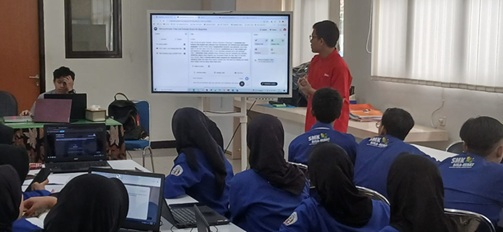
This community service activity aims to improve students' Artificial Intelligence (AI) literacy at SMK Negeri 6 Bandung through a Guest Lecturer Program and training on the ethical use of AI in learning. The activity involved 32 students from the Audio Video Engineering Department, who received materials on AI concepts, their application in vocational education, and digital ethics. Learning outcomes were evaluated through an interactive quiz to assess participants' understanding levels. The results showed an average answer accuracy of 63.75% and an average score of 9,822 points, indicating a good understanding of AI concepts and applications, though ethical awareness still needs improvement. The activity successfully increased students' enthusiasm and learning motivation through interactive methods and strengthened collaboration between higher education and vocational schools to develop technology-based, ethically oriented learning.
Downloads
Article Details

This work is licensed under a Creative Commons Attribution-ShareAlike 4.0 International License.
Authors who publish with this journal agree to the following terms:
- Any article on the copyright is retained by the author(s).
- Author grant the journal, right of first publication with the work simultaneously licensed under a Creative Commons Attribution License that allows others to share work with acknowledgment of the work authors and initial publications in this journal.
- Authors are able to enter into a separate, additional contractual arrangements for non-exclusive distribution of published articles of work (eg, post-institutional repository) or publish it in a book, with acknowledgment of its initial publication in this journal.
- Authors are permitted and encouraged to post their work online (e.g., in institutional repositories or on their websites) prior to and during the submission process, as can lead to productive exchanges, as well as earlier and greater citation of published work.
- The article and any associated published material is distributed under the Creative Commons Attribution-ShareAlike 4.0 International License
References
Holmes, W., Bialik, M., & Fadel, C. (2022). The ethics of AI in education: Towards a community-wide approach. International Journal of Artificial Intelligence in Education, 32(4), 1–18. https://doi.org/10.1007/s40593-022-00300-2
Munaye, Y. Y., Alghamdi, A. K., & Asad, M. M. (2025). ChatGPT in education: A systematic review on opportunities, challenges, and future directions. Algorithms, 18(3), 101–119. https://doi.org/10.3390/a18030101
Porayska-Pomsta, K. (2024). The ethics of artificial intelligence in education: Current perspectives and future challenges. British Journal of Educational Technology, 55(2), 401–419. https://doi.org/10.1111/bjet.13320
Sari, D. K. (2025). Measuring artificial intelligence literacy: Dimensions and instruments. Educational Research and Evaluation, 30(2), 221–237. https://doi.org/10.1080/13803611.2025.1005674
UNESCO. (2021). Artificial intelligence in education: Guidance for policymakers. UNESCO Institute for Information Technologies in Education (IITE). https://unesdoc.unesco.org/ark:/48223/pf0000376708
Wang, J., Zhang, H., & Li, Y. (2025). The effect of ChatGPT on students' learning performance: A meta-analysis. Humanities and Social Sciences Communications, 12(1), 245–260. https://doi.org/10.1057/s41599-025-01234-8