Peningkatan Kemampuan Berbahasa Inggris Siswa MAN 3 Sleman dengan Penerapan Pembelajaran Mendalam (Deep Learning) dalam Program “Mayoga Super English Day” Developing English Proficiency of MAN 3 Sleman Students through Deep Learning Activities in the “Mayoga Super English Day” Program
Article Sidebar
Main Article Content
Abstract
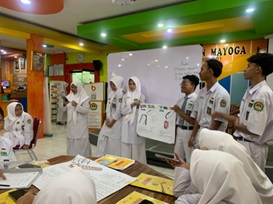
The project "Developing English Proficiency of MAN 3 Sleman Students through Deep Learning Activities in the 'Mayoga Super English Day'" at MAN 3 Sleman aims to strengthen students' English competence, particularly in speaking, through the theme Traditional Games and Stories. The program involved 296 tenth-grade students and 18 tutors from Universitas Islam Indonesia. Employing a Deep Learning approach, the activities encouraged students to use English in conscious, meaningful, and engaging learning contexts while fostering an appreciation of cultural heritage. This approach aligns with the Merdeka Curriculum, emphasizing critical thinking, collaboration, and creativity. Additionally, the program highlights the development of soft skills, especially communication and critical thinking, grounded in Islamic values. Through a series of projects and exhibitions, the initiative seeks to enhance students' confidence and promote active collaboration among schools, parents, and the surrounding community in preparing students to face global challenges.
Downloads
Article Details

This work is licensed under a Creative Commons Attribution-ShareAlike 4.0 International License.
Authors who publish with this journal agree to the following terms:
- Any article on the copyright is retained by the author(s).
- Author grant the journal, right of first publication with the work simultaneously licensed under a Creative Commons Attribution License that allows others to share work with acknowledgment of the work authors and initial publications in this journal.
- Authors are able to enter into a separate, additional contractual arrangements for non-exclusive distribution of published articles of work (eg, post-institutional repository) or publish it in a book, with acknowledgment of its initial publication in this journal.
- Authors are permitted and encouraged to post their work online (e.g., in institutional repositories or on their websites) prior to and during the submission process, as can lead to productive exchanges, as well as earlier and greater citation of published work.
- The article and any associated published material is distributed under the Creative Commons Attribution-ShareAlike 4.0 International License
References
Afriyeni, C., & Zaim, M. (2023). The students’ perception toward reward and punishment to increase their motivation in learning English. Journal of English Language Teaching (JELT), 12(3). https://doi.org/10.24036/jelt.v12i3.124448
Ahmed N., Pathan Z. H., & Khan F. S. (2017). Exploring the causes of English language speaking anxiety among postgraduate students of the University of Balochistan, Pakistan. International Journal of English Linguistics, 7(2), 99–105, https://doi.org/10.5539/ijel.v7n2p99.
Elfayeni, M.N., & Melani, M., (2025). The effect of using ice breaking on students’ motivation in English learning in junior high school. Pendas: Jurnal Ilmiah Pendidikan Dasar, 10(4). https://doi.org/10.23969/jp.v10i04.34668
Faraz, Anisa, D.D., & Ramadhani, D. (2024). The application of positive psychology in English learning for students of MTsN 3 Sleman. Journal of Community Empowerment, 9(2), 272-278. https://doi.org/10.31603/ce.10700
Feriyanto, F., & Anjariyah, D. (2024). Deep learning approach thorugh meaningful, mindful, and joyful learning: A library research. Electronic Journal of Education, Social Economic and Technology, 5(2), 208-212. https://doi.org/10.33122/ejeset.v5i2.321
Jamilatun, I., & Faruq, U. (2025). Deep learning approach through meaningful, mindful, and joyful learning. European Journal of Education Studies, 5(2), 208-212. https://doi.org/10.33122/ejeset.v5i2.321
Khatoony H. and Rahmani L. (2020). Difficulties and weaknesses of speaking skill among Iranian EFL learners: a review article of speaking obstacles in applied linguistic students, International Journal of Language, Literature, Culture and History Studies. 2(2), 59–69. https://www.researchgate.net/publication/349916854_Difficulties_and_Weaknesses_of_Speaking_Skill_among_Iranian_EFL_Learners_A_Review_Article_of_Speaking_Obstacles_in_Applied_Linguistic_Students
Leky, A. M. S., Pratolo, B. W., & Oktavianti, I. N. (2024). Investigating problems of inductive approach in ELT during early career of Indonesian EFL teachers. IJEE (Indonesian Journal Of English Education), 89–104. https://doi.org/10.15408/ijee.v11i1.33871
Levin, O. (2024). Simulation as a pedagogical model for deep learning in teacher education. Teaching and Teacher Education, 143, 104571. https://doi.org/10.1016/j.tate.2024.104571
Mystakidis, S. (2021). Deep Meaningful Learning. Encyclopedia. 1, 988–997. https://doi.org/10.3390/encyclopedia1030075?urlappend=%3Futm_source%3Dresearchgate
Parmawati, A. (2018). Using analytic teams technique to improve students’ speaking skill. Edulitics (Education, Literature, And Linguistics) Journal, 3(2), 21-25. https://doi.org/10.52166/edulitics.v3i2.1257
Putri, N. & Refnaldi, R. (2020). Rewards and punishments given by the teacher in teaching English as foreign language in Indonesian context. Journal of English Language Teaching (JELT), 9(1). https://doi.org/10.24036/jelt.v9i1.107819
Riandini, D. (2025). Assessing students’ perceptions of EFL learners’ problems in speaking skills. Sintaksis: Publikasi Para Ahli Bahasa Dan Sastra Inggris, 3(3), 236–244. https://doi.org/10.61132/sintaksis.v3i3.2195
Sofiriyah N.M., Romadhon, S., Fatmala, D.N.R., & Ahmad, T.B. (2024). Project-based learning to enhance student’s English Skill. English Education: Jurnal Tadris Bahasa Inggris, 17(1), 108-119. https://doi.org/10.61132/arjuna.v3i1.1412
Surini, S. (2024). Peningkatan hasil belajar bahasa Inggris melalui model project-based learning: Studi tindakan pada siswa kelas XI MAN 1 Yogyakarta. Indonesian Journal of Action Research, 3(2), 69-77. https://doi.org/10.14421/ijar.2024.32-02
Thomas, J. W. (2000). A review of research on project-based learning. San Rafael, CA: Autodesk Foundation.
Tristasari, S. & Yuliati (2025). Analysis of students’ difficulties in speaking skills in studying English. Journal of English Language Teaching, 14, 369–381. https://doi.org/10.15294/elt.v14iSpecial%20Issue.29953
Weng, C., Chen, C., & Ai, X. (2023). A pedagogical study on promoting students’ deep learning through design-based learning. International Journal of Technology and Design Education, 33(4), 1653–1674. https://doi.org/10.1007/s10798-022-09789-4