Pemanfaatan Media Wordwall sebagai Inovasi Pembelajaran Bilangan Bulat di SDN 217 Palembang untuk Penguatan Computational Thinking Using Wordwall as an Innovative Approach to Improve Computational Thinking in Integer Learning at SDN 217 Palembang
Article Sidebar
Main Article Content
Abstract
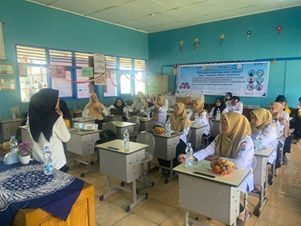
This community service program was carried out to address the need for elementary school teachers to understand and implement learning grounded in Computational Thinking, aligned with curriculum demands and current developments in educational technology. The program targeted teachers at SDN 217 Palembang through a series of activities comprising an initial observation, an introduction to the fundamental concepts of computational thinking, training in the use of Wordwall, classroom implementation, and continuous mentoring and evaluation. The implementation adopted a participatory approach through discussions, demonstrations, classroom simulations, direct observations, and pretests and posttests to measure teachers' understanding. The results show that teachers developed the ability to comprehend the basic concepts of computational thinking, identify instructional applications of computational thinking in teaching integers, and adapt Wordwall as an interactive tool to enhance students' problem-solving skills. Observations indicate an increase in student engagement and the effectiveness of digital media in supporting meaningful mathematics learning. Ongoing mentoring revealed that teachers became more confident in designing technology-enhanced instructional activities. Overall, the program successfully strengthened teachers' readiness to implement innovative mathematics learning aligned with the characteristics of elementary school students.
Downloads
Article Details

This work is licensed under a Creative Commons Attribution-ShareAlike 4.0 International License.
Authors who publish with this journal agree to the following terms:
- Any article on the copyright is retained by the author(s).
- Author grant the journal, right of first publication with the work simultaneously licensed under a Creative Commons Attribution License that allows others to share work with acknowledgment of the work authors and initial publications in this journal.
- Authors are able to enter into a separate, additional contractual arrangements for non-exclusive distribution of published articles of work (eg, post-institutional repository) or publish it in a book, with acknowledgment of its initial publication in this journal.
- Authors are permitted and encouraged to post their work online (e.g., in institutional repositories or on their websites) prior to and during the submission process, as can lead to productive exchanges, as well as earlier and greater citation of published work.
- The article and any associated published material is distributed under the Creative Commons Attribution-ShareAlike 4.0 International License
References
Abidin, Z., Herman, T., Wahyudin, T., & Penehafo, A. E. (2023). Computational Thinking With An Open-Ended Approach Using Interactive powerpoint Media: An Experiment In Elementary Schools. Journal of Engineering Science and Technology. https://ejournal.upi.edu/index.php/AJSE/article/view/72528
Amelia, N., Sinaga, R. B., & Asriati, W. W. (2023). Pengaruh Penggunaan Media Wordwall Terhadap Motivasi Dan Hasil Belajar Matematika. Jurnal Mathematic Paedagogic, 9(1). https://doi.org/10.36294/jmp.v9i1.4539
Asiani, R. W., Syahputri, E. D., & Pradani, A. P. (2022). Pelatihan Penggunaan Aplikasi Wordwall Sebagai Sarana Menciptakan Media Pembelajaran Interaktif. Lokomotif Abdimas: Jurnal Pengabdian Kepada Masyarakat, 1(1). https://doi.org/10.30631/lokomotifabdimas.v1i1.1644
Astuti, A., Syahza, A., & Putra, Z. H. (2023). Penelitian Computational Thinking dalam Pembelajaran Matematika. AKSIOMA: Jurnal Program Studi Pendidikan Matematika. http://dx.doi.org/10.24127/ajpm.v12i1.5860
Espinal, A., Vieira, C., & Magana, A. J. (2024). Professional Development in Computational Thinking: A Systematic Literature Review. ACM Transactions on Computing Education, 24(2). https://dl.acm.org/doi/10.1145/3648477
Herlinawati, H., & Putri, S. M. (2024). Penerapan media pembelajaran Wordwall terhadap peningkatan hasil belajar siswa pada mata pelajaran matematika. Pendas: Jurnal Ilmiah Pendidikan Dasar, 10(3). https://doi.org/10.23969/jp.v10i3.32176
Khaninahtul Izzah, & Rekan. (2025). Rekonstruksi kompetensi guru SD dalam mengintegrasikan Computational Thinking dengan nilai-nilai Al-Qur’an. Jurnal Penelitian PGSD, 13(9), 2509-2521. https://ejournal.unesa.ac.id/index.php/jurnal-penelitian-pgsd/article/view/70845
Mulyadi, M., & Ahmad, N. (2022). Perbandingan Hasil Belajar Siswa Menggunakan Pembelajaran Metakognitif dengan Metode Konvensional pada Pokok Bahasan Bilangan Bulat di Kelas VII SMP. Almufi Journal of Measurement, Assessment, and Evaluation Education, 2(1), 34-43. https://almufi.com/index.php/AJMAEE/article/view/135
Mulyati, M. (2023). Tren dan Pengembangan Keterampilan Berpikir Komputasional: Peran Kompetensi Guru dalam Implementasi CT. (Makalah/metaanalisis). https://obsesi.or.id/index.php/obsesi/article/view/4005/3064
Nordby, A., Sriraman, B., & Froestad, P. (2022). Computational Thinking in Mathematics Education: A Systematic Review of Scandinavian Research. International Journal of Mathematical Education in Science and Technology, 53(9), 2351–2374. https://doi.org/10.18844/cjes.v17i6.7494
Nouri, J., Zhang, L., Mannila, L., & Norén, E. (2020). Development of computational thinking, digital competence and 21st century skills when learning programming in K-9. Education Inquiry, 11(1). https://doi.org/10.1080/20004508.2019.1627844
Permana, F. C., Purnama Sari, M., Sylviani, S., et al. (2023). Pengenalan Konsep Computational Thinking bagi Guru dalam Menghadapi Kurikulum Abad XXI di Sekolah Dasar. Dharmakarya: Jurnal Aplikasi Iptek untuk Masyarakat, 12(2). https://doi.org/10.24198/dharmakarya.v12i2.36603
Rahmawati, A., Putra, R. M., & Permatasari, D. (2023). Peningkatan literasi digital guru sekolah dasar melalui pelatihan pemanfaatan aplikasi pembelajaran berbasis teknologi di masa kurikulum merdeka. Jurnal Pengabdian Masyarakat Ilmu Keguruan dan Pendidikan, 7(1). https://doi.org/10.31326/jpm-ikp.v7i1.2277
Rohman, I. F., Anwar, A. S., & Nur’aeni, L. (2024). Pengaruh penggunaan media Wordwall dalam pembelajaran matematika terhadap kemampuan berpikir kritis di sekolah dasar. Pendas: Jurnal Ilmiah Pendidikan Dasar, 9(4). https://journal.unpas.ac.id/index.php/pendas/article/view/19104/9869
Rosadi, A. A., Juwita, R., & Mahtari, S. (2025). Analisis Penerapan Computational Thinking dalam Pembelajaran Berbasis Proyek pada Materi Aritmetika Sosial. INDiktika: Jurnal Inovasi Pendidikan Matematika, 5(1), 28–35.
Sitompul, B. (2022). Kompetensi Guru dalam Pembelajaran di Era Digital. Jurnal Pendidikan Tambusai, 6(3), 13953-13960. https://doi.org/10.31004/jptam.v6i3.4823
Solihin, A., dkk. (2024). Computational Thinking with the Guided-Discovery-Learning Model Using Ethnomathematics-Based LKPD in Elementary School. DIDAKTIKA: Jurnal Pendidikan Sekolah Dasar, 7(1), 80–93. https://doi.org/10.21831/didaktika.v7i1.75845
Wing, J. M. (2006). Computational Thinking. Communications of the ACM, 49(3), 33–35. https://dl.acm.org/doi/10.1145/1118178.1118215
Wulan, N. S., Kasmad, M., & Caturiasari, J. (2022). Seminar dan Pelatihan Computational Thinking Skills di Lingkungan Sekolah Dasar Kabupaten Purwakarta. Jurnal ABMAS, 22(1), 27–36. https://doi.org/10.17509/abmas.v22i1.47588
Yulianti, H., Rachman, A., & Suganda, A. (2025). Analisis Penggunaan Media Interaktif Wordwall Terhadap Motivasi Belajar Siswa Pada Materi Kekayaan Budaya Indonesia Kelas IV SD. Pendas: Jurnal Ilmiah Pendidikan Dasar, 10(3). https://journal.unpas.ac.id/index.php/pendas/article/view/33014/16886
Zahid, M. Z. (2025). Mathematics teachers’ perceptions of Computational Thinking and its integration into mathematics education. LUMAT: International Journal on Math, Science and Technology Education, 13(1). https://doi.org/10.31129/LUMAT.13.1.2696
Zhang, L. & Nouri, J. (2019), A systematic review of learning Computational Thinking through Scratch in K-9. Computers & Education, 141, 103607. https://doi.org/10.1016/j.compedu.2019.103607