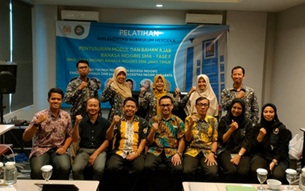
Pelatihan Pengembangan Bahan Ajar dan Modul Ajar untuk Fase F bagi Guru MGMP Bahasa Inggris Jawa Timur Training on the Development of Teaching Materials and Instructional Modules for Phase F for the East Java English MGMP Teachers
Article Sidebar
Main Article Content
Abstract
The Senior High School English MGMP of East Java Province faces several urgent issues, including the large number of terminologies and processes that must be internalized and implemented within the Merdeka Curriculum and its supporting components. In addition, the Senior High School English MGMP of East Java Province should specifically focus on developing instructional modules and teaching materials for Senior High School English subjects in the Merdeka Curriculum, particularly for Phase F (General and Advanced). The proposed solution to address these challenges is to provide training on breaking down the Learning Outcomes, Learning Objectives, and Learning Objective Pathways for Phase F General and Phase F Advanced, as well as on developing Phase F Instructional Modules and English teaching materials. This training is conducted through practical workshops. This method is chosen because it aligns with participant-centered principles, is non-directive, and enables teachers to work collaboratively, actively, and productively. The community service activities with the East Java Senior High School English MGMP have been carried out through several stages: coordination meetings with MGMP board members, preparation of training modules, delivery of theoretical materials, preparation of Phase F instructional module materials, offline theoretical sessions, practical workshops on developing teaching materials and instructional modules for both General and Advanced Phase F, and follow-up activities. All activities were successfully implemented, and nearly all expected outputs were achieved.
Downloads
Article Details

This work is licensed under a Creative Commons Attribution-ShareAlike 4.0 International License.
Authors who publish with this journal agree to the following terms:
- Any article on the copyright is retained by the author(s).
- Author grant the journal, right of first publication with the work simultaneously licensed under a Creative Commons Attribution License that allows others to share work with acknowledgment of the work authors and initial publications in this journal.
- Authors are able to enter into a separate, additional contractual arrangements for non-exclusive distribution of published articles of work (eg, post-institutional repository) or publish it in a book, with acknowledgment of its initial publication in this journal.
- Authors are permitted and encouraged to post their work online (e.g., in institutional repositories or on their websites) prior to and during the submission process, as can lead to productive exchanges, as well as earlier and greater citation of published work.
- The article and any associated published material is distributed under the Creative Commons Attribution-ShareAlike 4.0 International License
References
Angga, A., Suryana, C., Nurwahidah, I., Hernawan, A. H., & Prihantini, P. (2022). Komparasi implementasi Kurikulum 2013 dan Kurikulum Merdeka di sekolah dasar Kabupaten Garut. Jurnal Basicedu, 6(4), 5877–5889. https://doi.org/10.31004/basicedu.v6i4.3149
Badan Standar, Kurikulum, dan Asesmen Pendidikan Kementerian Pendidikan, Kebudayaan, Riset, dan Teknologi Republik Indonesia. (2022). Panduan pembelajaran dan asesmen pendidikan anak usia dini, pendidikan dasar, dan menengah. BSKAP.
Barlian, U. C., & Solekah, S. (2022). Implementasi Kurikulum Merdeka dalam meningkatkan mutu pendidikan. JOEL: Journal of Educational and Language Research, 1(12), 2105–2118.
Direktorat Jenderal Pembinaan SMP. (2015). Panduan penguatan proses pembelajaran sekolah menengah pertama. Direktorat Pembinaan SMP.
Famulaqih, S., & Lukman, A. (2024). Pengembangan bahan ajar modul pembelajaran. Karakter: Jurnal Riset Ilmu Pendidikan Islam, 1(2), 1–12.
Hakimi, H. (2019). Pengaruh modul pembelajaran berbasis problem-based learning terhadap peningkatan motivasi belajar dan hasil belajar peserta didik pada mata pelajaran PAI kelas XI SMK Negeri 2 Kerinci. EDU RESEARCH, 1(1), 68–74.
NCELT MAD Unesa
MGMP Bahasa Inggris SMA Jatim YouTube Channel
Kementerian Pendidikan, Kebudayaan, Riset, dan Teknologi. (2022). Keputusan Kepala Badan Standar, Kurikulum, dan Asesmen Pendidikan Nomor 008/H/KR/2022. BSKAP.
Magdalena, I., Sundari, T., Nurkamilah, S., Amalia, D. A., & Muhammadiyah Tangerang, U. (2020). Analisis bahan ajar. Jurnal Pendidikan dan Ilmu Sosial, 2(2), 311–326. Jurnal Nusantara STITPN
Muzaki, A. N., & Mutia, T. (2023). BUSPERAK: Menilik kebaharuan Kurikulum Merdeka melalui pengembangan bahan ajar. Jambura Geo Education Journal, 4(1), 1–11. https://doi.org/10.34312/jgej.v4i1.17406
Piawi, K., Nizar, U. K., & Mawardi, M. (2018). Development of student worksheet based on guided inquiry with class activity and laboratory in thermochemistry material. Dalam International Conferences on Educational, Social Sciences and Technology, 679–683. Fakultas Ilmu Pendidikan UNP. https://doi.org/10.29210/2018163
Pusat Kurikulum dan Pembelajaran. (2023). Kurikulum Merdeka. Kementerian Pendidikan, Kebudayaan, Riset, dan Teknologi. Kurikulum Merdeka
Sugria, F. A., Mawardi, M., & Isnaeni, F. (2023). Pengembangan bahan ajar untuk menunjang pembelajaran Kurikulum Merdeka pada materi bentuk molekul fase F SMA/MA. EduMatSains: Jurnal Pendidikan, Matematika dan Sains, 8(1), 35–45. https://doi.org/10.33541/edumatsains.v8i1.4423
Tomlinson, B. (2022). The discipline of materials development. Dalam J. Norton & H. Buchanan (Eds.), The Routledge handbook of materials development for language teaching (pp. 3–16). Routledge. https://doi.org/10.4324/9780367482565-2
Trabelsi, S. (2016). Authenticity in materials development. Dalam M. Azarnoosh, M. Zeraatpishe, A. Faravani, & H. R. Kargozari (Eds.), Issues in materials development (pp. xx–xx). Sense Publishers. https://doi.org/10.1007/978-94-6300-432-9_2