Sosialisasi Pemanfaatan Limbah Eceng Gondok untuk Bernilai Ekonomis bagi Masyarakat Danau Toba Socialization of Water Hyacinth Waste Utilization for Economic Value for the Lake Toba Community
Article Sidebar
Main Article Content
Abstract
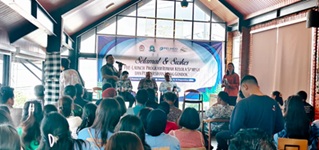
This community service project aims to address the serious environmental threat to Lake Toba caused by the massive proliferation of water hyacinth (Eichhornia crassipes), while also offering an economic solution for the surrounding community by utilizing it as a fermented probiotic feed with high monetary value. Lake Toba, as a Super Priority Tourism Destination, requires an integrated waste management solution. The implementation method for this activity involves participatory socialization and live demonstrations, with 50 participants from fish farmers, entrepreneurs, and housewives in the Sibola Hotasas Village area, Balige, North Sumatra Province. The main material presented included identifying water hyacinth nutrients and simple probiotic feed production techniques using probiotic bacteria and molasses. The questionnaire evaluation results showed a significant increase in participants' knowledge, with the average understanding score rising from 45% to 90%, indicating successful technology transfer. The use of water hyacinth as probiotic feed not only contributes to efforts to mitigate ecological waste in Lake Toba waters but also provides a direct economic impact through potential savings in animal feed costs compared to commercial feed. It is hoped that this activity will be the first step toward establishing a communal business unit based on water hyacinth recycling, serving as a model of environmental and economic sustainability for the Lake Toba community.
Downloads
Article Details

This work is licensed under a Creative Commons Attribution-ShareAlike 4.0 International License.
Authors who publish with this journal agree to the following terms:
- Any article on the copyright is retained by the author(s).
- Author grant the journal, right of first publication with the work simultaneously licensed under a Creative Commons Attribution License that allows others to share work with acknowledgment of the work authors and initial publications in this journal.
- Authors are able to enter into a separate, additional contractual arrangements for non-exclusive distribution of published articles of work (eg, post-institutional repository) or publish it in a book, with acknowledgment of its initial publication in this journal.
- Authors are permitted and encouraged to post their work online (e.g., in institutional repositories or on their websites) prior to and during the submission process, as can lead to productive exchanges, as well as earlier and greater citation of published work.
- The article and any associated published material is distributed under the Creative Commons Attribution-ShareAlike 4.0 International License
References
Adibrata, S., Yani, N. T., Ferdyanti, E., Gustia, A., Mulyani, R., Purnama, dan Fadli, J. (2024). Pengabdian Kepada Masyarakat Melalui Pembesaran Ikan Lele (Clarias sp) Dengan Sistem Keramba Jaring Tancap Menggunakan Pakan Berprobiotik di Desa Balunijuk. Pusaka Abdimas, 1(1), 9-18. https://garuda.kemdiktisaintek.go.id/documents/detail/4935741
Damanik, D. R. S., Sianturi, N. M., Nizar, A., Sitopu, J. W., Purba, V. E., & Saragih, D. S. (2024). Pengembangan Potensi Lokal Melalui Upaya Pemberdayaan Masyarakat Untuk Mendukung Pembangunan Pariwisata Di Desa Hatulian Laguboti. Jurnal Pengabdian Masyarakat Sapangambei Manoktok Hitei, 4(2), 341-346. https://doi.org/10.36985/4p0e9g38
Nasution Z dan Damanik S. (2009). Ekologi ekosistem Kawasan danau Toba. Universitas Sumatera Utara. https://www.academia.edu/35791394/Ekologi_Ekosistim_Kawasan_Danau_Toba
Rosyidah, A., Ediati, R., Murwani, I. K., Shomadany, S., & Humaira, S. S. (2024). Pembuatan Pakan Ikan Mandiri di Kalirejo Kabupaten Gresik Jawa Timur. Sewagati, 8(2), 1500-1511. https://doi.org/10.12962/j26139960.v8i2.1012
Sianipar, H. F., Sianturi, T., & Purba, J. S. (2022). Sosialisasi pentingnya plankton pada budidaya ikan di danau toba. Jurnal Abdimas Bina Bangsa, 3(1), 42-46. https://doi.org/10.46306/jabb.v3i1.149
Sianipar, H. F., Sijabat, A., Sinaga, C. V. R., Sinaga, M. P., & Barat, W. O. B. (2022). Identification of Phytochemical Compounds Aquatic Plants in Pematangsiantar. Jurnal Biologi Tropis, 22(4), 1253-1258. https://doi.org/10.29303/jbt.v22i4.4255