Training on the Implementation of the Halal Product Assurance System for Micro and Small Enterprises to Increase Their Intention to Obtain Halal Certification
Article Sidebar
Main Article Content
Abstract
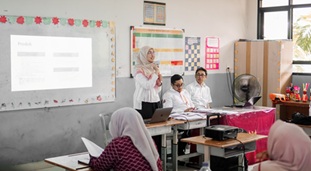
The Administrative District of Kepulauan Seribu, despite being located within the Special Capital Region (DKI) of Jakarta, has a lagging economy compared to other administrative regions of Jakarta. In fact, Kepulauan Seribu has significant development potential, particularly in tourism, fisheries, and food processing. Currently, 90% of businesses in Kepulauan Seribu are Micro, Small, and Medium Enterprises (MSMEs). These enterprises have significant potential to grow in line with the region’s own resources and opportunities. On the other hand, the national administration has mandated halal certification for food and beverage products, effective October 17, 2024. This requirement will also extend to MSMEs’ food and beverage products, effective from October 17, 2026. Furthermore, the government, through the Ministry of Tourism, is actively promoting halal tourism, aiming to position Indonesia as a global leader in the sector. Therefore, training on the Halal Product Assurance System is considered essential to strengthen the economy of Kepulauan Seribu by preparing its MSMEs to register for halal certification. Following Ajzen’s Theory of Planned Behavior, the training emphasized positive attitudes and subjective norms and aimed to lower perceived behavioral control. The study shows that the training led to a high intention to apply for halal certification.
Downloads
Article Details

This work is licensed under a Creative Commons Attribution-ShareAlike 4.0 International License.
Authors who publish with this journal agree to the following terms:
- Any article on the copyright is retained by the author(s).
- Author grant the journal, right of first publication with the work simultaneously licensed under a Creative Commons Attribution License that allows others to share work with acknowledgment of the work authors and initial publications in this journal.
- Authors are able to enter into a separate, additional contractual arrangements for non-exclusive distribution of published articles of work (eg, post-institutional repository) or publish it in a book, with acknowledgment of its initial publication in this journal.
- Authors are permitted and encouraged to post their work online (e.g., in institutional repositories or on their websites) prior to and during the submission process, as can lead to productive exchanges, as well as earlier and greater citation of published work.
- The article and any associated published material is distributed under the Creative Commons Attribution-ShareAlike 4.0 International License
References
Ahmad Firza Fauzan, & Agussalim Burhanuddin. (2023). Potensi dan Tantangan Pariwisata Maritim Kepulauan Seribu. Student Scientific Creativity Journal, 1(6), 379–391. https://doi.org/10.55606/sscj-amik.v1i6.2391
Ajzen, I. (1991). The theory of planned behavior. Organizational Behavior and Human Decision Processes, 50(2), 179–211. https://doi.org/10.1016/0749-5978(91)90020-T
Aydin, B., & Emeksiz, M. (2018). Sustainable urban tourism success factors and the economic performance of small tourism enterprises. Asia Pacific Journal of Tourism Research, 23(10), 975–988. https://doi.org/10.1080/10941665.2018.1513049
Badan Pusat Statistik. (2021). Statistik Potensi Kelurahan Kabupaten Kepulauan Seribu (Agregasi Data Kelurahan) 2020. https://searchengine.web.bps.go.id/deep?q=Statistik%20Potensial%20Wilayah%20Kepulauan%20Seribu&id=97b485c98e0b61e9b060154b&content=publication&mfd=3100&page=1
BPS. (2025). Provinsi DKI Jakarta Dalam Angka 2025.
BPS DKI Jakarta. (2022a). Produksi dan Nilai Produksi Perikanan Tangkap Menurut Kabupaten/Kota dan Jenis Penangkapan di Provinsi DKI Jakarta. https://jakarta.bps.go.id/id/statistics-table/3/U2k4d1MwcFZjRGhSVVRKaWRHRm5Temw1VURJeFp6MDkjMw==/volume-produksi-dan-nilai-produksi-perikanan-tangkap-menurut-kabupaten-kota-dan-jenis-penangkapan-di-provinsi-dki-jakarta--2024.html?year=2024
BPS DKI Jakarta. (2022b). Produksi Perikanan Budidaya Menurut Kabupaten/Kota dan Jenis Kegiatan di Provinsi DKI Jakarta. https://jakarta.bps.go.id/id/statistics-table/3/WjFab0sxVjVkR3hOVUdjMWNIRnNkbWd3ZWl0bWR6MDkjMw==/production-volume-of-aquaculture-by-regency-municipality-and-type-of-activity1-in-dki-jakarta-province--2021.html
Chomsah, A. (2024). Produk Makanan-Minuman UMK Harus Sudah Bersertifikat Halal pada 17 Oktober 2026, Bagaimana Produk Luar Negeri?. Kementerian Agama Kantor Wilayah NTT. https://ntt.kemenag.go.id/berita/528390/produk-makananminuman-umk-harus-sudah-bersertifikat-halal-pada-17-oktober-2026-bagaimana-produk-luar-negeri
Dewi, C. K., Pradana, M., Huertas-García, R., Rubiyanti, N., & Syarifuddin, S. (2022). Developing halal consumer behavior and tourism studies: Recommendations for Indonesia and Spain. Frontiers in Psychology, 13. https://doi.org/10.3389/fpsyg.2022.863130
Fianto, B. A., Fauzi, F. P., Suprayogi, N., Filianti, D., Gan, C., & Anisha, A. I. I. N. (2025). Factors influencing behavior intention to obtain halal certificate: study on MSMEs in Indonesia and Malaysia. Journal of Islamic Marketing. https://doi.org/10.1108/JIMA-09-2024-0446
Katuk, N., Ku-Mahamud, K. R., Kayat, K., Abdul Hamid, Mohd. N., Zakaria, N. H., & Purbasari, A. (2021). Halal certification for tourism marketing: the attributes and attitudes of food operators in Indonesia. Journal of Islamic Marketing, 12(5), 1043–1062. https://doi.org/10.1108/JIMA-03-2020-0068
Krisna, R., & Yusuf, M. (2023). Halal Ecosystem Improvement Study Reviewed of Halal Product Regulations Halal. International Journal of Research and Review, 10(2), 339–359. https://doi.org/10.52403/ijrr.20230243
Neksidin, Fahrudin, A., & Krisanti, M. (2021). Keberlanjutan Pengelolaan Wisata Bahari di Pulau Pari, Kabupaten Kepulauan Seribu. Jurnal Ilmu Pertanian Indonesia, 26(2), 284–291. https://doi.org/10.18343/jipi.26.2.284
Rachmiatie, A., Setiawan, E., Zakiah, K., Saud, M., & Martian, F. (2024). Halal tourism ecosystem: networks, institutions and implementations in Indonesia. Journal of Islamic Marketing, 15(11), 3247–3265. https://doi.org/10.1108/JIMA-09-2023-0286
Sudiarti, S., Syarvina, W., & Yanti, N. (2024). Analysis of Fishermen’s Income in The Seribu Archipelago. Jurnal Riset Ilmu Ekonomi, 4(1), 1–13. https://doi.org/10.23969/jrie.v4i1.100
Supaat*, S. H., Nizam, N. Z., & Ahamat, A. (2019). Through the Theory of Planned Behaviour (TPB) for Extended Model of Entrepreneurs Intentions to Involve in Halal Industry. International Journal of Recent Technology and Engineering (IJRTE), 8(4), 4450–4458. https://doi.org/10.35940/ijrte.D8392.118419
Wijijayanti, T., Agustina, Y., Winarno, A., Istanti, L., & Dharma, B. (2020). Rural Tourism: A Local Economic Development. Australasian Accounting, Business and Finance Journal, 14(1), 5–13. https://doi.org/10.14453/aabfj.v14i1.2
Yaumidin, U. K., Yuliana, C. I., Soesilowati, E. S., Hidayatina, A., Mulyaningsih, Y., Bakti, I. G. M. Y., Oelviani, R., Adiyoga, W., Purwanto, P., Sihombing, Y., & Malik, F. (2025). The moderating effect of halal certification awareness on farmers’ behaviour for halal rice: an extended theory of planned behaviour. Journal of Islamic Marketing, 16(6), 1720–1741. https://doi.org/10.1108/JIMA-07-2024-0281.