Peningkatan Literasi Hak Cipta dan Kesiapan Monetisasi Konten Digital Siswa SMK Melalui Workshop Partisipatif Enhancing Copyright Literacy and Readiness for Monetizing Digital Content Among Vocational School Students Through Participatory Workshops
Article Sidebar
Main Article Content
Abstract
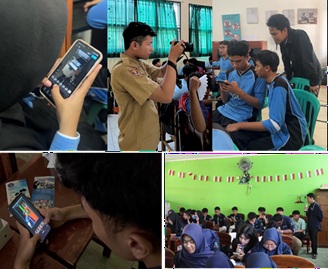
Digital content production in vocational schools is growing rapidly, but this has not been accompanied by an adequate understanding of copyright, the use of legal assets, and readiness for monetization. This situation has the potential to lead to copyright infringement and to hinder students' economic opportunities for creativity. This community service activity aims to improve copyright literacy, the application of legal elements in content production, and digital monetization readiness among students and teachers at SMKN 1, SMKN 7, and SMKN 4 Bandar Lampung through participatory workshops grounded in media production practices. The implementation method used a workshop approach with one-group pre-test post-test evaluation, supplemented by artifact analysis and observation of the production process to assess changes in students' knowledge and practices. The results of the activity showed a significant increase in all knowledge domains, with pre-test scores of 57.7–64.7 increasing to 89.1–94.0 and high effectiveness based on N-Gain (0.75–0.83). Analysis of the work shows that students are able to apply attribution more accurately, select legally licensed assets, compile metadata more systematically, and exercise greater caution when using third-party material. The direct benefits for partners include increased student competence in producing legally safe digital content that is better prepared for publication on digital platforms. Teachers also gain practical models for integrating into productive learning. This activity demonstrates that practice-based workshops are effective in strengthening the legal, technical, and digital economic readiness competencies of vocational students.
Downloads
Article Details

This work is licensed under a Creative Commons Attribution-ShareAlike 4.0 International License.
Authors who publish with this journal agree to the following terms:
- Any article on the copyright is retained by the author(s).
- Author grant the journal, right of first publication with the work simultaneously licensed under a Creative Commons Attribution License that allows others to share work with acknowledgment of the work authors and initial publications in this journal.
- Authors are able to enter into a separate, additional contractual arrangements for non-exclusive distribution of published articles of work (eg, post-institutional repository) or publish it in a book, with acknowledgment of its initial publication in this journal.
- Authors are permitted and encouraged to post their work online (e.g., in institutional repositories or on their websites) prior to and during the submission process, as can lead to productive exchanges, as well as earlier and greater citation of published work.
- The article and any associated published material is distributed under the Creative Commons Attribution-ShareAlike 4.0 International License
References
Abdillah, F. (2024). Dampak Ekonomi Digital Terhadap Pertumbuhan Ekonomi di Indonesia. BENEFIT: Journal Of Business, Economics, And Finance, 2(1), 27–35. https://doi.org/https://doi.org/10.70437/benefit.v2i1.335
Amalia, D. U., Mulyana, B. B., Ramadhan, F. F., & Fajarwati, N. K. (2024). Perlindungan Hukum Terhadap Kekayaan Intelektual Dalam Era Digital Di Indonesia. 1(1), 26–46. https://doi.org/https://doi.org/10.62383/terang.v1i1.52
Amirullah, M., Muchtar, H. N., & Saleh, K. A. (2022). Peningkatan Pemahaman Hak Kekayaan Intelektual vagi Guru dan Siswa SMKN 4 Kuningan Jawa Barat. Kumawula: Jurnal Pengabdian Kepada Masyarakat, 5(2). https://doi.org/10.24198/kumawula.v5i2.36775
Bankov, K. (2022). Copyright in the Digital Experience Economy. In Numanities - Arts and Humanities in Progress (Vol. 22, pp. 37–50). Springer Science and Business Media B.V. https://doi.org/10.1007/978-3-030-92555-0_3
Bechtold, S. (2002). From copyright to information law-implications of digital rights management. In S. T. & 821 Alexander Rd InterTrust STAR Lab. - New Jersey Princeton, 08540-6303, NJ (Eds.), Lecture Notes in Computer Science including subseries Lecture Notes in Artificial Intelligence and Lecture Notes in Bioinformatics, 2320, pp. 213–232). Springer Verlag. https://doi.org/10.1007/3-540-47870-1_14
Coates, J. (2022). Fundamentals of modern copyright. In Navigating Copyright for Libraries: Purpose and Scope (pp. 23–58). De Gruyter. https://doi.org/10.1515/9783110732009-004
Cunningham, S., & Carig, D. (2019). Social Media Entertainment: The New Intersection of Hollywood and Silicon Valley. NYU Press. https://researchprofiles.canberra.edu.au/en/publications/social-media-entertainment-the-new-intersection-of-hollywood-and-/
Erickson, K., & Kretschmer, M. (2020). Empirical Approach to Intermediary Liability. In The Oxford Handbook of Online Intermediary Liability (5). Oxford Academic. https://doi.org/10.1093/oxfordhb/9780198837138.013.5
Fiesler, C., Lampe, C., & Bruckman, A. S. (2016). Reality and perception of copyright terms of service for online content creation. Proceedings of the ACM Conference on Computer Supported Cooperative Work, CSCW, 27, 1450–1461. https://doi.org/10.1145/2818048.2819931
Hake, R. R. (1998). Interactive-engagement versus traditional methods: A six-thousand-student survey of mechanics test data for introductory physics courses. American Journal of Physics, 66(1), 64 – 74. https://doi.org/10.1119/1.18809
Hossain, Z., Çelik, Ö., & Hertel, C. (2024). Academic integrity and copyright literacy policy and instruction in K-12 schools: a global study from the perspective of school library professionals. International Journal for Educational Integrity, 20(1), 1–17. https://doi.org/10.1007/s40979-024-00150-x
Koščík, M., & Šavelka, J. (2013). Dangers of over-enthusiasm in licensing under creative commons. Masaryk University Journal of Law and Technology, 7(2), 201 – 227. https://www.scopus.com/inward/record.uri?eid=2-s2.0-84888878454&partnerID=40&md5=39f015191a7454daae8fb93d0bbf5511
Lombardi, E. M. (2024). Digitization, Copyright and the Law: Copyleft and the Future of Intellectual Property. In Digitization, Copyright and the Law: Copyleft and the Future of Intellectual Property. https://doi.org/10.4324/9781003424413
Myška, M. (2015). The new creative commons 4.0 licenses. Grey Journal, 11, 58 – 62. https://www.scopus.com/inward/record.uri?eid=2-s2.0-84958062581&partnerID=40&md5=aef5d5aeebcad359db67a096c7192819
Peukert, C. (2025). Copyright and the Dynamics of Innovation in Artificial Intelligence. Proceedings of the Annual Hawaii International Conference on System Sciences, 4480 – 4489. https://doi.org/10.24251/hicss.2025.538
Singh, H. (2025). Concept of Copyleft: Free Software, Creative Commons and Open Source. Journal of Intellectual Property Rights, 30(3), 269 – 273. https://doi.org/10.56042/jipr.v30i3.6225
Todorova, T., Trencheva, T., Kurbanoğlu, S., Doğan, G., Horvat, A., & Boustany, J. (2014). A multinational study on copyright literacy competencies of LIS professionals. Communications in Computer and Information Science, 492, 138 – 148. https://doi.org/10.1007/978-3-319-14136-7_15
Tucker, A. (2021). Copyright Law for Librarians and Educators: Creative Strategies and Practical Solutions. Journal of Hospital Librarianship, 21(1), 99–100. https://doi.org/10.1080/15323269.2021.1862534
Utama, A. S., & Susanty, A. P. (2023). Legal Strategy for Intellectual Property Protection in the Era of Open-source and Creative Commons in Indonesia. The Easta Journal Law and Human Rights, 2(01), 17–24. https://doi.org/10.58812/eslhr.v2i01.149
Vizvary, P. (2022). Copyright Literacy of Cultural Heritage Workers in the Czech Republic with a Focus on Librarians. Communications in Computer and Information Science, 1533 CCIS, 179–188. https://doi.org/10.1007/978-3-030-99885-1_16
Widjaja, G. (2025). Advantages of Copyright Law in the Digital Age: Challenges and Opportunities for Content Creators. Journal of Intellectual Property Rights, 30(5), 574–582. https://doi.org/10.56042/jipr.v30i5.11026