Peningkatan Kualitas Bokar Petani Karet Desa Lorok, Ogan Ilir Improving the Quality of Rubber Farmers in Lorok Village, Ogan Ilir
Article Sidebar
Main Article Content
Abstract
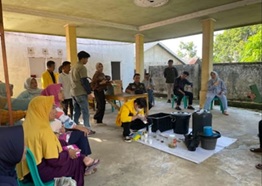
This Community Service Activity aims to improve the quality of rubber farmers' bokar in Lorok Village, Ogan Ilir, through effective tapping techniques, controlling white root fungus with Trichoderma sp, and using recommended coagulants. The implementation took place from September to December 2025 in Lorok Village, Ogan Ilir. The targets are for rubber farmers, rubber collectors, and Lorok Village officials. The activity began with a Forum Group Discussion and interviews to identify the problems of rubber farmers in Lorok Village, then preparing socialization materials, training and coaching designs, as well as pre- and post-activity evaluations; socialization, demonstrations, and mentoring; and analyzing Bokar results as an evaluation of the implementation of efforts to improve the quality of Bokar that were socialized. From the results of the activity, it was found that rubber farmers in Lorok Village can produce high-quality bokar if they apply effective tapping techniques, select recommended coagulants, and control JAP with Trichoderma sp. By carrying out this activity, farmers believe they will be able to increase their income by selling high-quality bokar at competitive selling prices for industrial needs.
Downloads
Article Details

This work is licensed under a Creative Commons Attribution-ShareAlike 4.0 International License.
Authors who publish with this journal agree to the following terms:
- Any article on the copyright is retained by the author(s).
- Author grant the journal, right of first publication with the work simultaneously licensed under a Creative Commons Attribution License that allows others to share work with acknowledgment of the work authors and initial publications in this journal.
- Authors are able to enter into a separate, additional contractual arrangements for non-exclusive distribution of published articles of work (eg, post-institutional repository) or publish it in a book, with acknowledgment of its initial publication in this journal.
- Authors are permitted and encouraged to post their work online (e.g., in institutional repositories or on their websites) prior to and during the submission process, as can lead to productive exchanges, as well as earlier and greater citation of published work.
- The article and any associated published material is distributed under the Creative Commons Attribution-ShareAlike 4.0 International License
References
Adfa, M., Darwis, W., Gustian, I., & Bustaman, H. (2015). Pengendalian penyakit jamur akar putih (JAP) pada tanaman karet rakyat dengan fungisida hayati jamur antagonis Trichoderma spp. Dharma Raflesia, 13(2), 203–211.
Amypalupy, K. (2012). Produksi bahan tanam karet. Balai Penelitian Karet Sembawa.
Anggiani, F., & Kurniawan, R. (2021). Pemasaran bokar melalui unit pengolahan dan pemasaran bokar (UPPB) sebagai upaya peningkatan pendapatan petani dari usahatani karet di Kecamatan Sembawa Kabupaten Banyuasin. Societa, 10, 52–58.
Badan Standardisasi Nasional. (2002). Standar Nasional Indonesia 06-2047-2002 bahan olah karet. Badan Standardisasi Nasional.
Kementerian Pertanian. (n.d.). Pedoman budidaya karet (Hevea brasiliensis) yang baik. Kementerian Pertanian.
Dinas Perkebunan Provinsi Sumatera Selatan. (2020). Unit pengolahan dan pemasaran bokar 2020. Dinas Perkebunan Provinsi Sumatera Selatan.
Diskominfo Ogan Ilir. (2024). Tentang Desa Lorok. https://lorok.oganilirkab.go.id/page/tentang-desa
Gofar, N., Nur, T. P., Permatasari, S. D. I., Muslimah, S., Fikri, H., Haryono, A., et al. (2023). Application of organic fertilizer enriched with Trichoderma harzianum on shallot (Allium cepa) cultivation in ultisols. Biodiversitas, 24(4), 2426–2433. https://doi.org/10.13057/biodiv/d240462
Hidayoko, G., & Wulandra, O. (2014). Pengaruh penggunaan jenis bahan penggumpal lateks terhadap mutu SIR 20. Agritepa, 1, 113–130.
Junaidi. (2020). Peran teknologi budi daya dan pola tanam pilihan petani dalam meningkatkan produktivitas karet rakyat. Jurnal Penelitian dan Pengembangan Pertanian, 39(2), 86–95. https://doi.org/10.21082/jp3.v39n2.2020.p86-95
Nata, A. W., Onasis, R., & Saputro, B. (2025). Pengolahan bahan olah karet rakyat (bokar) di Kecamatan Kahayan Hilir Kabupaten Pulang Pisau. K. P. SHK.
Neffatalia, Y. M., Daulay, H. B., & Surawan, F. E. D. (2015). Identifikasi bokar (bahan olah karet) rakyat yang masuk ke PTPN VII (Persero) Unit Padang Pelawi Kabupaten Seluma. Jurnal Agroindustri, 5(2), 95–108.
Novirman, K. (2021). Quality analysis of rubber materials (BOKAR) with liquid smoke coagulants pelawan wood (Tristaniopsis merguensis). Jurnal Sains Dasar, 9(2), 37–41.
Prasetyo, G. G., Harahap, S., & Rizal, A. (2024). Kajian trend produktivitas tanaman karet (Hevea brasiliensis Arg): Studi kasus di Provinsi Jawa Barat. AGRIBIOS: Jurnal Ilmiah, 22(1).
Purbaya, M., & Suwardin, D. (2017). Pengujian kualitatif terhadap jenis koagulan dalam bahan olahan karet. Jurnal Penelitian Karet, 35(1), 103–114. https://doi.org/10.22302/ppk.jpk.v35i1.218
Syarifa, L. F., Agustina, D. S., & Nancy, C. (2013). Evaluasi pengolahan dan mutu bahan olah karet rakyat (bokar) di tingkat petani karet di Sumatera Selatan. Jurnal Penelitian Karet, 31(2), 139–148. https://doi.org/10.22302/ppk.jpk.v31i2.132
Wiyanto, & Kusnadi, N. (2013). Faktor-faktor yang mempengaruhi kualitas karet perkebunan rakyat (Kasus perkebunan rakyat di Kecamatan Tulang Bawang Tengah Kabupaten Tulang Bawang, Lampung). Jurnal Agribisnis Indonesia, 1(1), 39–58.