Psikoedukasi Berbasis Komunitas untuk Memperkuat Kesiapsiagaan Psikologis dan Resiliensi pada Masyarakat Pesisir Rawan Tsunami: Kelurahan Jangkaran, Kulon Progo Community-Based Psychoeducation to Strengthen Psychological Preparedness and Resilience in a Tsunami-Prone Coastal Community: Jangkaran Village, Kulon Progo
Article Sidebar
Main Article Content
Abstract
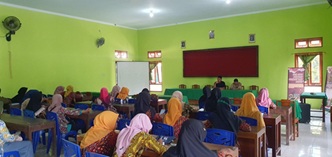
Coastal communities in Jangkaran Village face both physical and psychological disaster-related vulnerabilities, including damaged coastal vegetation, inadequate evacuation routes, limited shelters, low knowledge, limited emotional readiness, and insufficient self-efficacy in responding to emergencies. This community engagement program aimed to enhance psychological preparedness through psychoeducation and to empower local cadres to disseminate disaster mitigation information sustainably. The activities involved initial assessments through observation, focus group discussions, and interviews, followed by psychoeducational sessions on emotion regulation, risk understanding, and mental simulation of evacuation procedures, which were evaluated through pre- and post-intervention measurements. The results indicated improvements in community understanding, emotional regulation, and confidence in decision-making during emergencies. This program concludes that psychoeducation combined with cadre involvement is an effective strategy for strengthening psychological preparedness in coastal communities and recommends its implementation in other disaster-prone areas.
Downloads
Article Details

This work is licensed under a Creative Commons Attribution-ShareAlike 4.0 International License.
Authors who publish with this journal agree to the following terms:
- Any article on the copyright is retained by the author(s).
- Author grant the journal, right of first publication with the work simultaneously licensed under a Creative Commons Attribution License that allows others to share work with acknowledgment of the work authors and initial publications in this journal.
- Authors are able to enter into a separate, additional contractual arrangements for non-exclusive distribution of published articles of work (eg, post-institutional repository) or publish it in a book, with acknowledgment of its initial publication in this journal.
- Authors are permitted and encouraged to post their work online (e.g., in institutional repositories or on their websites) prior to and during the submission process, as can lead to productive exchanges, as well as earlier and greater citation of published work.
- The article and any associated published material is distributed under the Creative Commons Attribution-ShareAlike 4.0 International License
References
Adger, W. N. (2000). Social and ecological resilience: Are they related? Progress in Human Geography, 24(3), 347–364. https://journals.sagepub.com/doi/10.1191/030913200701540465
Amri, A., Bird, D. K., Ronan, K., Haynes, K., & Towers, B. (2019). Disaster risk reduction education in Indonesia: Challenges and recommendations for scaling up. International Journal of Disaster Risk Reduction, 39, 1–11. https://nhess.copernicus.org/articles/17/595/2017/
Ayu, N. P., Wibawa, A., & Rahayu, D. (2021). Edukasi mitigasi bencana sebagai upaya peningkatan kesiapsiagaan masyarakat pesisir. Jurnal Pengabdian Pada Masyarakat, 6(2), 412–420. https://doi.org/10.23960/jpfp.v4i1.10609
Bandura, A. (1997). Self-efficacy: The exercise of control. W.H. Freeman.
Becker, J. S., Paton, D., Johnston, D. M., & Ronan, K. R. (2017). Salient beliefs about earthquake hazards and household preparedness. Risk Analysis, 37(3), 526–546. https://doi.org/10.1111/risa.12014
Bonanno, G. A., Brewin, C. R., Kaniasty, K., & La Greca, A. M. (2010). Weighing the costs of disaster: Consequences, risks, and resilience in individuals, families, and communities. Psychological Science in the Public Interest, 11(1), 1–49. https://doi.org/10.1177/1529100610387086
Cattaneo, L. B., & Chapman, A. R. (2010). The process of empowerment: A model for use in research and practice. American Psychologist, 65(7), 646–659. https://psycnet.apa.org/record/2010-19922-003
Cattaneo, L. B., & Goodman, L. A. (2015). What is empowerment anyway? A model for domestic violence practice, research, and evaluation. Psychology of Violence, 5(1), 84–94. https://psycnet.apa.org/doi/10.1037/a0035137
Darmawan, I. P. A., & Diana, R. (2021). Program edukasi kebencanaan berbasis sekolah sebagai upaya peningkatan kesiapsiagaan bencana. Jurnal Mitigasi Bencana, 16(2), 75–88. https://doi.org/10.31284/j.adipati.2025.v4i1.6863
Every, D., Thompson, K., Rainbird, S., Cornell, V., Smith, W., & Trigg, J. (2015). We’re ready: Early childhood educators perceptions of emergency preparedness. Australian Journal of Emergency Management, 30(1), 23–28. https://www.aidr.org.au/media/11369/ajem_2021-03.pdf
Farid, M., Sudaryono, S., & Hidayati, D. (2020). Pelatihan mitigasi bencana berbasis masyarakat untuk peningkatan kesiapsiagaan tsunami. Jurnal Abdimas, 24(3), 155–164.
Guest, G., Namey, E., & Mitchell, M. (2017). Collecting qualitative data: A field manual for applied research. SAGE Publications. https://methods.sagepub.com/book/mono/collecting-qualitative-data/toc#_
Krueger, R. A., & Casey, M. A. (2015). Focus groups: A practical guide for applied research (5th ed.). SAGE Publications. https://books.google.co.id/books?id=tXpZDwAAQBAJ
Laverack, G., & Labonte, R. (2000). A planning framework for community empowerment goals within health promotion. Health Policy and Planning, 15(3), 255–262. https://doi.org/10.1093/heapol/15.3.255
Masten, A. S. (2001). Ordinary magic: Resilience processes in development. American Psychologist, 56(3), 227–238. https://doi.org/10.1037//0003-066x.56.3.227
Patel, S. S., Rogers, M. B., Amlôt, R., & Rubin, G. J. (2017). What do we mean by community resilience? A systematic literature review of how it is defined in the literature. International Journal of Disaster Risk Reduction, 24, 44–51. https://pmc.ncbi.nlm.nih.gov/articles/PMC5693357/
Paton, D. (2003). Disaster preparedness: A social-cognitive perspective. Disaster Prevention and Management, 12(3), 210–216. https://doi.org/10.1108/09653560310480686
Paton, D., & Johnston, D. (2017). Disaster resilience: An integrated approach (2nd ed.). Charles C Thomas Publisher. https://www.ccthomas.com/details.cfm?P_ISBN13=9780398091699
Sharifi, A. (2016). A critical review of selected tools for assessing community resilience. Ecological Indicators, 69, 629–647. https://doi.org/10.1016/j.ecolind.2016.05.023
Sherrieb, K., Norris, F. H., & Galea, S. (2019). Measuring capacities for community resilience. Social Indicators Research, 145(2), 703–722. https://ideas.repec.org/a/spr/soinre/v99y2010i2p227-247.html
Walsh, F. (2016). Strengthening family resilience (3rd ed.). Guilford Press. https://books.google.co.id/books?id=RY1_CgAAQBAJ&printsec=copyright&hl=id&source=gbs_pub_info_r#v=onepage&q&f=false
Wijaya, D. A., Widyorini, E., & Tim Pengembang. (2020). Modul Psikoedukasi Kesiapsiagaan Bencana. Universitas Negeri Semarang. https://repository.ugm.ac.id/view/year/2012.html
Zulch, H. (2011). Psychological preparedness for natural disasters. Australian Journal of Emergency Management, 26(4), 35–40. https://hazards.colorado.edu/uploads/basicpage/Zulch.pdf
Zulch, H. (2019). Psychological preparedness for natural hazards. Springer. https://www.preventionweb.net/files/66345_f357zulchpsychologicalpreparednessf.pdf?startDownload=true