Optimalisasi Konsentrasi dan Kinerja Guru: Implementasi Teknik Mindfulness bagi Guru SD Imanuel Palu Optimizing Teachers’ Focus and Performance: Implementing Mindfulness Techniques at Imanuel Palu Elementary School
Article Sidebar
Main Article Content
Abstract
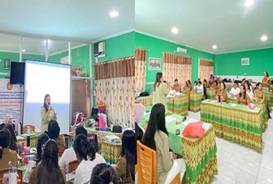
Optimal concentration is an essential cognitive function for elementary school teachers facing high demands on multitasking and workload. However, the data indicate that many teachers struggle to maintain focus, which impacts learning quality and psychological well-being. This community service aimed to improve teachers' concentration through mindfulness training at Imanuel Palu Elementary School in Central Sulawesi. The method used a one-group pretest-posttest design with 16 participants. The training included the delivery of material and direct practice of mindfulness techniques (breathing exercises and full awareness). Concentration was measured using the Grit Concentration Test before and after the training. Results showed an increase in mean scores from 6.25 (pretest) to 9.75 (posttest). The Wilcoxon Signed-Rank Test yielded Z = -3.541 and p < 0.001, indicating a statistically significant improvement in concentration. All participants experienced increased scores. Thus, brief mindfulness technique training is effective in enhancing teacher concentration. This activity is recommended for adoption as part of sustainable professional teacher development.
Downloads
Article Details

This work is licensed under a Creative Commons Attribution-ShareAlike 4.0 International License.
Authors who publish with this journal agree to the following terms:
- Any article on the copyright is retained by the author(s).
- Author grant the journal, right of first publication with the work simultaneously licensed under a Creative Commons Attribution License that allows others to share work with acknowledgment of the work authors and initial publications in this journal.
- Authors are able to enter into a separate, additional contractual arrangements for non-exclusive distribution of published articles of work (eg, post-institutional repository) or publish it in a book, with acknowledgment of its initial publication in this journal.
- Authors are permitted and encouraged to post their work online (e.g., in institutional repositories or on their websites) prior to and during the submission process, as can lead to productive exchanges, as well as earlier and greater citation of published work.
- The article and any associated published material is distributed under the Creative Commons Attribution-ShareAlike 4.0 International License
References
Ajzen, I. (1991). The theory of planned behavior. Organizational Behavior and Human Decision Processes, 50(2), 179–211. https://doi.org/10.1016/0749-5978(91)90020-T
Darling-hammond, L., Flook, L., Cook-harvey, C., & Barron, B. (2020). Implications for educational practice of the science of learning and development. Applied Developmental Science, 24(2), 97–140. https://doi.org/10.1080/10888691.2018.1537791
Flook, L., Goldberg, S. B., Pinger, L., Bonus, K., & Davidson, R. J. (2013). Mindfulness for teachers: A pilot study to assess effects on stress, burnout, and teaching efficacy. Mind, Brain, and Education, 7(3), 182–195. https://doi.org/10.1111/mbe.12026
Ford, S. D., & Nagamatsu, L. S. (2024). Four weeks of meditation training improves sustained attention in community-dwelling older adults: A proof-of-concept randomized controlled trial. Frontiers in Aging, 5. https://doi.org/10.3389/fragi.2024.1322705
ILO. (2018). Stress and well-being in the teaching profession: A global perspective. International Labour Organization.
Jennings, P. A., & Greenberg, M. T. (2009). The prosocial classroom: Teacher social and emotional competence in relation to student and classroom outcomes. Review of Educational Research, 79(1), 491-525. https://doi.org/10.3102/0034654308325693
Kabat-Zinn, J. (1994). Wherever you go, there you are: Mindfulness meditation in everyday life. Hyperion.
Kemdikbud. (2021). Laporan Survei Beban Kerja Guru di Indonesia 2021. Kementerian Pendidikan dan Kebudayaan RI.
Klingbeil DA, Renshaw TL.(2018). Mindfulness-based interventions for teachers: A meta-analysis of the emerging evidence base. Sch Psychol Q. https://doi.org/10.1037/spq0000291
Mukti, D., Wimbarti, S., Psikologi, F., & Mada, U. G. (2020). Pengaruh Pelatihan Meditasi Mindfulness terhadap Atensi Selektif pada Siswa SMP The Effect of Mindfulness Meditation Training toward. 6(1), 30–46. https://doi.org/10.22146/gamajpp.53189
Roeser, R. W., Schonert-Reichl, K. A., Jha, A., Cullen, M., Wallace, L., Wilensky, R., Oberle, E., Thomson, K., Taylor, C., & Harrison, J. (2013). Mindfulness training and reductions in teacher stress and burnout: Results from two randomized, waitlist-control field trials. Journal of Educational Psychology, 105(3), 787–804. https://doi.org/10.1037/a0032093
Roeser, R. W., Skinner, E., Beers, J., & Jennings, P. A. (2012). Mindfulness training and teachers' professional development: An emerging area of research and practice. Child Development Perspectives, 6(2), 167–173. https://doi.org/10.1111/j.1750-8606.2012.00238.x
Seligman, M. E. P. (2011). Flourish: A visionary new understanding of happiness and well-being. Free Press.
Sweller, J. (1988). Cognitive load during problem solving: Effects on learning. Cognitive Science, 12(2), 257–285. https://doi.org/10.1207/s15516709cog1202_4
Tang, YY., Hölzel, B. & Posner, M. The neuroscience of mindfulness meditation. Nat Rev Neurosci, 16, 213–225 (2015). https://doi.org/10.1038/nrn3916.
Trikusyanti, R. N. (2022). Meditasi Mindfulness Sebagai Upaya Mengatasi Masalah Psikologis Siswa. Tlutuh Sawo: Jurnal Ilmiah Pendidikan Dan Humaniora, 6(1), 27–36. https://widyasari-press.com/wp-content/uploads/2021/11/4.-Rita-Nunung-Trikusyanti-Meditasi-Mindfulness-Sebagai-Upaya-Mengatasi-Masalah-Psikologis-Siswa.pdf