Pemanfaatan Limbah Ampas Kopi sebagai Coffee clay untuk Meningkatkan Sikap Peduli Lingkungan Siswa SMA/Sederajat Utilization of Coffee Grounds Waste as Coffee clay to Improve Environmental Concern Attitude of High School Students
Article Sidebar
Main Article Content
Abstract
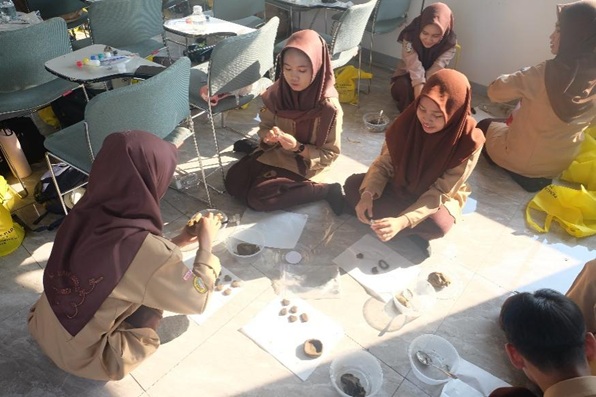
Organic waste, including coffee grounds, represents a growing environmental concern, with Indonesia generating approximately 15.59 tons of coffee-ground waste daily. In East Jakarta, many coffee shops continue to dispose of this waste without treatment, exacerbating pollution and greenhouse gas emissions. The 2025 P2M program addresses this issue by converting coffee grounds into coffee clay for the production of economically valuable handicraft products and by educating students about organic waste recycling through structured workshops. This year, the coffee clay formula was refined by adding white cement at a 1:1:1 ratio, which experimental tests showed significantly improved structural strength, reduced drying time, and lowered the risk of fungal contamination. Training sessions were delivered to 15 students at EduTechnoPark UNJ, and post-training assessments indicated a moderate level of environmental awareness (mean score: 3.29), with the strongest agreement on shared responsibility for protecting the environment. These findings demonstrate the program's effectiveness in enhancing environmental knowledge and awareness, underscoring the importance of sustained educational initiatives to foster environmentally responsible behavior.
Downloads
Article Details

This work is licensed under a Creative Commons Attribution-ShareAlike 4.0 International License.
Authors who publish with this journal agree to the following terms:
- Any article on the copyright is retained by the author(s).
- Author grant the journal, right of first publication with the work simultaneously licensed under a Creative Commons Attribution License that allows others to share work with acknowledgment of the work authors and initial publications in this journal.
- Authors are able to enter into a separate, additional contractual arrangements for non-exclusive distribution of published articles of work (eg, post-institutional repository) or publish it in a book, with acknowledgment of its initial publication in this journal.
- Authors are permitted and encouraged to post their work online (e.g., in institutional repositories or on their websites) prior to and during the submission process, as can lead to productive exchanges, as well as earlier and greater citation of published work.
- The article and any associated published material is distributed under the Creative Commons Attribution-ShareAlike 4.0 International License
References
Arquilla, V. (2018). A Machine Upcling Used Tea Leaves And Coffee Grounds Design Zero Waste: A Machine Upcycling Used Tea Leaves And Coffee Grounds Design. https://www.politesi.polimi.it/handle/10589/142284
Bomfim, A. S. C. de, de Oliveira, D. M., Walling, E., Babin, A., Hersant, G., Vaneeckhaute, C., Dumont, M.-J., & Rodrigue, D. (2022). Spent Coffee Grounds Characterization and Reuse in Composting and Soil Amendment. Waste, 1(1), 2–20. https://doi.org/10.3390/waste1010002
Ilham, M. M., Anggraini, D., Yofinaldi, S., & Wirayuda, R. (2024). Pemanfaatan Limbah Ampas Kopi menjadi Pupuk Organik. Jurnal Sains Teknologi Dalam Pemberdayaan Masyarakat, 4(1), 9–14. https://doi.org/10.31599/pvn1a241
Kua, T. A., Imteaz, M. A., Arulrajah, A., & Horpibulsuk, S. (2019). Environmental and economic viability of Alkali Activated Material (AAM) comprising slag, fly ash and spent coffee ground. International Journal of Sustainable Engineering, 12(4), 223–232. https://doi.org/10.1080/19397038.2018.1492043
Melikoglu, M., Lin, C. S. K., & Webb, C. (2013). Analysing global food waste problem: Pinpointing the facts and estimating the energy content. Central European Journal of Engineering, 3(2), 157–164. https://doi.org/10.2478/s13531-012-0058-5
Munirwan, R. P., Taha, M. R., Taib, A. M., & Munirwansyah, M. (2022). Shear Strength Improvement of Clay Soil Stabilized by Coffee Husk Ash. Applied Sciences (Switzerland), 12(11). https://doi.org/10.3390/app12115542
Nuryana, Y., Fauzi, A., & Hidayat, R. (2022). Environmental Knowledge and Pro-Environmental Behavior: Mediating Role of Environmental Attitude. International Journal of Sustainability in Higher Education, 23(4), 679–695. https://doi.org/10.29244/jpsl.15.2.227
Park, S. S., Woo, S. W., Lee, J. S., Yun, Y. M., & Lee, D. E. (2022). Evaluation of Recycled Spent Coffee Material Treated with Animal Glue, Starch, and Red Clay as Acid Materials. Materials, 15(19). https://doi.org/10.3390/ma15196622
Prabawanti, B. E., Manajemen, P., Ekonomi, F., & Bisnis, D. (2020). Application of Green Marketing in the Use of Coffee Waste as A Business Creative Industry Based on Social Enterprise. Jurnal Manajemen Dan Organisasi (JMO), 11(3), 136–142. https://doi.org/10.29244/jmo.v11i3.32886
Purwanto, P.-, & Diasmara, G. (2020). Pemanfaatan Limbah Ampas Kopi Menjadi Bahan Komposit Sebagai Bahan Dasar Alternatif Pembuatan Produk Dompet. Jurnal Strategi Desain Dan Inovasi Sosial, 1(2), 175. https://doi.org/10.37312/jsdis.v1i2.2351
Putra, I. G. A. A., & Suryani, N. M. (2023). Long-Term Environmental Education Programs and Students’ Sustainable Behavior. Sustainability and Education Journal, 8(1), 12–27. https://journal.ugm.ac.id/agritech/pages/view/Citation
Ramadhan, M. A., & Wulandari, E. (2024). Experiential Learning in Environmental Awareness: A Study of Waste Management Practices in Secondary Schools. Journal of Experiential Education and Environment, 10(1), 45–60. https://doi.org/10.31949/jcp.v10i2.8475
Rini, D. S., Pusparini, F., Aulya, N. R., Ramadhani, A., & Hikmah, A. N. (2024). Pemanfaatan Sampah Ampas Kopi Sebagai Media Pembelajran dalam Bentuk Coffee clay. Jurnal SOLMA, 13(3), 2965–2975. https://doi.org/10.22236/solma.v13i3.16530
Roychand, R., Kilmartin-Lynch, S., Saberian, M., Li, J., Zhang, G., & Li, C. Q. (2023). Transforming spent coffee grounds into a valuable resource for the enhancement of concrete strength. Journal of Cleaner Production, 419. https://doi.org/10.1016/j.jclepro.2023.138205
Sena Da Fonseca, B., Vilão, A., Galhano, C., & Simão, J. A. R. (2014). Reusing coffee waste in manufacture of ceramics for construction. Advances in Applied Ceramics, 113(3), 159–166. https://doi.org/10.1179/1743676113Y.0000000131
Suprapto, B., Herlina, T., & Wijaya, S. (2021). The Knowledge-Behavior Gap in Environmental Action: Evidence from Urban Youth. Journal of Environmental Psychology and Education, 5(3), 157–170. https://doi.org/10.31234/osf.io/chqug
Susilayati, M., Marwoto, P., & Priatmoko, S. (2022). Characterization of Spent Coffee Grounds in the Community as Supporting Materials for Renewable Energy. Jurnal Penelitian Pendidikan IPA, 8(2), 918–924. https://doi.org/10.29303/jppipa.v8i2.1227
Usman, I., & Nanda, P. V. (2017). Green business opportunity of Coffee ground waste through reverse logistics. In J. Global Business Advancement (Vol. 10, Number 6). www.tripadvisor.com.