Penguatan Pendidikan Karakter Berbasis Islamic Action Theory untuk Meningkatkan Daya Juang dan Ketahanan Moral Guru Strengthening Character Education Based on Islamic Action Theory to Enhance Teacher Perseverance and Moral Resilience
Article Sidebar
Main Article Content
Abstract
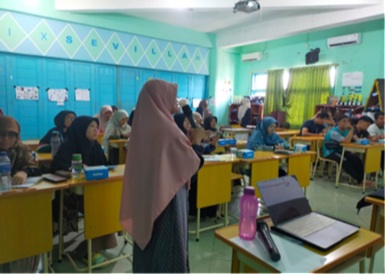
This community service program aimed to strengthen teachers’ understanding and awareness of character education through the Islamic Action Theory (IAT) approach, particularly in developing action awareness, perseverance, and moral resilience in professional practice. The program was initiated to reinforce teachers’ internal dimensions in interpreting values, professional ethics, and the consistency of intention in pedagogical activities. The activity was conducted in the form of a socialization program designed to provide conceptual reinforcement regarding Islamic Action Theory, professional reflection, and their relevance to moral awareness in educational actions. The methods included material presentation, interactive discussions, and exploration of participants’ professional experiences. The implementation indicated that the program provided a reflective space for teachers to reexamine their professional practices, particularly in self-reflection, intention alignment, and the interpretation of values in pedagogical actions. Teachers began to perceive reflection not merely as an evaluative activity but as an essential mechanism for strengthening professional awareness, perseverance, and moral resilience in responding to the dynamics of educational practice. This program represents an initial step toward supporting the reinforcement of character education, based on action awareness and integrated with moral and spiritual values. The program is expected to serve as a foundation for further practical and sustainable activities.
Downloads
Article Details

This work is licensed under a Creative Commons Attribution-ShareAlike 4.0 International License.
Authors who publish with this journal agree to the following terms:
- Any article on the copyright is retained by the author(s).
- Author grant the journal, right of first publication with the work simultaneously licensed under a Creative Commons Attribution License that allows others to share work with acknowledgment of the work authors and initial publications in this journal.
- Authors are able to enter into a separate, additional contractual arrangements for non-exclusive distribution of published articles of work (eg, post-institutional repository) or publish it in a book, with acknowledgment of its initial publication in this journal.
- Authors are permitted and encouraged to post their work online (e.g., in institutional repositories or on their websites) prior to and during the submission process, as can lead to productive exchanges, as well as earlier and greater citation of published work.
- The article and any associated published material is distributed under the Creative Commons Attribution-ShareAlike 4.0 International License
References
Al-Attas, S. M. N. (1991). The concept of education in Islam: A framework for an Islamic philosophy of education. Kuala Lumpur: International Institute of Islamic Thought and Civilization (ISTAC). https://www.scirp.org/reference/referencespapers?referenceid=1647489
Al-Ghazali. (2010). The revival of the religious sciences (Ihya Ulum al-Din) (Islamic Texts Society ed.). Cambridge: Islamic Texts Society. https://www.academia.edu/43064176/al_Ghazalis_The_Revival_of_the_Religious_Sciences_Ihya_Ulum_al_Din_for_the_21st_Century
Ardi, Z., Putra, A. H., & Mulia, F. D. (2024). Resiliensi Akademik: Fondasi Sukses Pendidikan. CV Eureka Media Aksara.
Arthur, J., Kristjánsson, K., et al. (2017). Teaching character and virtue in schools. Routledge.
Berkowitz, M. W., & Bier, M. C. (2005). What works in character education: A research-driven guide for educators. Character Education Partnership. https://www.researchgate.net/publication/251977043_What_Works_In_Character_Education
Berkowitz, M. W., Bier, M. C., & McCauley, B. (2017). Toward a science of character education: Frameworks for identifying and implementing effective practices. https://doi.org/10.1108/JCED-12-2017-0004
Bhoki, H., Are, T., & Ola, M. I. D. (2025). Membentuk karakter siswa melalui budaya positif sekolah. CV. Ruang Tentor.
Credo, K. R., Tynan, M. C., & Harms, P. D. (2017). Much ado about grit: A meta-analytic synthesis of the grit literature. Journal of Personality and Social Psychology. https://doi.org/10.1037/pspp0000102
Duckworth, A. L., Peterson, C., Matthews, M. D., & Kelly, D. R. (2007). Grit: Perseverance and passion for long-term goals. Journal of Personality and Social Psychology, 92(6), 1087–1101. https://doi.org/10.1037/0022-3514.92.6.1087
Dweck, C. S. (2006). Mindset: The new psychology of success. Random House.
Farrell, T. S. C. (2019). Reflective practice in ELT. Equinox Publishing.
Fata, Z. (2024). Analisis etika produksi Islami: Tinjauan prinsip-prinsip dan praktik produksi berdasarkan nilai-nilai Islami. Islamic Economics And Finance Journal, 2(2), 75-86. https://doi.org/10.62005/iseco.v2i2.90
Ghaniy, A. A., & Muhajirin, I. (2024). Nilai-nilai Bugis dalam daya juang dan motivasi menuntut ilmu: Analisis telaah pustaka. Jurnal Studi Edukasi Integratif, 1(3), 161-171. https://pustaka.biz.id/journal/jsei/article/view/47
Gu, Q., & Day, C. (2013). Challenges to teacher resilience: Conditions count. British Educational Research Journal, 39(1), 22–44. https://doi.org/10.1080/01411926.2011.623152
Han, H. (2018). Moral education in a global context. Journal of Moral Education, 47(2), 123–135. https://doi.org/10.1080/03057240.2017.1375906
Han, H., & Kristjánsson, K. (2020). Religious education and character development. British Journal of Educational Studies, 68(3), 345–362. https://doi.org/10.1080/00071005.2019.1592142
Hasibuan, N., Khasanah, U., & Alanur, S. N. (2024). Transformasi pendidikan karakter: Menuju SDM unggul dan berkelanjutan. Penerbit Tahta Media. https://tahtamedia.co.id/index.php/issj/article/view/774
Holik, Z. I., Dewi, B., & Prasetiya, B. (2026). Internalisasi nilai adab siswa menurut al-ghazali dalam pembentukan karakter peserta didik. Paradigma: Jurnal Pemikiran dan Penelitian Pendidikan, 12(1), 338-348. https://doi.org/10.64540/95jagb76
Korthagen, F. A. J. (2017). Inconvenient truths about teacher learning. Teachers and Teaching, 23(4), 387–405. https://doi.org/10.1080/13540602.2016.1211523
Kristjánsson, K. (2015). Aristotelian character education. Routledge.
Lickona, T. (1996). Character education: A guidebook for teachers, parents, and community members. Bantam Books.
Mann, S., & Walsh, S. (2017). Reflective practice in English language teaching. Routledge.
Mansfield, C. F., Beltman, S., Price, A., & McConney, A. (2016). Building teacher resilience: A review of research. Teaching and Teacher Education, 54, 77–87. https://doi.org/10.1016/j.tate.2015.11.016
Mezirow, J. (1997). Transformative learning: Theory to practice. New Directions for Adult and Continuing Education, 74, 5–12. https://doi.org/10.1002/ace.7401
Nucci, L. P., Narvaez, D., & Krettenauer, T. (Eds.). (2014). Handbook of moral and character education (2nd ed.). Routledge. https://doi.org/10.62951/ijsie.v2i2.307
Rozi, F., Ansya, Y. A. U., & Salsabilla, T. (2024). Strategi pendidikan karakter untuk siswa sekolah dasar dalam mewujudkan tujuan SDG 4: Pendidikan berkualitas. PT. Penerbit Naga Pustaka. https://doi.org/10.23969/jp.v9i04.21443
Ryan, R. M., & Deci, E. L. (2020). Intrinsic motivation and self-determination in human behavior. Springer.
Sahin, A., & Sugiharto, D. Y. P. (2025). Persiapan Karier Masa Depan: Peran Guru dan Konselor Sekolah Membangun Adaptabilitas Karier. Cerdas Akademika Nusantara. https://books.google.com/books/about/Persiapan_Karier_Masa_Depan.html?id=1tWKEQAAQBAJ
Seijts, G. H., & Milani, K. Y. (2022). The application of leader character to building cultures of equity, diversity, and inclusion. Business Horizons, 65(5), 573-590. https://doi.org/10.1016/j.bushor.2021.07.007
Susanto, T. T. D., Soraya, E., Febriana, A., & Muhidin, A. (2025). Transformasi pendidikan untuk memerangi korupsi: Integrasi filsafat pendidikan dan pedagogi masa depan. Deepublish. https://doi.org/10.52250/dbe.v10i2.1072
Teimouri, Y., et al. (2020). Second language grit. Journal of Research in Personality. https://doi.org/10.1016/j.jrp.2019.103847